




(a) Monochromatic light of frequency $6.0 \times {10^{14}}Hz$ is produced by a laser. The power emitted is $2.0 \times {10^{ - 3}}W$ . Estimate the number of photons emitted per second on an average by the source.
(b) Draw a plot showing the variation of photoelectric current versus the intensity of incident radiation on a given photosensitive surface.
Answer
 Verified
601.8k+ views
Hint: You can start mentioning the equation for power emitted by photoemission, i.e. $P = n \times E$ . Then in this equation replace $E$ with $hv$ , as we already know $E = hv$ (Equation for the energy of a single photon). Then you will get the equation $P = nhv$ to calculate the number of photons emitted per second. Photoelectric current in the current generated in a circuit when photoelectric emission takes place in between the circuit. Photoelectric current is directly proportional to the intensity of incident radiation.
Complete step-by-step answer:
(a) We know that,
$E = h \times v$
$E = $ The energy of the photon
$h = $ Planck’s constant
$v = $ Frequency of the photon
The power of the photons is given by the equation
Total Energy $ = $ Number of photons $ \times $ Energy of a single photon
$P = n \times E$
$P = $ Total energy
$n = $ Number of photons
$E = $ The energy of a single photon
$\because E = hv$
$\therefore P = nhv$
$ \Rightarrow n = \dfrac{P}{{hv}}$
Given in the problem, $P = 2.0 \times {10^{ - 3}}W$
$v = 6.0 \times {10^{14}}Hz$
$h = 6.6 \times {10^{ - 34}}$
So, $n = \dfrac{{2 \times {{10}^3}}}{{6.6 \times {{10}^{ - 34}} \times 6 \times {{10}^{14}}}}$
$ \Rightarrow n = 5 \times {10^{15}}$
Therefore, the number of photons emitted is $5 \times {10^{15}}$ per second.
(b) Photoelectric current –
To understand the concept of photoelectric current, we have to first understand the photoelectric effect.
Photoelectric effect – When photons with a certain frequency strike the surface of a metal, electrons receive the energy from these photons and are ejected out of the surface of the metal, these ejected electrons are called photoelectrons.
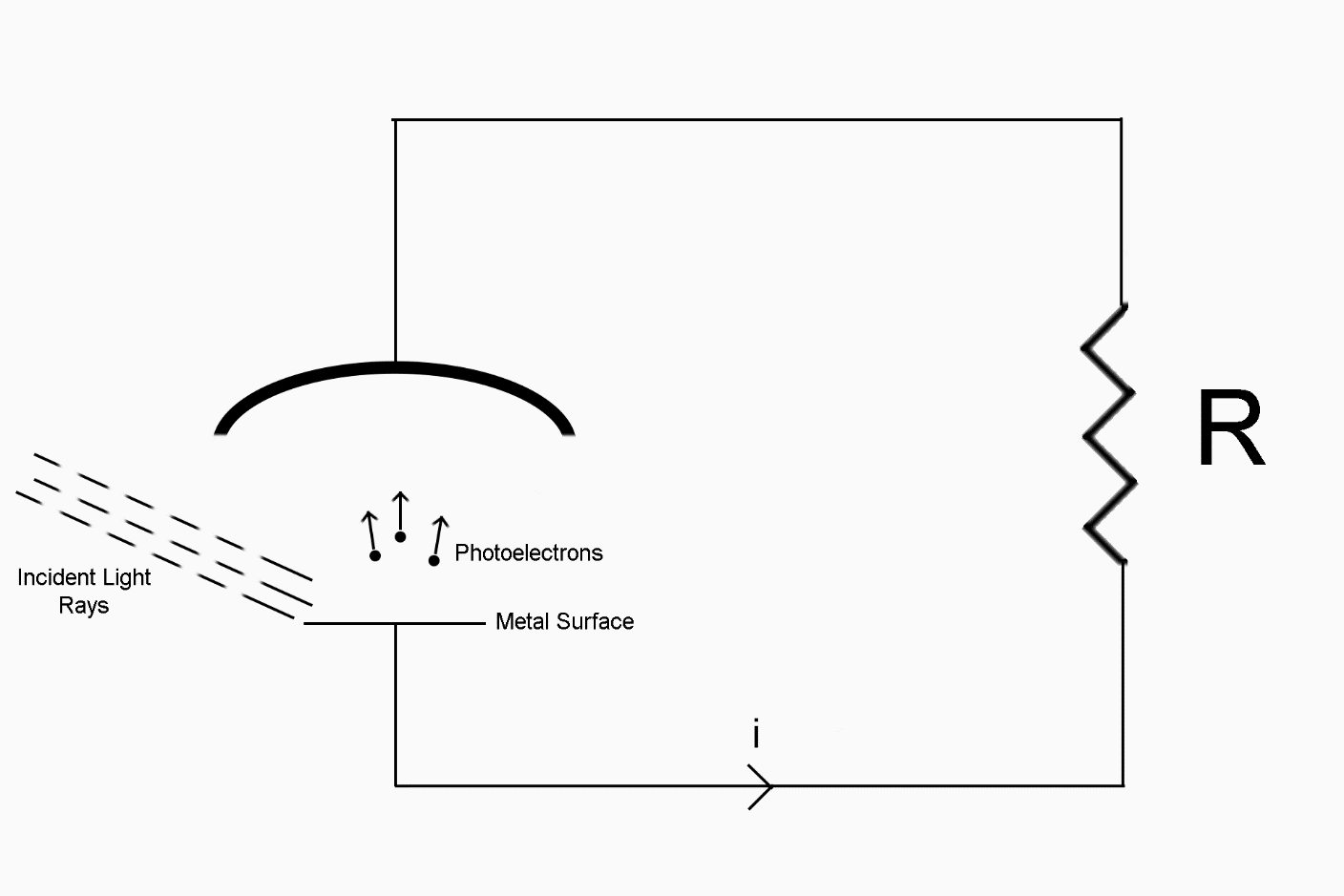
We make an arrangement in which the photoelectrons ejected from the surface of the metal strike another surface which is connected to the same circuit as the metal (shown in the diagram above), this makes the circuit complete and thus a small current called the photoelectric current starts to flow through the circuit.
There are two points to remember –
The photoelectrons are only emitted when the frequency of the light striking the surface of the metal is higher than a certain frequency called the threshold frequency.
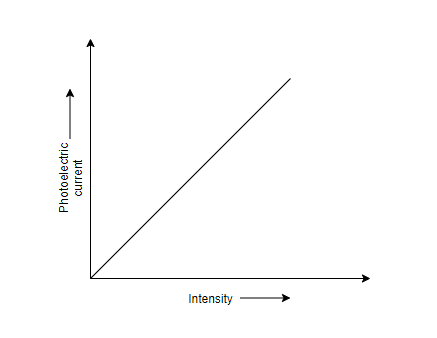
The number of photoelectrons is directly proportional to the intensity of the incident light as more is the intensity of light more is the number of photons in the incident light. Since the current is the flow of electrons, therefore, the photoelectric current is directly proportional to the intensity of the light.
The graph of photoelectric current with respect to intensity is as follows –
Note: As we discussed the emission of photoelectrons is dependent on the frequency of the photons in incident light and the number of photoelectrons. It is also important to remember that the intensity does not decide whether photoemission will take place or not and the number of photoelectrons does not depend upon the frequency of the incident light.
Complete step-by-step answer:
(a) We know that,
$E = h \times v$
$E = $ The energy of the photon
$h = $ Planck’s constant
$v = $ Frequency of the photon
The power of the photons is given by the equation
Total Energy $ = $ Number of photons $ \times $ Energy of a single photon
$P = n \times E$
$P = $ Total energy
$n = $ Number of photons
$E = $ The energy of a single photon
$\because E = hv$
$\therefore P = nhv$
$ \Rightarrow n = \dfrac{P}{{hv}}$
Given in the problem, $P = 2.0 \times {10^{ - 3}}W$
$v = 6.0 \times {10^{14}}Hz$
$h = 6.6 \times {10^{ - 34}}$
So, $n = \dfrac{{2 \times {{10}^3}}}{{6.6 \times {{10}^{ - 34}} \times 6 \times {{10}^{14}}}}$
$ \Rightarrow n = 5 \times {10^{15}}$
Therefore, the number of photons emitted is $5 \times {10^{15}}$ per second.
(b) Photoelectric current –
To understand the concept of photoelectric current, we have to first understand the photoelectric effect.
Photoelectric effect – When photons with a certain frequency strike the surface of a metal, electrons receive the energy from these photons and are ejected out of the surface of the metal, these ejected electrons are called photoelectrons.
We make an arrangement in which the photoelectrons ejected from the surface of the metal strike another surface which is connected to the same circuit as the metal (shown in the diagram above), this makes the circuit complete and thus a small current called the photoelectric current starts to flow through the circuit.
There are two points to remember –
The photoelectrons are only emitted when the frequency of the light striking the surface of the metal is higher than a certain frequency called the threshold frequency.
The number of photoelectrons is directly proportional to the intensity of the incident light as more is the intensity of light more is the number of photons in the incident light. Since the current is the flow of electrons, therefore, the photoelectric current is directly proportional to the intensity of the light.
The graph of photoelectric current with respect to intensity is as follows –
Note: As we discussed the emission of photoelectrons is dependent on the frequency of the photons in incident light and the number of photoelectrons. It is also important to remember that the intensity does not decide whether photoemission will take place or not and the number of photoelectrons does not depend upon the frequency of the incident light.
Recently Updated Pages
Master Class 12 Economics: Engaging Questions & Answers for Success

Master Class 12 English: Engaging Questions & Answers for Success
Master Class 12 Social Science: Engaging Questions & Answers for Success
Master Class 12 Maths: Engaging Questions & Answers for Success
Master Class 12 Physics: Engaging Questions & Answers for Success
Master Class 12 Business Studies: Engaging Questions & Answers for Success
Trending doubts
Which are the Top 10 Largest Countries of the World?
Draw a labelled sketch of the human eye class 12 physics CBSE
Differentiate between homogeneous and heterogeneous class 12 chemistry CBSE
Why is the cell called the structural and functional class 12 biology CBSE
Draw ray diagrams each showing i myopic eye and ii class 12 physics CBSE
Which is the correct genotypic ratio of mendel dihybrid class 12 biology CBSE