




A meter-bridge is based on the principle of
A. Wheatstone bridge
B. Variation of resistance with temperature
C. Galvanometer
D. None of these
Answer
 Verified
618.9k+ views
Hint: Meter bridge consists of 4 resistance in bridge form in which the ratio of two resistance in one half of the bridge is equal to the ratio of the other two resistance, then there will be no flow of current between those edges containing the resistors.
Formula used:
Balanced condition for a meter bridge\[\dfrac{P}{Q}=\dfrac{R}{S}\]
Where P,Q, R, S are the 4 resistors of the bridge
Resistance per unit length,$\sigma =\dfrac{\text{Resistance}}{\text{Length}}$
Complete step by step answer:
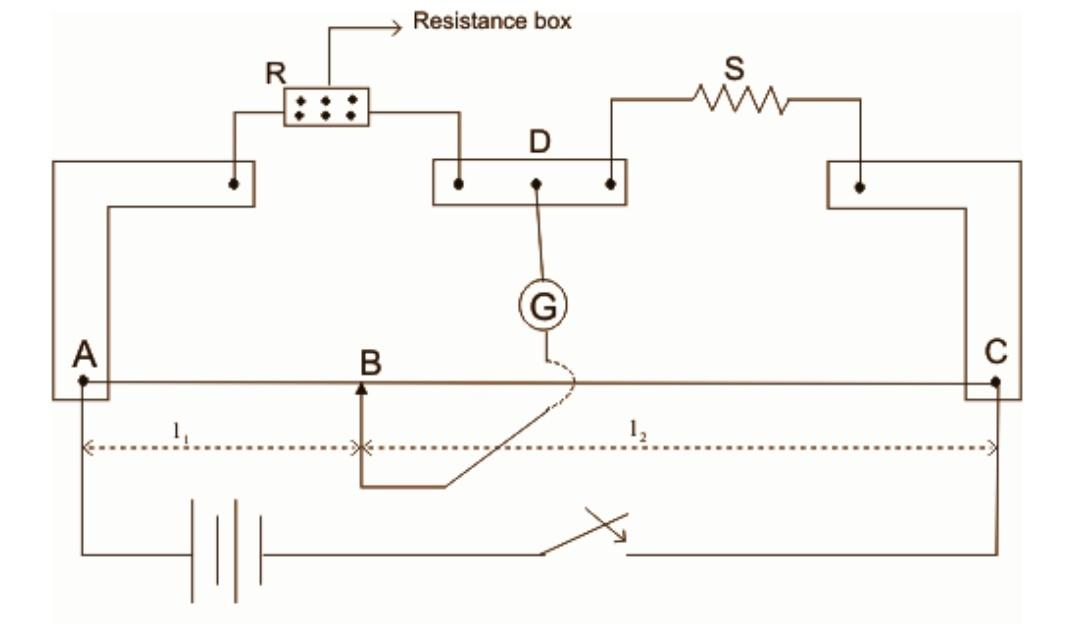
Meter bridge is used to measure the value of unknown resistance, It is based on the principle of Wheatstone bridge i.e. when the bridge is balanced then
\[\dfrac{P}{Q}=\dfrac{R}{S}\].
Where P= resistance of wire AB, Q= resistance of wire BC.
So correct option is A.Wheatstone Bridge
Additional Information:
Meter bridge consists of one-meter long manganin wire having uniform cross-section, which is stretched along a meter scale fixed over a wooden board and with its two ends connected to two L-shaped copped strips at A and C. Another copper strip is fixed in between these two strips to provide the gap for connection of resistance box R and resistance S. An emf source is connected across AC. A movable jockey in series with a galvanometer is connected across points B and D.
For a suitable resistance, the jockey is moved along the wire AC, until there is no deflection in the galvanometer. This is the balanced condition and point B is called the null point.
For balanced condition \[\dfrac{P}{Q}=\dfrac{R}{S}\]
Total length of wire $AC=100cm$,let $AB=l\;cm$,then $BC=(100-l)\;cm$.As the wire has uniform cross section so
Resistance of wire α length of wire
So, $\dfrac{P}{Q}=\dfrac{\text{Resistance}\ \text{of}\ \text{wire AB}}{\text{Resistance}\ \text{of}\ \text{wire BC}}$
If $\sigma =\text{resistance per unit length}$,then resistance of AB is $\sigma l$and resistance of BC is $\sigma \left( 100-l \right)$
So above equation becomes
$\dfrac{P}{Q}=\dfrac{\sigma l}{\sigma (100-l)}=\dfrac{l}{100-l}$
As $ \dfrac{P}{Q}=\dfrac{R}{S} $, so
$\dfrac{R}{S}=\dfrac{l}{100-l}$
Or , $ S=\dfrac{l}{100-l}R$
Knowing the value of $l$ and $R$ unknown resistance $S$ can be measured.
Note:
Meter bridge works on the balanced condition of the Wheatstone bridge. During a lab experiment of a meter, the bridge adjusts the value of the resistance box and moves the jockey to get a null deflection. Then calculate the value of ${{L}_{1}}\text{ and }{{L}_{2}}$. After substituting these values in the Meter Bridge equation above you can calculate the value of unknown resistance $S$.
Formula used:
Balanced condition for a meter bridge\[\dfrac{P}{Q}=\dfrac{R}{S}\]
Where P,Q, R, S are the 4 resistors of the bridge
Resistance per unit length,$\sigma =\dfrac{\text{Resistance}}{\text{Length}}$
Complete step by step answer:
Meter bridge is used to measure the value of unknown resistance, It is based on the principle of Wheatstone bridge i.e. when the bridge is balanced then
\[\dfrac{P}{Q}=\dfrac{R}{S}\].
Where P= resistance of wire AB, Q= resistance of wire BC.
So correct option is A.Wheatstone Bridge
Additional Information:
Meter bridge consists of one-meter long manganin wire having uniform cross-section, which is stretched along a meter scale fixed over a wooden board and with its two ends connected to two L-shaped copped strips at A and C. Another copper strip is fixed in between these two strips to provide the gap for connection of resistance box R and resistance S. An emf source is connected across AC. A movable jockey in series with a galvanometer is connected across points B and D.
For a suitable resistance, the jockey is moved along the wire AC, until there is no deflection in the galvanometer. This is the balanced condition and point B is called the null point.
For balanced condition \[\dfrac{P}{Q}=\dfrac{R}{S}\]
Total length of wire $AC=100cm$,let $AB=l\;cm$,then $BC=(100-l)\;cm$.As the wire has uniform cross section so
Resistance of wire α length of wire
So, $\dfrac{P}{Q}=\dfrac{\text{Resistance}\ \text{of}\ \text{wire AB}}{\text{Resistance}\ \text{of}\ \text{wire BC}}$
If $\sigma =\text{resistance per unit length}$,then resistance of AB is $\sigma l$and resistance of BC is $\sigma \left( 100-l \right)$
So above equation becomes
$\dfrac{P}{Q}=\dfrac{\sigma l}{\sigma (100-l)}=\dfrac{l}{100-l}$
As $ \dfrac{P}{Q}=\dfrac{R}{S} $, so
$\dfrac{R}{S}=\dfrac{l}{100-l}$
Or , $ S=\dfrac{l}{100-l}R$
Knowing the value of $l$ and $R$ unknown resistance $S$ can be measured.
Note:
Meter bridge works on the balanced condition of the Wheatstone bridge. During a lab experiment of a meter, the bridge adjusts the value of the resistance box and moves the jockey to get a null deflection. Then calculate the value of ${{L}_{1}}\text{ and }{{L}_{2}}$. After substituting these values in the Meter Bridge equation above you can calculate the value of unknown resistance $S$.
Recently Updated Pages
Master Class 12 Business Studies: Engaging Questions & Answers for Success

Master Class 12 Biology: Engaging Questions & Answers for Success
Master Class 12 Chemistry: Engaging Questions & Answers for Success
Class 12 Question and Answer - Your Ultimate Solutions Guide
Master Class 11 Social Science: Engaging Questions & Answers for Success
Master Class 11 English: Engaging Questions & Answers for Success
Trending doubts
Which is more stable and why class 12 chemistry CBSE
Which are the Top 10 Largest Countries of the World?
Draw a labelled sketch of the human eye class 12 physics CBSE
Differentiate between homogeneous and heterogeneous class 12 chemistry CBSE
What are the major means of transport Explain each class 12 social science CBSE
Sulphuric acid is known as the king of acids State class 12 chemistry CBSE