




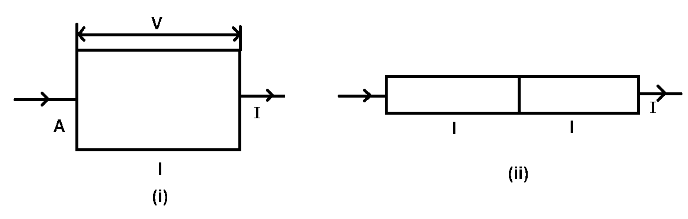
A metal rod of square cross-sectional area $A$ having length $l$ has current $I$ flowing through it when a potential difference of $V$ volt is applied across its ends (figure ii). What potential difference must be maintained across the length $2l$ so that the current in the rod is still $I$?
Answer
 Verified
601.5k+ views
Hint:From the figure, we can say that the rod in figure i is cut parallel and is rejoined by length as shown in figure ii making its length change. Due to this, its cross sectional area is changed and these both in turn will affect the value of resistance. After getting the value for this new resistance, we will apply Ohm’s law to find the required potential difference.
Formulas used:
$V = IR$,
where, $V$ is the potential difference, \[I\] is the current and $R$ is the resistance.
\[R = \dfrac{{\rho l}}{A}\] ,
where, $R$ is the resistance, $\rho$ is the resistivity of the material, $l$ is the length and $A$ is the cross-sectional area.
Complete step by step answer:
Let us first consider figure I where a metal rod of square cross-sectional area $A$having length $l$ has current $I$ flowing through it when a potential difference of $V$volt is applied across its ends. If we take resistance in this case as $R$and apply the Ohm’s law, we get
$V = IR$
And \[R = \dfrac{{\rho l}}{A}\]
Now, in the second case, the metal rod is cut parallel and is rejoined by length as shown in figure ii making its length double which is $2l$. Due to this, its cross-sectional area becomes half which is $\dfrac{A}{2}$. Therefore, new resistance for this case is
$R' = \dfrac{{\rho \left( {2l} \right)}}{{\left( {\dfrac{A}{2}} \right)}}\\
\Rightarrow R' = 4\dfrac{{\rho l}}{A} \\
\Rightarrow R' = 4R$
It is given that the current should remain the same as the previous case which is $I$.
Therefore, when we apply Ohm’s law, we get
${V^1} = I R' \\
\Rightarrow{V^1} = I\left( {4R} \right) \\
\Rightarrow{V^1} = 4IR \\
\therefore{V^1} = 4V$
Thus, the potential difference must be maintained across the length $2l$ so that the current in the rod is still $I$ is four times the original voltage.
Note:In this problem, we have seen that the potential difference is dependent on resistance when the current is constant. Also, in this case the rod is cut parallel which doubles its length and decreases its cross-sectional area to half of its original value. Both these parameters affect the resistance and therefore in any case, if it is given that length or area is changing, then we can find the corresponding value of resistance and then apply the Ohm’s law to find the required potential difference.
Formulas used:
$V = IR$,
where, $V$ is the potential difference, \[I\] is the current and $R$ is the resistance.
\[R = \dfrac{{\rho l}}{A}\] ,
where, $R$ is the resistance, $\rho$ is the resistivity of the material, $l$ is the length and $A$ is the cross-sectional area.
Complete step by step answer:
Let us first consider figure I where a metal rod of square cross-sectional area $A$having length $l$ has current $I$ flowing through it when a potential difference of $V$volt is applied across its ends. If we take resistance in this case as $R$and apply the Ohm’s law, we get
$V = IR$
And \[R = \dfrac{{\rho l}}{A}\]
Now, in the second case, the metal rod is cut parallel and is rejoined by length as shown in figure ii making its length double which is $2l$. Due to this, its cross-sectional area becomes half which is $\dfrac{A}{2}$. Therefore, new resistance for this case is
$R' = \dfrac{{\rho \left( {2l} \right)}}{{\left( {\dfrac{A}{2}} \right)}}\\
\Rightarrow R' = 4\dfrac{{\rho l}}{A} \\
\Rightarrow R' = 4R$
It is given that the current should remain the same as the previous case which is $I$.
Therefore, when we apply Ohm’s law, we get
${V^1} = I R' \\
\Rightarrow{V^1} = I\left( {4R} \right) \\
\Rightarrow{V^1} = 4IR \\
\therefore{V^1} = 4V$
Thus, the potential difference must be maintained across the length $2l$ so that the current in the rod is still $I$ is four times the original voltage.
Note:In this problem, we have seen that the potential difference is dependent on resistance when the current is constant. Also, in this case the rod is cut parallel which doubles its length and decreases its cross-sectional area to half of its original value. Both these parameters affect the resistance and therefore in any case, if it is given that length or area is changing, then we can find the corresponding value of resistance and then apply the Ohm’s law to find the required potential difference.
Recently Updated Pages
Master Class 12 Economics: Engaging Questions & Answers for Success

Master Class 12 English: Engaging Questions & Answers for Success
Master Class 12 Social Science: Engaging Questions & Answers for Success
Master Class 12 Maths: Engaging Questions & Answers for Success
Master Class 12 Physics: Engaging Questions & Answers for Success
Master Class 9 General Knowledge: Engaging Questions & Answers for Success
Trending doubts
Which are the Top 10 Largest Countries of the World?
Draw a labelled sketch of the human eye class 12 physics CBSE
Differentiate between homogeneous and heterogeneous class 12 chemistry CBSE
Why is the cell called the structural and functional class 12 biology CBSE
Draw ray diagrams each showing i myopic eye and ii class 12 physics CBSE
Which is the correct genotypic ratio of mendel dihybrid class 12 biology CBSE