




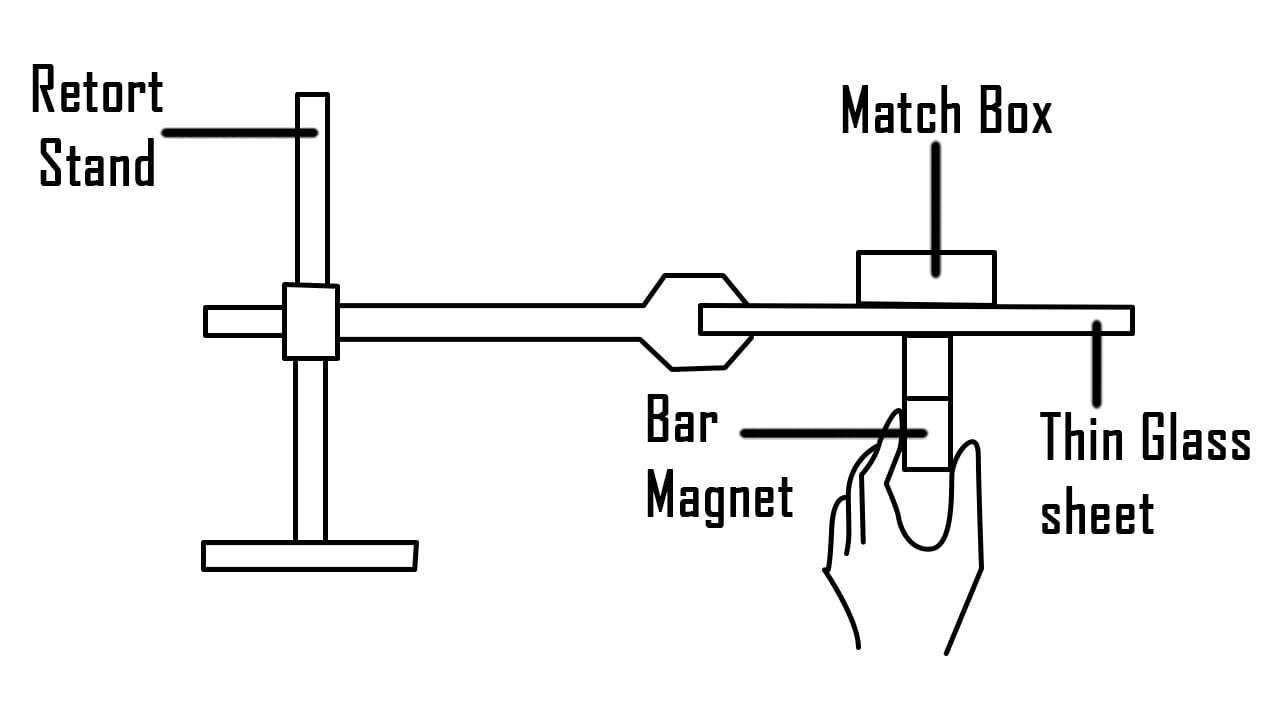
A matchbox containing an unknown object is placed on a thin sheet of glass in the experimental setup shown in the figure. When the bar magnet moves it drags the matchbox along. What is most likely to be found in the matchbox?
A) Marble
B) Toothpick
C) Ten-cent coin
D) Steel ball bearing
Answer
 Verified
579.9k+ views
Hint:Here, as the bar magnet moves, the matchbox moves along with it. This implies that the bar magnet attracts the unknown material inside the matchbox. So, the content of the matchbox must be magnetic in nature.
Complete step by step answer.
Step 1: Compare the magnetic property of the marble, toothpick, ten-cent coin and steel ball bearing.
Materials of magnetic nature will get attracted by a bar magnet while materials that do not get attracted or repelled will have no magnetic nature.
Out of the given four materials, marble and toothpick are not magnetic in nature. Marble is made of glass, plastic or clay. These substances themselves are not magnetic materials. A toothpick is usually made of wood and wood is not a magnetic material.
But the other two i.e., the ten-cent coin and the steel ball-bearing have a magnetic nature. The ten-cent coin is most probably made of some metal and metals are magnetic in nature. Steel is an alloy of iron and carbon. Hence the matchbox may contain a ten-cent coin or a steel ball bearing.
So, the correct options are C and D.
If you were to choose one correct option, option D. steel ball-bearing would be the better choice.
Note: All metals are not magnetic in nature. Here, the ten-cent coin and steel have fractions of iron in them. Iron has good magnetising properties. If the content inside the matchbox was oppositely magnetized before bringing the bar magnet near it then it would have repelled the magnet. A bar magnet has a north pole and a south pole. Like poles attract while unlike poles repel.
Complete step by step answer.
Step 1: Compare the magnetic property of the marble, toothpick, ten-cent coin and steel ball bearing.
Materials of magnetic nature will get attracted by a bar magnet while materials that do not get attracted or repelled will have no magnetic nature.
Out of the given four materials, marble and toothpick are not magnetic in nature. Marble is made of glass, plastic or clay. These substances themselves are not magnetic materials. A toothpick is usually made of wood and wood is not a magnetic material.
But the other two i.e., the ten-cent coin and the steel ball-bearing have a magnetic nature. The ten-cent coin is most probably made of some metal and metals are magnetic in nature. Steel is an alloy of iron and carbon. Hence the matchbox may contain a ten-cent coin or a steel ball bearing.
So, the correct options are C and D.
If you were to choose one correct option, option D. steel ball-bearing would be the better choice.
Note: All metals are not magnetic in nature. Here, the ten-cent coin and steel have fractions of iron in them. Iron has good magnetising properties. If the content inside the matchbox was oppositely magnetized before bringing the bar magnet near it then it would have repelled the magnet. A bar magnet has a north pole and a south pole. Like poles attract while unlike poles repel.
Recently Updated Pages
Master Class 12 Economics: Engaging Questions & Answers for Success

Master Class 12 Physics: Engaging Questions & Answers for Success
Master Class 12 English: Engaging Questions & Answers for Success
Master Class 12 Social Science: Engaging Questions & Answers for Success
Master Class 12 Maths: Engaging Questions & Answers for Success
Master Class 12 Business Studies: Engaging Questions & Answers for Success
Trending doubts
Which are the Top 10 Largest Countries of the World?
What are the major means of transport Explain each class 12 social science CBSE
Draw a labelled sketch of the human eye class 12 physics CBSE
Why cannot DNA pass through cell membranes class 12 biology CBSE
Differentiate between insitu conservation and exsitu class 12 biology CBSE
Draw a neat and well labeled diagram of TS of ovary class 12 biology CBSE