




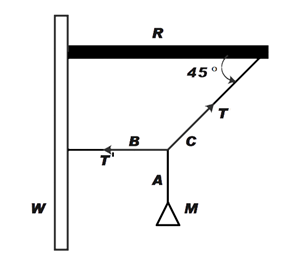
A mass M of 100 kg is suspended with use of strings A, B and C as shown in figure, where W is vertical wall and R is a rigid horizontal rod. The tension in string B is:
A. 100 gN
B. 0
C. \[100\sqrt{2}gN\]
D. \[\dfrac{100}{\sqrt{2}gN}\]
Answer
 Verified
618k+ views
Hint: In this question we have been asked to calculate the tension in the string B from the diagram given. It is given that a mass of 100 kg is suspended from the string A. To solve this question, we shall first draw a suitable free body diagram. We shall then calculate the tension in the given string by using the equation of motion from Newton's seconds law for the given system.
Complete Step by step solution:
It is given that 100 kg mass is suspended from a string A.
Now, consider the Free Body diagram below.
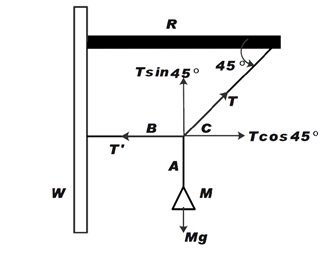
Now, from the diagram we can say that tension in the string B is T’.
Therefore, to calculate T’
After resolving the tension T in string C as shown in the diagram
We get,
\[T'=T\cos 45{}^\circ \] …………….. (1)
Using equation of motion from Newton's second law
\[Mg=T\sin 45{}^\circ \]……………… (2)
Now, the mass is given to be 100 kg.
Also, the options provided to us have used acceleration due to gravity as g therefore, we shall not substitute any value.
Therefore,
\[100g=T\dfrac{1}{\sqrt{2}}\]
Solving for T
We get,
\[T=100\sqrt{2}g\] …………….. (3)
Now from (1) and (3)
We get,
\[T'=100\sqrt{2}g\dfrac{1}{\sqrt{2}}\]
Therefore,
\[T'=100g\] N
Therefore, the correct answer is option A.
Note:
Newton’s second law states that greater the mass of the object, the more force it will require to accelerate. The second law can also be stated as the acceleration of a particle is directly proportional to the force applied on the particle and inversely proportional to the mass of the particle.
Complete Step by step solution:
It is given that 100 kg mass is suspended from a string A.
Now, consider the Free Body diagram below.
Now, from the diagram we can say that tension in the string B is T’.
Therefore, to calculate T’
After resolving the tension T in string C as shown in the diagram
We get,
\[T'=T\cos 45{}^\circ \] …………….. (1)
Using equation of motion from Newton's second law
\[Mg=T\sin 45{}^\circ \]……………… (2)
Now, the mass is given to be 100 kg.
Also, the options provided to us have used acceleration due to gravity as g therefore, we shall not substitute any value.
Therefore,
\[100g=T\dfrac{1}{\sqrt{2}}\]
Solving for T
We get,
\[T=100\sqrt{2}g\] …………….. (3)
Now from (1) and (3)
We get,
\[T'=100\sqrt{2}g\dfrac{1}{\sqrt{2}}\]
Therefore,
\[T'=100g\] N
Therefore, the correct answer is option A.
Note:
Newton’s second law states that greater the mass of the object, the more force it will require to accelerate. The second law can also be stated as the acceleration of a particle is directly proportional to the force applied on the particle and inversely proportional to the mass of the particle.
Recently Updated Pages
Basicity of sulphurous acid and sulphuric acid are

Master Class 12 Economics: Engaging Questions & Answers for Success
Master Class 12 Biology: Engaging Questions & Answers for Success
Master Class 11 English: Engaging Questions & Answers for Success
Master Class 11 Physics: Engaging Questions & Answers for Success
Master Class 11 Computer Science: Engaging Questions & Answers for Success
Trending doubts
Draw a labelled sketch of the human eye class 12 physics CBSE
The chemical formula of tear gas is A CO Cl 2 B C 10 class 12 chemistry CBSE
Draw ray diagrams each showing i myopic eye and ii class 12 physics CBSE
Which are the Top 10 Largest Countries of the World?
Differentiate between homogeneous and heterogeneous class 12 chemistry CBSE
Which is the correct genotypic ratio of mendel dihybrid class 12 biology CBSE