




A marketing firm that, of 200 households surveyed, 80 used neither brand A nor brand B soap, 60 used only brand A soap and for every household that used both brands of soap, 3 used only brand B soap. How many of the 200 households surveyed used both brands of soap.
Answer
 Verified
597k+ views
Hint: To solve this problem, we will consider A as the set containing number of households using brand A and B as the set containing number of households using brand B. Now, we will use the formula that $n\left( A\bigcup B \right)=n\left( A \right)+n\left( B \right)-n\left( A\bigcap B \right)$. Here, $A\bigcup B$ determines the set containing all the elements of A and B, while $A\bigcap B$ determines the set having only the common elements of A and B. Along with this, we will also make use of $A'\bigcap B'=(A\bigcup B)'$.
Complete step-by-step answer:
Let us now consider the given question,
Since it is given that 80 households use neither Brand A nor Brand B, then we have that $A'\bigcap B'$ = 80 (here, $A'$ means all the events excluding that in set A and $B'$ means all the events excluding set B). Now, we use the following theorem that $A'\bigcap B'=(A\bigcup B)'$ (where ‘ stands for complement of an event as shown for the case of $A'$ and $B'$ ). Thus, we have, $(A\bigcup B)'=80$.
(Thus, $n\left( A\bigcup B \right)=200-80=120$).
It is also given that 60 households use only brand A and that three times as many households use Brand B exclusively as use both brands.
If x is the number of households that use both Brand A and Brand B, then 3x use Brand B alone (as per the information given in the problem).
Thus, we have, $n\left( A\bigcup B \right)=n\left( A \right)+n\left( B \right)-n\left( A\bigcap B \right)$. By substituting, we have,
$120=\left( 60+x \right)+\left( 3x+x \right)-x$
[n(A) means the entire set containing elements of A. Thus, we have to add x to A to get n(A). Similar is the case with n(B)]
Solving the above equation we get,
$120=60+4x$
Let us subtract 60 from both sides to get,
$4x=60$
Hence, x=15
So, 15 people use both brand A and brand B of soaps.
Therefore, the final answer is option (a).
Note: To avoid the algebraic expressions in set, one of the easier ways to solve is to represent the above problem on the Venn diagram. One can easily calculate the value of x using the space of $n(A\bigcap B)$ in the Venn diagram.
We have shown in the above solution that:
60 households use only brand A means:
$n\left( A \right)-n\left( A\bigcap B \right)=60$
x is the number of households that use both Brand A and Brand B which means:
$n\left( A\bigcap B \right)=x$
3x use Brand B alone which means:
$n\left( B \right)-n\left( A\bigcap B \right)=3x$
Representing the above information on the Venn diagram we get,
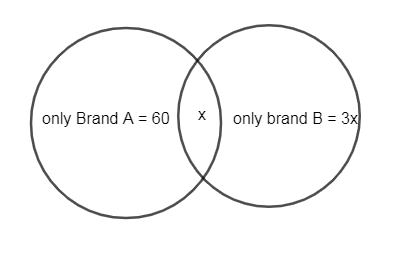
From the above Venn diagram,
$n\left( A\bigcup B \right)=60+x+3x$
We have calculated in the above solution that $n\left( A\bigcup B \right)=120$ so substituting this value in the above equation we get,
$\begin{align}
& 120=60+x+3x \\
& \Rightarrow 60=4x \\
\end{align}$
Dividing 4 on both the sides of the equation we get,
$15=x$
Hence, we have got the number of households who use both brands A and B is 15.
Complete step-by-step answer:
Let us now consider the given question,
Since it is given that 80 households use neither Brand A nor Brand B, then we have that $A'\bigcap B'$ = 80 (here, $A'$ means all the events excluding that in set A and $B'$ means all the events excluding set B). Now, we use the following theorem that $A'\bigcap B'=(A\bigcup B)'$ (where ‘ stands for complement of an event as shown for the case of $A'$ and $B'$ ). Thus, we have, $(A\bigcup B)'=80$.
(Thus, $n\left( A\bigcup B \right)=200-80=120$).
It is also given that 60 households use only brand A and that three times as many households use Brand B exclusively as use both brands.
If x is the number of households that use both Brand A and Brand B, then 3x use Brand B alone (as per the information given in the problem).
Thus, we have, $n\left( A\bigcup B \right)=n\left( A \right)+n\left( B \right)-n\left( A\bigcap B \right)$. By substituting, we have,
$120=\left( 60+x \right)+\left( 3x+x \right)-x$
[n(A) means the entire set containing elements of A. Thus, we have to add x to A to get n(A). Similar is the case with n(B)]
Solving the above equation we get,
$120=60+4x$
Let us subtract 60 from both sides to get,
$4x=60$
Hence, x=15
So, 15 people use both brand A and brand B of soaps.
Therefore, the final answer is option (a).
Note: To avoid the algebraic expressions in set, one of the easier ways to solve is to represent the above problem on the Venn diagram. One can easily calculate the value of x using the space of $n(A\bigcap B)$ in the Venn diagram.
We have shown in the above solution that:
60 households use only brand A means:
$n\left( A \right)-n\left( A\bigcap B \right)=60$
x is the number of households that use both Brand A and Brand B which means:
$n\left( A\bigcap B \right)=x$
3x use Brand B alone which means:
$n\left( B \right)-n\left( A\bigcap B \right)=3x$
Representing the above information on the Venn diagram we get,
From the above Venn diagram,
$n\left( A\bigcup B \right)=60+x+3x$
We have calculated in the above solution that $n\left( A\bigcup B \right)=120$ so substituting this value in the above equation we get,
$\begin{align}
& 120=60+x+3x \\
& \Rightarrow 60=4x \\
\end{align}$
Dividing 4 on both the sides of the equation we get,
$15=x$
Hence, we have got the number of households who use both brands A and B is 15.
Recently Updated Pages
Master Class 11 Computer Science: Engaging Questions & Answers for Success

Master Class 11 Business Studies: Engaging Questions & Answers for Success
Master Class 11 Economics: Engaging Questions & Answers for Success
Master Class 11 English: Engaging Questions & Answers for Success
Master Class 11 Maths: Engaging Questions & Answers for Success
Master Class 11 Biology: Engaging Questions & Answers for Success
Trending doubts
There are 720 permutations of the digits 1 2 3 4 5 class 11 maths CBSE
Discuss the various forms of bacteria class 11 biology CBSE
Draw a diagram of a plant cell and label at least eight class 11 biology CBSE
Explain zero factorial class 11 maths CBSE
What organs are located on the left side of your body class 11 biology CBSE
Draw a diagram of nephron and explain its structur class 11 biology CBSE