




A man with blood group 'A' marries a woman with blood group 'B'. All the possible blood groups of their offsprings?
I. A and B only
II. A B and AB only
III. A, B, AB, and O
IV. O only
Answer
 Verified
597.9k+ views
Hint: ABO blood grouping system is based on the surface antigens present on the surface of RBC and corresponding antibodies in the plasma. Major phenotypes in ABO blood grouping are A, B, AB, and O blood groups.
Complete answer:
A blood sort (too known as a blood bunch) may be a classification of blood, based on the nearness and nonattendance of antibodies and inherited antigenic substances on the surface of ruddy blood cells (RBCs). These antigens may be proteins, carbohydrates, glycoproteins, or glycolipids, depending on the blood bunch framework. A few of these antigens are moreover shown on the surface of other sorts of cells of different tissues. A few of these ruddy blood cell surface antigens can stem from one allele (or an elective form of quality) and collectively shape a blood bunch framework. Here, the man has A blood group and the woman has B blood group. So the offspring can have all the four phenotypes like A, B, AB, and O blood groups.
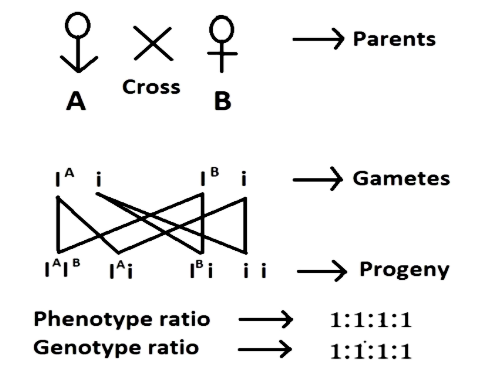
Hence, it clearly understands that option C is the correct answer.
Note: Keep in mind that, a man with blood accumulates A has an antigen on its RBC encoded by quality A and counteracting operator for B. So also, a woman with blood bunch B has B antigen on its RBC encoded by quality B and counteracting specialist for A. A man with blood accumulated 'A' marries a woman with blood bunch 'B', the conceivable blood bunches of their relatives can be A, B, AB, and O since they have both antigen A and B and antibodies for both A and B.
Complete answer:
A blood sort (too known as a blood bunch) may be a classification of blood, based on the nearness and nonattendance of antibodies and inherited antigenic substances on the surface of ruddy blood cells (RBCs). These antigens may be proteins, carbohydrates, glycoproteins, or glycolipids, depending on the blood bunch framework. A few of these antigens are moreover shown on the surface of other sorts of cells of different tissues. A few of these ruddy blood cell surface antigens can stem from one allele (or an elective form of quality) and collectively shape a blood bunch framework. Here, the man has A blood group and the woman has B blood group. So the offspring can have all the four phenotypes like A, B, AB, and O blood groups.
Hence, it clearly understands that option C is the correct answer.
Note: Keep in mind that, a man with blood accumulates A has an antigen on its RBC encoded by quality A and counteracting operator for B. So also, a woman with blood bunch B has B antigen on its RBC encoded by quality B and counteracting specialist for A. A man with blood accumulated 'A' marries a woman with blood bunch 'B', the conceivable blood bunches of their relatives can be A, B, AB, and O since they have both antigen A and B and antibodies for both A and B.
Recently Updated Pages
Master Class 12 Business Studies: Engaging Questions & Answers for Success

Master Class 12 Chemistry: Engaging Questions & Answers for Success
Master Class 12 Biology: Engaging Questions & Answers for Success
Class 12 Question and Answer - Your Ultimate Solutions Guide
Master Class 11 English: Engaging Questions & Answers for Success
Master Class 11 Social Science: Engaging Questions & Answers for Success
Trending doubts
Which are the Top 10 Largest Countries of the World?
Draw a labelled sketch of the human eye class 12 physics CBSE
Differentiate between homogeneous and heterogeneous class 12 chemistry CBSE
In order to find out the different types of gametes class 12 biology NEET_UG
Why is the cell called the structural and functional class 12 biology CBSE
Draw ray diagrams each showing i myopic eye and ii class 12 physics CBSE