




A man uses a concave mirror for shaving. He keeps his face at a distance of twenty centimeters from the mirror and gets an image that is $1.5$ times enlarged. Find the focal length of the mirror.
Answer
 Verified
634.8k+ views
Hint: We can solve this problem with the formula of the focal length of the concave mirror. A concave mirror has concavity facing forwards where the light rays incidents. It is also known as a converging mirror. Concave mirror forms images that are real or virtual, inverted or erect and magnified, reduced, or be similar in size of the object depending upon the positions. Magnification is equal to the negative of the ratio of the distance of the image from the mirror to the distance of the object from the mirror. Magnification $m = \dfrac{{AB}}{{A'B'}}$ and $m = - \dfrac{V}{u}$, where $AB$ is the height of image and $A'B'$ is the height of object.
Formula used:
$\dfrac{1}{V} + \dfrac{1}{u} = \dfrac{1}{F}$ where if $F$ focal length of mirror, $V$ is the image distance and $u$ is the object distance.
Complete step-by-step solution:
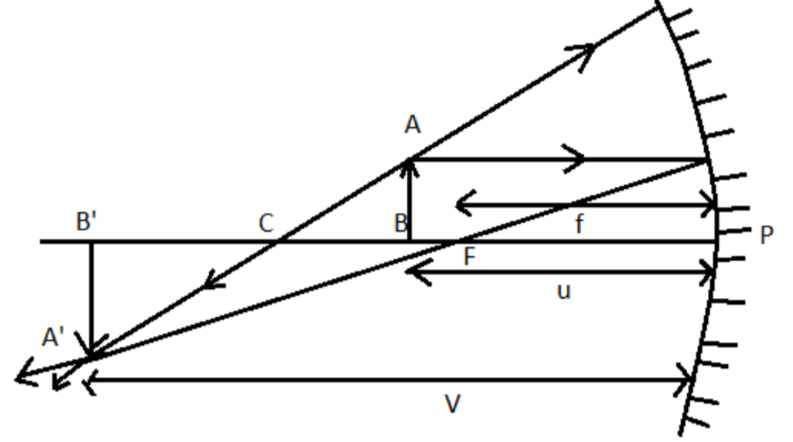
If an object is placed in front of a concave mirror then an image is formed at the front of the mirror. This image is inverted, real, and larger than the object. The figure is shown below:
Given that,
Distance of object i.e. $u = - 20cm$
Magnification $ = 1.5$
Consider the distance of image $ = V$
As we know that magnification is equal to the negative of the ratio of the distance of the image from the mirror to the distance of the object from the mirror.
$ 1.5 = \dfrac{{ - V}}{{ - 20}} \\
\Rightarrow V = 30cm \\ $
Now using the mirror formula:
$\Rightarrow \dfrac{1}{V} + \dfrac{1}{u} = \dfrac{1}{F} = \dfrac{1}{{30}} - \dfrac{1}{{20}} = \dfrac{1}{F} \\
\Rightarrow \dfrac{{2 - 3}}{{60}} = \dfrac{1}{F} \\
\Rightarrow F = - 60cm $
Note: In this question, object distance and magnification are given hence we calculated the distance of image as thirty centimeters after that we applied the values in the mirror formula i.e. $\dfrac{1}{V} + \dfrac{1}{u} = \dfrac{1}{F}$ and calculated the focal length of the concave mirror as $60cm$. The image is real, enlarged, and inverted.
Formula used:
$\dfrac{1}{V} + \dfrac{1}{u} = \dfrac{1}{F}$ where if $F$ focal length of mirror, $V$ is the image distance and $u$ is the object distance.
Complete step-by-step solution:
If an object is placed in front of a concave mirror then an image is formed at the front of the mirror. This image is inverted, real, and larger than the object. The figure is shown below:
Given that,
Distance of object i.e. $u = - 20cm$
Magnification $ = 1.5$
Consider the distance of image $ = V$
As we know that magnification is equal to the negative of the ratio of the distance of the image from the mirror to the distance of the object from the mirror.
$ 1.5 = \dfrac{{ - V}}{{ - 20}} \\
\Rightarrow V = 30cm \\ $
Now using the mirror formula:
$\Rightarrow \dfrac{1}{V} + \dfrac{1}{u} = \dfrac{1}{F} = \dfrac{1}{{30}} - \dfrac{1}{{20}} = \dfrac{1}{F} \\
\Rightarrow \dfrac{{2 - 3}}{{60}} = \dfrac{1}{F} \\
\Rightarrow F = - 60cm $
Note: In this question, object distance and magnification are given hence we calculated the distance of image as thirty centimeters after that we applied the values in the mirror formula i.e. $\dfrac{1}{V} + \dfrac{1}{u} = \dfrac{1}{F}$ and calculated the focal length of the concave mirror as $60cm$. The image is real, enlarged, and inverted.
Recently Updated Pages
Master Class 12 Business Studies: Engaging Questions & Answers for Success

Master Class 12 Chemistry: Engaging Questions & Answers for Success
Master Class 12 Biology: Engaging Questions & Answers for Success
Class 12 Question and Answer - Your Ultimate Solutions Guide
Master Class 11 English: Engaging Questions & Answers for Success
Master Class 11 Social Science: Engaging Questions & Answers for Success
Trending doubts
Which are the Top 10 Largest Countries of the World?
Draw a labelled sketch of the human eye class 12 physics CBSE
Differentiate between homogeneous and heterogeneous class 12 chemistry CBSE
Differentiate between Pyramid of energy and pyramid class 12 biology CBSE
Why is the cell called the structural and functional class 12 biology CBSE
Draw the diagram of the pyramid of energy Explain In class 12 biology CBSE