




A man stands 9m away from a flag – pole. He observes that the angle of elevation of the top of the pole is ${{28}^{\circ }}$ and the depression of the bottom of the pole is ${{13}^{\circ }}$ . Calculate the height of the pole.
Answer
 Verified
623.4k+ views
Hint: To find the height of the pole first we need to draw the diagram to understand the data in question. Take AB as a pole where $AB=AE+BE$ then find BE with the help of $\tan {{13}^{\circ }}$ and AE with the help of $\tan {{28}^{\circ }}$ . We can use the value of $\tan {{13}^{\circ }}=0.23086$ and $\tan {{28}^{\circ }}=0.5317.$
Complete step-by-step answer:
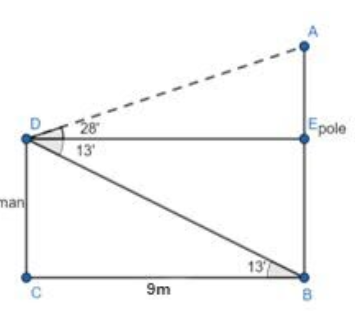
A man stands 9m away from a flag pole i.e. $BC=DE=9m$ .
He observes that the angle of elevation of the top of the pole is ${{28}^{\circ }}$ i.e. $\angle ADE={{28}^{\circ }}$ and the angle of depression of the bottom of the pole is ${{13}^{\circ }}$ i.e. $\angle EDB={{13}^{\circ }}$ .
$CD=BE.$
In $\Delta BDE$ .
$\tan \theta =\dfrac{\text{BE}}{DE}$ .
$\tan {{13}^{\circ }}=\dfrac{BE}{9}$ ( Here $DE=9cm$) .
$0.23086=\dfrac{\text{BE}}{\text{9}}$ ( Here $\tan {{13}^{\circ }}=0.23086$).
Now, multiply both side by $'9'$ we get –
$\begin{align}
& 0.23056\times 9=BE \\
& 2.077=BE. \\
\end{align}$
In $\Delta ADE$
$\tan \theta =\dfrac{\text{AE}}{\text{DE}}$ .
$\tan {{28}^{\circ }}=\dfrac{\text{AE}}{\text{9}}$ ( where $DE=9m$ ).
$0.53.17=\dfrac{AE}{\text{9}}$ ( HERE $\tan \theta =0.5317$ ).
Multiplying both side by $'9'$ we get –
$\begin{align}
& 0.5317\times 9=AE \\
& 4.785=AE \\
\end{align}$
Height of the pole $=AE+BE$
$=4.785+2.077$
$=6.862m.$
Hence the height of the pole is $6.862m.$
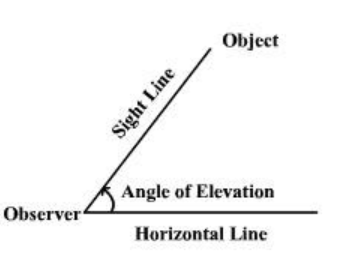
Note: In this question students may get confused because of angle of elevation and angle of depression. They should know the difference between angle of elevation and angle of depression. The term angle of elevation denotes the angle between the horizontal upward to an object.
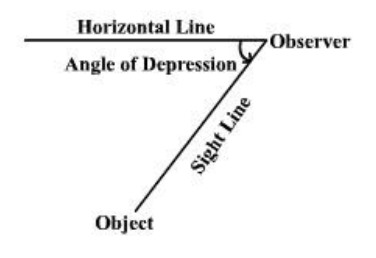
The term of depression denotes the angle from the horizontal down was to an object.
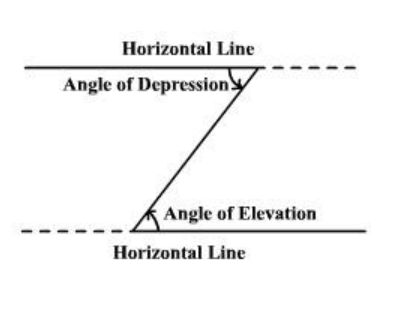
The angle of elevation and the angle of depression are congruent.
Complete step-by-step answer:
A man stands 9m away from a flag pole i.e. $BC=DE=9m$ .
He observes that the angle of elevation of the top of the pole is ${{28}^{\circ }}$ i.e. $\angle ADE={{28}^{\circ }}$ and the angle of depression of the bottom of the pole is ${{13}^{\circ }}$ i.e. $\angle EDB={{13}^{\circ }}$ .
$CD=BE.$
In $\Delta BDE$ .
$\tan \theta =\dfrac{\text{BE}}{DE}$ .
$\tan {{13}^{\circ }}=\dfrac{BE}{9}$ ( Here $DE=9cm$) .
$0.23086=\dfrac{\text{BE}}{\text{9}}$ ( Here $\tan {{13}^{\circ }}=0.23086$).
Now, multiply both side by $'9'$ we get –
$\begin{align}
& 0.23056\times 9=BE \\
& 2.077=BE. \\
\end{align}$
In $\Delta ADE$
$\tan \theta =\dfrac{\text{AE}}{\text{DE}}$ .
$\tan {{28}^{\circ }}=\dfrac{\text{AE}}{\text{9}}$ ( where $DE=9m$ ).
$0.53.17=\dfrac{AE}{\text{9}}$ ( HERE $\tan \theta =0.5317$ ).
Multiplying both side by $'9'$ we get –
$\begin{align}
& 0.5317\times 9=AE \\
& 4.785=AE \\
\end{align}$
Height of the pole $=AE+BE$
$=4.785+2.077$
$=6.862m.$
Hence the height of the pole is $6.862m.$
Note: In this question students may get confused because of angle of elevation and angle of depression. They should know the difference between angle of elevation and angle of depression. The term angle of elevation denotes the angle between the horizontal upward to an object.
The term of depression denotes the angle from the horizontal down was to an object.
The angle of elevation and the angle of depression are congruent.
Recently Updated Pages
Master Class 11 Social Science: Engaging Questions & Answers for Success

Master Class 11 Physics: Engaging Questions & Answers for Success
Master Class 11 Maths: Engaging Questions & Answers for Success
Master Class 11 Economics: Engaging Questions & Answers for Success
Master Class 11 Computer Science: Engaging Questions & Answers for Success
Master Class 11 Chemistry: Engaging Questions & Answers for Success
Trending doubts
One Metric ton is equal to kg A 10000 B 1000 C 100 class 11 physics CBSE
There are 720 permutations of the digits 1 2 3 4 5 class 11 maths CBSE
1 Quintal is equal to a 110 kg b 10 kg c 100kg d 1000 class 11 physics CBSE
State and prove Bernoullis theorem class 11 physics CBSE
Difference Between Prokaryotic Cells and Eukaryotic Cells
Which among the following are examples of coming together class 11 social science CBSE