




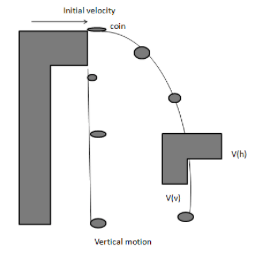
A man projects a coin upwards from the gate of a uniform moving train. The path of coin for the man will be
Answer
 Verified
600k+ views
Hint:Here, we use the concept of projectile motion. It is defined as when the object is thrown with the initial velocity and moves under the action of gravity alone in the curved path. This curved path followed by the particle is called a trajectory. It is a two-dimensional motion in a plane along the x-axis and y-axis.
Complete step by step answer:
According to projectile motion, the particle velocity can be resolved into two components along the x-axis and y-axis. That is along horizontally and vertically. When a man flips the coin upwards from the gate of a uniform moving train, the relative displacement becomes zero, and the horizontal velocity of the coin and the man will remain the same, i.e., straight line.
Additional information:The velocity and acceleration can analyze projectile motion in vector form. The motion of anybody who travels freely, so that it is subject only to the vertical acceleration due to gravity, can be analyzed simply in terms of its horizontal and vertical motion. The law of vector addition, which allows us to resolve components, is a key method in analyzing projectile motion.
Note:Free fall can only occur under gravity, but projectile motion can occur under any force field. Freefall is a special case of projectile motion where the initial velocity is zero. Three main factors affect the trajectory of an object or body in flight: the projection angle, the magnitude of projection velocity, and the projectile's height.
Complete step by step answer:
According to projectile motion, the particle velocity can be resolved into two components along the x-axis and y-axis. That is along horizontally and vertically. When a man flips the coin upwards from the gate of a uniform moving train, the relative displacement becomes zero, and the horizontal velocity of the coin and the man will remain the same, i.e., straight line.
Additional information:The velocity and acceleration can analyze projectile motion in vector form. The motion of anybody who travels freely, so that it is subject only to the vertical acceleration due to gravity, can be analyzed simply in terms of its horizontal and vertical motion. The law of vector addition, which allows us to resolve components, is a key method in analyzing projectile motion.
Note:Free fall can only occur under gravity, but projectile motion can occur under any force field. Freefall is a special case of projectile motion where the initial velocity is zero. Three main factors affect the trajectory of an object or body in flight: the projection angle, the magnitude of projection velocity, and the projectile's height.
Recently Updated Pages
Three beakers labelled as A B and C each containing 25 mL of water were taken A small amount of NaOH anhydrous CuSO4 and NaCl were added to the beakers A B and C respectively It was observed that there was an increase in the temperature of the solutions contained in beakers A and B whereas in case of beaker C the temperature of the solution falls Which one of the following statements isarecorrect i In beakers A and B exothermic process has occurred ii In beakers A and B endothermic process has occurred iii In beaker C exothermic process has occurred iv In beaker C endothermic process has occurred

Master Class 11 Social Science: Engaging Questions & Answers for Success
Master Class 11 Physics: Engaging Questions & Answers for Success
Master Class 11 Maths: Engaging Questions & Answers for Success
Master Class 11 Economics: Engaging Questions & Answers for Success
Master Class 11 Computer Science: Engaging Questions & Answers for Success
Three beakers labelled as A B and C each containing 25 mL of water were taken A small amount of NaOH anhydrous CuSO4 and NaCl were added to the beakers A B and C respectively It was observed that there was an increase in the temperature of the solutions contained in beakers A and B whereas in case of beaker C the temperature of the solution falls Which one of the following statements isarecorrect i In beakers A and B exothermic process has occurred ii In beakers A and B endothermic process has occurred iii In beaker C exothermic process has occurred iv In beaker C endothermic process has occurred
Master Class 11 Social Science: Engaging Questions & Answers for Success
Master Class 11 Physics: Engaging Questions & Answers for Success
Trending doubts
One Metric ton is equal to kg A 10000 B 1000 C 100 class 11 physics CBSE
There are 720 permutations of the digits 1 2 3 4 5 class 11 maths CBSE
State and prove Bernoullis theorem class 11 physics CBSE
Draw a diagram of a plant cell and label at least eight class 11 biology CBSE
Difference Between Prokaryotic Cells and Eukaryotic Cells
Discuss the various forms of bacteria class 11 biology CBSE