




A man on the top of a vertical tower observes a car moving at a uniform speed towards the tower on a horizontal road. If it takes $18$min. for the angle of depression of the car change from $30^\circ $ to $45^\circ $; then after this, the time taken(in min.) by the car to reach the foot of the tower ,is?
(A) $9\left( {1 + \sqrt 3 } \right)$
(B) $\dfrac{9}{2}\left( {\sqrt 3 - 1} \right)$
(C) $18\left( {1 + \sqrt 3 } \right)$
(D) $18\left( {\sqrt 3 - 1} \right)$
Answer
 Verified
581.1k+ views
Hint: The angle of depression of car changes from $30^\circ $ to $45^\circ $. It means the car moves in the direction of the tower. Consider the two triangles differently and then form relations for both the triangles. Later solve the relations to get the desired answer.
Complete step-by-step answer:
Consider the following figure.
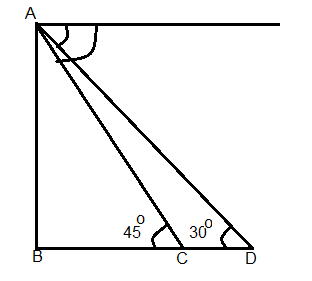
Let $A$ be the position of the man and $AB$ be the tower.
Now consider the triangle$ABD$.
$\tan 30^\circ = \dfrac{{AB}}{{BD}}$
$ \Rightarrow \dfrac{1}{{\sqrt 3 }} = \dfrac{{AB}}{{BC + CD}}$
$ \Rightarrow \dfrac{{BC + CD}}{{\sqrt 3 }} = AB$ …………...…. (1)
Now consider the triangle $ABC$.
$\tan 45^\circ = \dfrac{{AB}}{{BC}}$
$ \Rightarrow 1 = \dfrac{{AB}}{{BC}}$
$ \Rightarrow BC = AB$ …………….….(2)
Substitute the value of $BC$ from equation (2) in equation (1), we have
$\dfrac{{AB + CD}}{{\sqrt 3 }} = AB$
$ \Rightarrow AB + CD = \sqrt 3 AB$
$ \Rightarrow \sqrt 3 AB - AB = CD$
$ \Rightarrow AB\left( {\sqrt 3 - 1} \right) = CD$ ……………...…. (3)
Let $v$ m/min be the speed of the car.
Since the car takes $18$min. to cover the distance$CD$, we have
$CD = 18v$ …………..…. (4) $\left[ {Dis\tan ce = Speed \times Time} \right]$
Substitute the value of $CD$ from equation (4) in equation (3), we have
$AB\left( {\sqrt 3 - 1} \right) = 18v$
$\dfrac{{AB\left( {\sqrt 3 - 1} \right)}}{{18}} = v$ …………...…. (5)
We need to find the time taken by the car to cover the distance $BC$.
$Time = \dfrac{{BC}}{v}$ $\left[ {Time = \dfrac{{Dis\tan ce}}{{Speed}}} \right]$
$ \Rightarrow Time = \dfrac{{18BC}}{{AB\left( {\sqrt 3 - 1} \right)}}$ [from equation (5)]
$ \Rightarrow Time = \dfrac{{18AB}}{{AB\left( {\sqrt 3 - 1} \right)}}$ [from equation (2)]
$ \Rightarrow Time = \dfrac{{18}}{{\left( {\sqrt 3 - 1} \right)}}$
$ \Rightarrow Time = \dfrac{{18}}{{\left( {\sqrt 3 - 1} \right)}} \times \dfrac{{\left( {\sqrt 3 + 1} \right)}}{{\left( {\sqrt 3 + 1} \right)}}$
$ \Rightarrow Time = \dfrac{{18\left( {\sqrt 3 + 1} \right)}}{{3 - 1}}$
$ \Rightarrow Time = \dfrac{{18\left( {\sqrt 3 + 1} \right)}}{2}$
$ \Rightarrow Time = 9\left( {\sqrt 3 + 1} \right)$
Hence option (A) is the correct answer.
Note: The distance travelled by the car moving through velocity $v$ in $t$ seconds is given by : $x = v \times t$.
For a constant distance, speed and time are inversely proportional. With increase in speed time decreases and with decrease in speed, time increases.
Complete step-by-step answer:
Consider the following figure.
Let $A$ be the position of the man and $AB$ be the tower.
Now consider the triangle$ABD$.
$\tan 30^\circ = \dfrac{{AB}}{{BD}}$
$ \Rightarrow \dfrac{1}{{\sqrt 3 }} = \dfrac{{AB}}{{BC + CD}}$
$ \Rightarrow \dfrac{{BC + CD}}{{\sqrt 3 }} = AB$ …………...…. (1)
Now consider the triangle $ABC$.
$\tan 45^\circ = \dfrac{{AB}}{{BC}}$
$ \Rightarrow 1 = \dfrac{{AB}}{{BC}}$
$ \Rightarrow BC = AB$ …………….….(2)
Substitute the value of $BC$ from equation (2) in equation (1), we have
$\dfrac{{AB + CD}}{{\sqrt 3 }} = AB$
$ \Rightarrow AB + CD = \sqrt 3 AB$
$ \Rightarrow \sqrt 3 AB - AB = CD$
$ \Rightarrow AB\left( {\sqrt 3 - 1} \right) = CD$ ……………...…. (3)
Let $v$ m/min be the speed of the car.
Since the car takes $18$min. to cover the distance$CD$, we have
$CD = 18v$ …………..…. (4) $\left[ {Dis\tan ce = Speed \times Time} \right]$
Substitute the value of $CD$ from equation (4) in equation (3), we have
$AB\left( {\sqrt 3 - 1} \right) = 18v$
$\dfrac{{AB\left( {\sqrt 3 - 1} \right)}}{{18}} = v$ …………...…. (5)
We need to find the time taken by the car to cover the distance $BC$.
$Time = \dfrac{{BC}}{v}$ $\left[ {Time = \dfrac{{Dis\tan ce}}{{Speed}}} \right]$
$ \Rightarrow Time = \dfrac{{18BC}}{{AB\left( {\sqrt 3 - 1} \right)}}$ [from equation (5)]
$ \Rightarrow Time = \dfrac{{18AB}}{{AB\left( {\sqrt 3 - 1} \right)}}$ [from equation (2)]
$ \Rightarrow Time = \dfrac{{18}}{{\left( {\sqrt 3 - 1} \right)}}$
$ \Rightarrow Time = \dfrac{{18}}{{\left( {\sqrt 3 - 1} \right)}} \times \dfrac{{\left( {\sqrt 3 + 1} \right)}}{{\left( {\sqrt 3 + 1} \right)}}$
$ \Rightarrow Time = \dfrac{{18\left( {\sqrt 3 + 1} \right)}}{{3 - 1}}$
$ \Rightarrow Time = \dfrac{{18\left( {\sqrt 3 + 1} \right)}}{2}$
$ \Rightarrow Time = 9\left( {\sqrt 3 + 1} \right)$
Hence option (A) is the correct answer.
Note: The distance travelled by the car moving through velocity $v$ in $t$ seconds is given by : $x = v \times t$.
For a constant distance, speed and time are inversely proportional. With increase in speed time decreases and with decrease in speed, time increases.
Recently Updated Pages
Master Class 12 Economics: Engaging Questions & Answers for Success

Master Class 12 Physics: Engaging Questions & Answers for Success
Master Class 12 English: Engaging Questions & Answers for Success
Master Class 12 Social Science: Engaging Questions & Answers for Success
Master Class 12 Maths: Engaging Questions & Answers for Success
Master Class 12 Business Studies: Engaging Questions & Answers for Success
Trending doubts
Which are the Top 10 Largest Countries of the World?
What are the major means of transport Explain each class 12 social science CBSE
Draw a labelled sketch of the human eye class 12 physics CBSE
Why cannot DNA pass through cell membranes class 12 biology CBSE
Differentiate between insitu conservation and exsitu class 12 biology CBSE
Draw a neat and well labeled diagram of TS of ovary class 12 biology CBSE