




A man of mass m is suspended in air holding the rope of a balloon of mass M. A climb up the rope, the balloon
1) Moves upward
2) Moves downward
3) Remains stationary
Answer
 Verified
661.8k+ views
Hint: To solve the following question create a rough diagram for a better understanding of the question. Consider the balloon and the man climbing it be a system, then find the forces acting on the system.
Complete answer:
After assuming that the man and the balloon on which he is climbing is a system, we can find that no external force is acting on the system which means that the centre of mass will remain undisturbed. Initially, when the system which is both the man and the balloon are at rest then the centre of mass of the system will also be at rest. Let us say that the centre of mass of the system will be at the centre as shown in the figure.
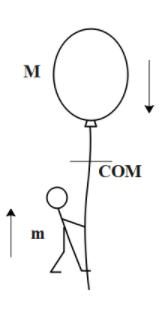
According to the question, the man climbs upward therefore, the balloon has to move downward in order to balance the centre of mass of the system.
Hence, option (2) moves downward.
Note:
The centre of mass of a system or a body is defined as a point at which all the masses of a system or whole of the mass of the body of a particle appear to be concentrated. The system of particles means a well-defined collection of a large number of particles which may or may not interact with each other. A system is defined as the collection of two or more objects. An isolated system is defined as the system which is free from the influence of any external force that alters the momentum of the system.
Complete answer:
After assuming that the man and the balloon on which he is climbing is a system, we can find that no external force is acting on the system which means that the centre of mass will remain undisturbed. Initially, when the system which is both the man and the balloon are at rest then the centre of mass of the system will also be at rest. Let us say that the centre of mass of the system will be at the centre as shown in the figure.
According to the question, the man climbs upward therefore, the balloon has to move downward in order to balance the centre of mass of the system.
Hence, option (2) moves downward.
Note:
The centre of mass of a system or a body is defined as a point at which all the masses of a system or whole of the mass of the body of a particle appear to be concentrated. The system of particles means a well-defined collection of a large number of particles which may or may not interact with each other. A system is defined as the collection of two or more objects. An isolated system is defined as the system which is free from the influence of any external force that alters the momentum of the system.
Recently Updated Pages
Which will be the least stable resonating structure class 11 chemistry CBSE

How many 5 digit telephone numbers can be construc-class-11-maths-CBSE
How do you find the angle of the resultant vector class 11 physics CBSE
Draw labelled diagram of the following i Gram seed class 11 biology CBSE
1 Quintal is equal to a 110 kg b 10 kg c 100kg d 1000 class 11 physics CBSE
What is the need and importance of classification class 11 biology CBSE
Trending doubts
Find the value of the expression given below sin 30circ class 11 maths CBSE
One Metric ton is equal to kg A 10000 B 1000 C 100 class 11 physics CBSE
10 examples of friction in our daily life
Draw a diagram of a plant cell and label at least eight class 11 biology CBSE
Difference between physical and chemical change class 11 chemistry CBSE
Proton was discovered by A Thomson B Rutherford C Chadwick class 11 chemistry CBSE