




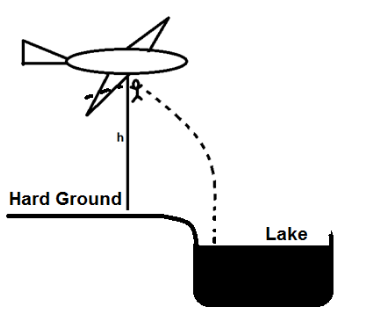
A man of \[M = 58kg\;\] jumps from an aeroplane as shown in figure. He sees the hard ground below him and a lake at a distance \[d = 1m\] from the point directly below him. He immediately puts off his jacket (mass \[m = 2kg\]) and throws it in a direction directly away from the lake. If he just fails to strike the ground, find the distance (in \[{10^1}m\]) he should walk now to pick his jacket. (Neglect air resistance and take the velocity of man at the time of jump with respect to earth zero)
A. $4m$
B. $5m$
C. $3m$
D. $2m$
Answer
 Verified
607.2k+ views
Hint:To solve this question, we need to apply two concepts. First, the law of momentum conservation. And second, we also need to consider the center of mass of the combined system of the man and the jacket because the jacket falls at a point such that the centre of mass of the man and the jacket will be directly below the point from where the man jumps.
Complete step by step answer:
We are given that the man falls at a distance \[d = 1m\] from the point directly below him.Let us consider that the distance from the point he falls to the jacket is $x$ in the opposite direction. Therefore, we can say that
$Md = mx \\
\Rightarrow x = \dfrac{{Md}}{m} \\ $
We are given that \[M = 58kg\;\], \[d = 1m\]and \[m = 2kg\].
$ \Rightarrow x = \dfrac{{58 \times 1}}{2} = 29m$
Now, we know that as the jacket falls in the opposite direction, the man has to cover the distance \[d = 1m\] first and then $x = 29m$.
Thus, the total distance to be covered by a man to pick up his jacket is $1 + 29 = 30m$.
We can write $30m = 3 \times {10^1}m$
Here, we are asked to find the distance in \[{10^1}m\]. Therefore, our final answer is $3m$.
Hence, option C is the right answer.
Note:Here, we can see that the man throws his jacket in the opposite direction to the lake to save himself. According to momentum conservation, he himself gets a velocity in the direction of the lake. During the motion as gravity is the only external force on the system of man and jacket, the centre of mass will not be displaced horizontally. Thus, the centre of mass of the system falls vertically.
Complete step by step answer:
We are given that the man falls at a distance \[d = 1m\] from the point directly below him.Let us consider that the distance from the point he falls to the jacket is $x$ in the opposite direction. Therefore, we can say that
$Md = mx \\
\Rightarrow x = \dfrac{{Md}}{m} \\ $
We are given that \[M = 58kg\;\], \[d = 1m\]and \[m = 2kg\].
$ \Rightarrow x = \dfrac{{58 \times 1}}{2} = 29m$
Now, we know that as the jacket falls in the opposite direction, the man has to cover the distance \[d = 1m\] first and then $x = 29m$.
Thus, the total distance to be covered by a man to pick up his jacket is $1 + 29 = 30m$.
We can write $30m = 3 \times {10^1}m$
Here, we are asked to find the distance in \[{10^1}m\]. Therefore, our final answer is $3m$.
Hence, option C is the right answer.
Note:Here, we can see that the man throws his jacket in the opposite direction to the lake to save himself. According to momentum conservation, he himself gets a velocity in the direction of the lake. During the motion as gravity is the only external force on the system of man and jacket, the centre of mass will not be displaced horizontally. Thus, the centre of mass of the system falls vertically.
Recently Updated Pages
Which will be the least stable resonating structure class 11 chemistry CBSE

How many 5 digit telephone numbers can be construc-class-11-maths-CBSE
How do you find the angle of the resultant vector class 11 physics CBSE
Draw labelled diagram of the following i Gram seed class 11 biology CBSE
What is the need and importance of classification class 11 biology CBSE
The way in which the sparrows expressed their sorrow class 11 english CBSE
Trending doubts
One Metric ton is equal to kg A 10000 B 1000 C 100 class 11 physics CBSE
Find the value of the expression given below sin 30circ class 11 maths CBSE
1 Quintal is equal to a 110 kg b 10 kg c 100kg d 1000 class 11 physics CBSE
Draw a diagram of nephron and explain its structur class 11 biology CBSE
10 examples of friction in our daily life
Proton was discovered by A Thomson B Rutherford C Chadwick class 11 chemistry CBSE