




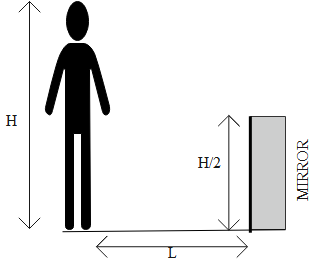
A man of height $H$ is standing in front of a mirror, which has been fixed on the ground. What length of his body will the man be able to see in the mirror? The length of the mirror is \[\dfrac{H}{2}\] (Neglect separation between eyes and head).
A. $H$
B. $\dfrac{{{H}^{2}}}{{{({{H}^{2}}+{{L}^{2}})}^{\dfrac{1}{2}}}}$
C. Zero
D. $\dfrac{Z{{H}^{2}}}{L}$
Answer
 Verified
585.9k+ views
Hint: A plane mirror is a uniform reflective surface in which one side is silver coated for maximum reflection. A plane mirror forms a virtual image. The image formed by it is of the same dimension as that of the object and at distance inside the mirror equal to the distance of the object from the mirror.
Complete step by step answer:
The basic rule followed by a plain mirror is that the angle of incidence is equal to the angle of reflection concerning the reference line. This rule is known as the law of reflection.
According to the question a man is standing in front of a mirror of height $\dfrac{H}{2}$ at a distance L.
The incident light from the feet will interest the top point of the mirror and by Law of reflection, it will reflect and will be visible to the man. All other rays of light won't be able to intersect with the mirror because the height of the mirror is half of the person's height. For better clarity, we can refer to the below diagram.
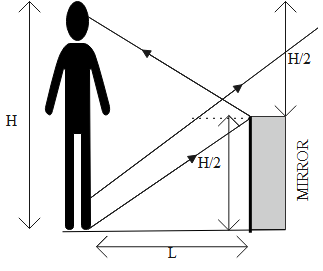
So we can conclude that the man will not be able to see even a small length of his height. Thus, the correct option which satisfies the question is option C zero.
Note:
When we talk about a plane mirror there is no difference in the dimension of the image and the object. For the mentioned condition in the question, the mirror is half the length of the man's height the rays passing from his body won't be able to intersect the mirror surface, and they will normally pass away without any reflection.
Complete step by step answer:
The basic rule followed by a plain mirror is that the angle of incidence is equal to the angle of reflection concerning the reference line. This rule is known as the law of reflection.
According to the question a man is standing in front of a mirror of height $\dfrac{H}{2}$ at a distance L.
The incident light from the feet will interest the top point of the mirror and by Law of reflection, it will reflect and will be visible to the man. All other rays of light won't be able to intersect with the mirror because the height of the mirror is half of the person's height. For better clarity, we can refer to the below diagram.
So we can conclude that the man will not be able to see even a small length of his height. Thus, the correct option which satisfies the question is option C zero.
Note:
When we talk about a plane mirror there is no difference in the dimension of the image and the object. For the mentioned condition in the question, the mirror is half the length of the man's height the rays passing from his body won't be able to intersect the mirror surface, and they will normally pass away without any reflection.
Recently Updated Pages
Master Class 12 Economics: Engaging Questions & Answers for Success

Master Class 12 Physics: Engaging Questions & Answers for Success
Master Class 12 English: Engaging Questions & Answers for Success
Master Class 12 Social Science: Engaging Questions & Answers for Success
Master Class 12 Maths: Engaging Questions & Answers for Success
Master Class 12 Business Studies: Engaging Questions & Answers for Success
Trending doubts
Which are the Top 10 Largest Countries of the World?
What are the major means of transport Explain each class 12 social science CBSE
Draw a labelled sketch of the human eye class 12 physics CBSE
Why cannot DNA pass through cell membranes class 12 biology CBSE
Differentiate between insitu conservation and exsitu class 12 biology CBSE
Draw a neat and well labeled diagram of TS of ovary class 12 biology CBSE