




A man is traveling on a flat car which is moving up a plane inclined at $\cos \theta = \dfrac{4}{5}$ to the horizontal with a speed $5{\text{ m/s}}$. He throws a ball towards a stationary hoop located perpendicular to the incline in such a way that the ball moves parallel to the slope of the incline while going through the center of the hoop. The center of the hoop is $4m$ high from the man’s hand. Calculate the time taken by the ball to reach the hoop.

Answer
 Verified
526.5k+ views
Hint: First, the formula of maximum height that the ball reaches due to throwing towards the stationary hoop is to be used to find the initial velocity. Next, by putting the value of the sine component of initial velocity from the above relation in the formula of time taken by the ball to reach the hoop. Note that, all the formulas or equations of motion are used here regarding projectile motion.
Formula used:
The maximum height that the ball reaches due to throwing towards the stationary hoop, ${H_{\max }} = \dfrac{{{u^2}{{\sin }^2}\alpha }}{{2g\cos \theta }}$
$\theta $ is the angle of inclination
$u\sin \alpha $ is the sine component of the initial velocity of the ball.
The time is taken by the ball to reach the hoop, $T = \dfrac{{2u\sin \alpha }}{{2g\cos \theta }}$
Complete step by step answer:
Given that, A man is traveling in a flat car which is moving up an inclined plane with a speed $5{\text{ m/s}}$.
$\theta $ is the angle of inclination to the horizontal.
Given, $\cos \theta = \dfrac{4}{5}$
The ball is thrown towards a stationary hoop located perpendicular to the incline.
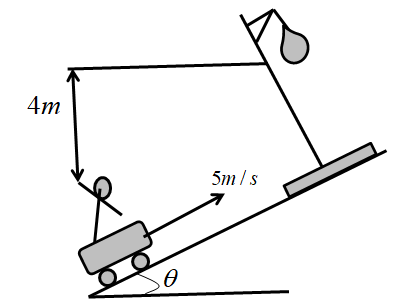
The maximum height that the ball reaches due to throwing towards the stationary hoop, ${H_{\max }} = \dfrac{{{u^2}{{\sin }^2}\alpha }}{{2g\cos \theta }}$
Where, ${H_{\max }} = 4$
$ \Rightarrow 4 = \dfrac{{{u^2}{{\sin }^2}\alpha }}{{2 \times 10 \times \dfrac{4}{5}}}$ [ the acceleration due to gravity is taken here, $g = 10m/{s^2}$ ]
On simplification,
\[ \Rightarrow {u^2}{\sin ^2}\alpha = 2 \times 10 \times \dfrac{4}{5} \times 4\]
On further simplification, we get
\[ \Rightarrow u\sin \alpha = \sqrt {64} \]
\[ \Rightarrow u\sin \alpha = 8\] We will use this value to find $T$ value.
Thereafter, the ball moves parallel to the slope of the incline that goes through the center of the hoop.
The time is taken by the ball to reach the hoop, $T = \dfrac{{2u\sin \alpha }}{{2g\cos \theta }}$
$ \Rightarrow T = \dfrac{{2 \times 8}}{{2 \times 10 \times \dfrac{4}{5}}}$
On simplification,
$ \Rightarrow T = \dfrac{{2 \times 8}}{{2 \times 2 \times 4}}$
$ \Rightarrow T = 1$
Therefore, the required time is $1\sec $.
Note:
Projectile motion is the motion of a body that is thrown or projected into the air and accelerates due to gravity. The body is called a projectile, and its path is known as trajectory. The motion of falling objects, as covered in Problem-Solving Basics for 1D Kinematics, is a general one-dimensional type of projectile motion in which there is a lack of horizontal motion. In this topic, we consider two-dimensional projectile motion, the air resistance is negligible.
Formula used:
The maximum height that the ball reaches due to throwing towards the stationary hoop, ${H_{\max }} = \dfrac{{{u^2}{{\sin }^2}\alpha }}{{2g\cos \theta }}$
$\theta $ is the angle of inclination
$u\sin \alpha $ is the sine component of the initial velocity of the ball.
The time is taken by the ball to reach the hoop, $T = \dfrac{{2u\sin \alpha }}{{2g\cos \theta }}$
Complete step by step answer:
Given that, A man is traveling in a flat car which is moving up an inclined plane with a speed $5{\text{ m/s}}$.
$\theta $ is the angle of inclination to the horizontal.
Given, $\cos \theta = \dfrac{4}{5}$
The ball is thrown towards a stationary hoop located perpendicular to the incline.
The maximum height that the ball reaches due to throwing towards the stationary hoop, ${H_{\max }} = \dfrac{{{u^2}{{\sin }^2}\alpha }}{{2g\cos \theta }}$
Where, ${H_{\max }} = 4$
$ \Rightarrow 4 = \dfrac{{{u^2}{{\sin }^2}\alpha }}{{2 \times 10 \times \dfrac{4}{5}}}$ [ the acceleration due to gravity is taken here, $g = 10m/{s^2}$ ]
On simplification,
\[ \Rightarrow {u^2}{\sin ^2}\alpha = 2 \times 10 \times \dfrac{4}{5} \times 4\]
On further simplification, we get
\[ \Rightarrow u\sin \alpha = \sqrt {64} \]
\[ \Rightarrow u\sin \alpha = 8\] We will use this value to find $T$ value.
Thereafter, the ball moves parallel to the slope of the incline that goes through the center of the hoop.
The time is taken by the ball to reach the hoop, $T = \dfrac{{2u\sin \alpha }}{{2g\cos \theta }}$
$ \Rightarrow T = \dfrac{{2 \times 8}}{{2 \times 10 \times \dfrac{4}{5}}}$
On simplification,
$ \Rightarrow T = \dfrac{{2 \times 8}}{{2 \times 2 \times 4}}$
$ \Rightarrow T = 1$
Therefore, the required time is $1\sec $.
Note:
Projectile motion is the motion of a body that is thrown or projected into the air and accelerates due to gravity. The body is called a projectile, and its path is known as trajectory. The motion of falling objects, as covered in Problem-Solving Basics for 1D Kinematics, is a general one-dimensional type of projectile motion in which there is a lack of horizontal motion. In this topic, we consider two-dimensional projectile motion, the air resistance is negligible.
Recently Updated Pages
Three beakers labelled as A B and C each containing 25 mL of water were taken A small amount of NaOH anhydrous CuSO4 and NaCl were added to the beakers A B and C respectively It was observed that there was an increase in the temperature of the solutions contained in beakers A and B whereas in case of beaker C the temperature of the solution falls Which one of the following statements isarecorrect i In beakers A and B exothermic process has occurred ii In beakers A and B endothermic process has occurred iii In beaker C exothermic process has occurred iv In beaker C endothermic process has occurred

Master Class 11 Social Science: Engaging Questions & Answers for Success
Master Class 11 Physics: Engaging Questions & Answers for Success
Master Class 11 Maths: Engaging Questions & Answers for Success
Master Class 11 Economics: Engaging Questions & Answers for Success
Master Class 11 Computer Science: Engaging Questions & Answers for Success
Three beakers labelled as A B and C each containing 25 mL of water were taken A small amount of NaOH anhydrous CuSO4 and NaCl were added to the beakers A B and C respectively It was observed that there was an increase in the temperature of the solutions contained in beakers A and B whereas in case of beaker C the temperature of the solution falls Which one of the following statements isarecorrect i In beakers A and B exothermic process has occurred ii In beakers A and B endothermic process has occurred iii In beaker C exothermic process has occurred iv In beaker C endothermic process has occurred
Master Class 11 Social Science: Engaging Questions & Answers for Success
Master Class 11 Physics: Engaging Questions & Answers for Success
Trending doubts
One Metric ton is equal to kg A 10000 B 1000 C 100 class 11 physics CBSE
There are 720 permutations of the digits 1 2 3 4 5 class 11 maths CBSE
State and prove Bernoullis theorem class 11 physics CBSE
Draw a diagram of a plant cell and label at least eight class 11 biology CBSE
Difference Between Prokaryotic Cells and Eukaryotic Cells
1 Quintal is equal to a 110 kg b 10 kg c 100kg d 1000 class 11 physics CBSE