




A man in a boat rowing away a lighthouse $100{\text{ m}}$ height takes $2{\text{ m}}$ to change the angle of elevation of the top at the lighthouse from ${60^ \circ }$ to ${30^ \circ }$. Find the speed of the boat in metres per minute.$(\sqrt 3 = 1.732)$.
Answer
 Verified
550.9k+ views
Hint: We have to find the speed of the boat, to calculate speed we need to find the distance that boat travelled from the lighthouse. We find the distance by using the angle elevation and tangent formula. After finding the distance we can find the speed of the boat in metres per minute.
Formula used: ${\text{Distance = Speed \times Time}}$
${\text{tan\theta = }}\dfrac{{{\text{Opposite}}}}{{{\text{Adjacent}}}}$
$\tan {60^ \circ } = \sqrt 3 $
\[\tan {30^ \circ } = \dfrac{1}{{\sqrt 3 }}\]
Complete step-by-step answer:
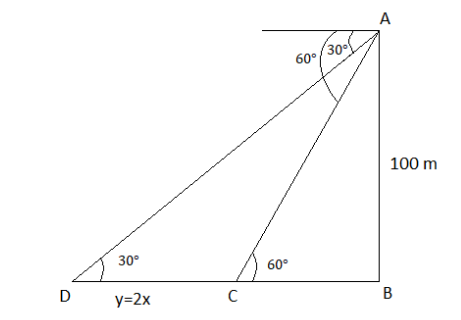
We construct the question as a diagram to understand easily.
Consider $\Delta ABD$,
Here $AB$ is a height of the lighthouse is $100{\text{ m}}$. $A$ be the top of the lighthouse, $B$ be the bottom of the light house. $CD$ be the distance which man travelled to change the angle of elevation.
Let $x$ be the speed of the boat metres per minute.
$ \Rightarrow CD = y = 2x{\text{ }}({\text{Distance = speed \times time}})$
$ \Rightarrow AB = 100\;{\text{m}}$
Now we are going to find the distance between $CB$ using the tangent formula,
From $\angle ACB$, opposite side is $AB$ and adjacent side is $CB$.
Consider $\angle ACB = {60^ \circ }$,
By using the tangent formula in $\angle ACB$ we get,
$ \Rightarrow \tan {60^ \circ } = \dfrac{{AB}}{{CB}}$
Substituting the value of $\tan {60^ \circ } = \sqrt 3 $ and $AB = 100\;{\text{m}}$ we get,
$ \Rightarrow \sqrt 3 = \dfrac{{100}}{{CB}}$
Let us solve this for $CB$,
$ \Rightarrow CB = \dfrac{{100}}{{\sqrt 3 }}$
$ \Rightarrow CB = \dfrac{{100}}{{1.732}}$ (For $\sqrt 3 = 1.732$)
$ \Rightarrow CB = 57.73$
Now we are going to find the distance between $DB$ using the tangent formula,
From $\angle ADB$, opposite side is $AB$ and adjacent side is $DB$.
Consider $\angle ADB = {30^ \circ }$,
By using the tangent formula in $\angle ADB$ we get,
$ \Rightarrow \tan {30^ \circ } = \dfrac{{AB}}{{DB}}$
Substituting the value of \[\tan {30^ \circ } = \dfrac{1}{{\sqrt 3 }}\] and $AB = 100\;{\text{m}}$ we get,
$ \Rightarrow \dfrac{1}{{\sqrt 3 }} = \dfrac{{100}}{{DB}}$
Let us solve this for $DB$,
$ \Rightarrow DB = 100 \times \sqrt 3 $
$ \Rightarrow DB = 100 \times 1.732$ (For $\sqrt 3 = 1.732$)
$ \Rightarrow DB = 173.2$
Consider,
$CD = DB - CB$
Substituting the values of $DB = 173.2$ and $CB = 57.73$ we get,
$ \Rightarrow CD = 172.3 - 57.73$
$ \Rightarrow CD = 115.47$
Since, $ \Rightarrow CD = y = 2x{\text{ }}({\text{Distance = speed \times time}})$
$ \Rightarrow CD = y = 2x = 115.47$
Let us solve this for $x$ we get,
$ \Rightarrow x = \dfrac{{115.47}}{2}$
$ \Rightarrow x = 57.73{\text{ m/min}}$
$\therefore $ The speed of the boat in metres per minute is $57.73{\text{ m/min}}$
Note: The term angle of elevation denotes the angle from the horizontal upward to an object. An observer’s line of sight would be above the horizontal. In this question we may go wrong on finding the speed of the boat and we will be careful on substituting the values. Given is already in required unit values. So we don’t change the unit values for speed and distance.
Formula used: ${\text{Distance = Speed \times Time}}$
${\text{tan\theta = }}\dfrac{{{\text{Opposite}}}}{{{\text{Adjacent}}}}$
$\tan {60^ \circ } = \sqrt 3 $
\[\tan {30^ \circ } = \dfrac{1}{{\sqrt 3 }}\]
Complete step-by-step answer:
We construct the question as a diagram to understand easily.
Consider $\Delta ABD$,
Here $AB$ is a height of the lighthouse is $100{\text{ m}}$. $A$ be the top of the lighthouse, $B$ be the bottom of the light house. $CD$ be the distance which man travelled to change the angle of elevation.
Let $x$ be the speed of the boat metres per minute.
$ \Rightarrow CD = y = 2x{\text{ }}({\text{Distance = speed \times time}})$
$ \Rightarrow AB = 100\;{\text{m}}$
Now we are going to find the distance between $CB$ using the tangent formula,
From $\angle ACB$, opposite side is $AB$ and adjacent side is $CB$.
Consider $\angle ACB = {60^ \circ }$,
By using the tangent formula in $\angle ACB$ we get,
$ \Rightarrow \tan {60^ \circ } = \dfrac{{AB}}{{CB}}$
Substituting the value of $\tan {60^ \circ } = \sqrt 3 $ and $AB = 100\;{\text{m}}$ we get,
$ \Rightarrow \sqrt 3 = \dfrac{{100}}{{CB}}$
Let us solve this for $CB$,
$ \Rightarrow CB = \dfrac{{100}}{{\sqrt 3 }}$
$ \Rightarrow CB = \dfrac{{100}}{{1.732}}$ (For $\sqrt 3 = 1.732$)
$ \Rightarrow CB = 57.73$
Now we are going to find the distance between $DB$ using the tangent formula,
From $\angle ADB$, opposite side is $AB$ and adjacent side is $DB$.
Consider $\angle ADB = {30^ \circ }$,
By using the tangent formula in $\angle ADB$ we get,
$ \Rightarrow \tan {30^ \circ } = \dfrac{{AB}}{{DB}}$
Substituting the value of \[\tan {30^ \circ } = \dfrac{1}{{\sqrt 3 }}\] and $AB = 100\;{\text{m}}$ we get,
$ \Rightarrow \dfrac{1}{{\sqrt 3 }} = \dfrac{{100}}{{DB}}$
Let us solve this for $DB$,
$ \Rightarrow DB = 100 \times \sqrt 3 $
$ \Rightarrow DB = 100 \times 1.732$ (For $\sqrt 3 = 1.732$)
$ \Rightarrow DB = 173.2$
Consider,
$CD = DB - CB$
Substituting the values of $DB = 173.2$ and $CB = 57.73$ we get,
$ \Rightarrow CD = 172.3 - 57.73$
$ \Rightarrow CD = 115.47$
Since, $ \Rightarrow CD = y = 2x{\text{ }}({\text{Distance = speed \times time}})$
$ \Rightarrow CD = y = 2x = 115.47$
Let us solve this for $x$ we get,
$ \Rightarrow x = \dfrac{{115.47}}{2}$
$ \Rightarrow x = 57.73{\text{ m/min}}$
$\therefore $ The speed of the boat in metres per minute is $57.73{\text{ m/min}}$
Note: The term angle of elevation denotes the angle from the horizontal upward to an object. An observer’s line of sight would be above the horizontal. In this question we may go wrong on finding the speed of the boat and we will be careful on substituting the values. Given is already in required unit values. So we don’t change the unit values for speed and distance.
Recently Updated Pages
Master Class 12 Business Studies: Engaging Questions & Answers for Success

Master Class 12 Biology: Engaging Questions & Answers for Success
Master Class 12 Chemistry: Engaging Questions & Answers for Success
Class 12 Question and Answer - Your Ultimate Solutions Guide
Master Class 11 Social Science: Engaging Questions & Answers for Success
Master Class 11 English: Engaging Questions & Answers for Success
Trending doubts
What is BLO What is the full form of BLO class 8 social science CBSE
Citizens of India can vote at the age of A 18 years class 8 social science CBSE
Right to vote is a AFundamental Right BFundamental class 8 social science CBSE
10 slogans on organ donation class 8 english CBSE
Name the states through which the Tropic of Cancer class 8 social science CBSE
What are the methods of reducing friction. Explain