




A man has to go $50m$ due north, $40m$ due east and $20m$ due south to reach a field.
(A). what is the distance he has to walk to reach the field.
(B). what is his displacement from his house to the field?
Answer
 Verified
607.8k+ views
Hint: The four main directions are: north, south, east, and west. Distance is the path taken between two points while displacement is the shortest path between two points. We can calculate the distance by adding the length of the paths the man travelled in all directions, while for displacement, we can calculate the line joining both points.
Formula used:
$H{{F}^{2}}=A{{H}^{2}}+A{{F}^{2}}$
Complete step-by-step solution:
Let the man follow the path as follows-
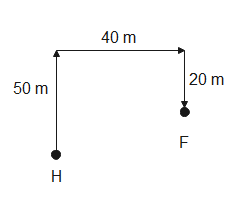
The distance is the length of the path taken by the man to reach the field from his home. The length of the path is-
$\begin{align}
& l=50+40+20 \\
& \therefore l=110m \\
\end{align}$
The total distance that the man travels is $110m$.
Displacement is the shortest distance between two points. It has magnitude as well as direction. While displacement is a vector, distance is a scalar.
The displacement between the man’s home and field will be-
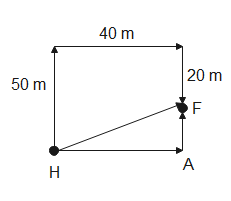
In triangle HAF,
$\begin{align}
& AH=40m \\
& AF=50-20=30m \\
\end{align}$
Applying Pythagoras theorem in $\Delta HAF$
$\begin{align}
& H{{F}^{2}}=A{{H}^{2}}+A{{F}^{2}} \\
& \Rightarrow H{{F}^{2}}={{(40)}^{2}}+{{(30)}^{2}} \\
& \Rightarrow H{{F}^{2}}=2500 \\
& \therefore HF=50m \\
\end{align}$
Therefore, the displacement between the man’s house and field is $50m$.
Therefore, the distance travelled by the man is $110m$, while the displacement between two points is $50m$.
Additional information:
There are different equations which are used to describe the motion of an object in one direction. They give us a relation between initial and final velocity, acceleration, displacement and time taken by an object. These are- $v=u+at$, ${{v}^{2}}={{u}^{2}}+2as$, $s=ut+\dfrac{1}{2}a{{t}^{2}}$.
Note:
The displacement is always shorter than the distance. Its direction is in the direction of motion of the object. Distance describes the motion of an object in one- dimension while displacement describes it in two-dimensions. Displacement is fundamental to other parameters like velocity and acceleration which describe motion.
Formula used:
$H{{F}^{2}}=A{{H}^{2}}+A{{F}^{2}}$
Complete step-by-step solution:
Let the man follow the path as follows-
The distance is the length of the path taken by the man to reach the field from his home. The length of the path is-
$\begin{align}
& l=50+40+20 \\
& \therefore l=110m \\
\end{align}$
The total distance that the man travels is $110m$.
Displacement is the shortest distance between two points. It has magnitude as well as direction. While displacement is a vector, distance is a scalar.
The displacement between the man’s home and field will be-
In triangle HAF,
$\begin{align}
& AH=40m \\
& AF=50-20=30m \\
\end{align}$
Applying Pythagoras theorem in $\Delta HAF$
$\begin{align}
& H{{F}^{2}}=A{{H}^{2}}+A{{F}^{2}} \\
& \Rightarrow H{{F}^{2}}={{(40)}^{2}}+{{(30)}^{2}} \\
& \Rightarrow H{{F}^{2}}=2500 \\
& \therefore HF=50m \\
\end{align}$
Therefore, the displacement between the man’s house and field is $50m$.
Therefore, the distance travelled by the man is $110m$, while the displacement between two points is $50m$.
Additional information:
There are different equations which are used to describe the motion of an object in one direction. They give us a relation between initial and final velocity, acceleration, displacement and time taken by an object. These are- $v=u+at$, ${{v}^{2}}={{u}^{2}}+2as$, $s=ut+\dfrac{1}{2}a{{t}^{2}}$.
Note:
The displacement is always shorter than the distance. Its direction is in the direction of motion of the object. Distance describes the motion of an object in one- dimension while displacement describes it in two-dimensions. Displacement is fundamental to other parameters like velocity and acceleration which describe motion.
Recently Updated Pages
Master Class 5 English: Engaging Questions & Answers for Success

Master Class 5 Maths: Engaging Questions & Answers for Success
Master Class 5 Social Science: Engaging Questions & Answers for Success
Master Class 5 Science: Engaging Questions & Answers for Success
Class 5 Question and Answer - Your Ultimate Solutions Guide
Master Class 9 General Knowledge: Engaging Questions & Answers for Success
Trending doubts
Which are the Top 10 Largest Countries of the World?
The total number of vertebrae in man is a30 b31 c32 class 12 biology CBSE
Draw a labelled sketch of the human eye class 12 physics CBSE
The number of cranial nerves in a frog is A 10 pairs class 12 biology CBSE
Differentiate between homogeneous and heterogeneous class 12 chemistry CBSE
Antibodies present in colostrum which protect the new class 12 biology CBSE