




A magnetic field can be produced by:
$
(a){\text{ a moving charge}} \\
{\text{(b) a changing electric field}} \\
{\text{(c) none of (a) and (b)}} \\
{\text{(d) both of (a) and (b)}} \\
$
Answer
 Verified
604.8k+ views
Hint – In this question use the term that a moving charge gives rise to current as current by definition is the movement of electrons, so that this current gives rise to magnetic field so that a moving charge has an indirect relation to magnetic field output, moreover a shifting electric field also plays a vital role in magnetic field development, using this term to get the correct response.
Complete step-by-step answer:
Magnetic field due to moving charges
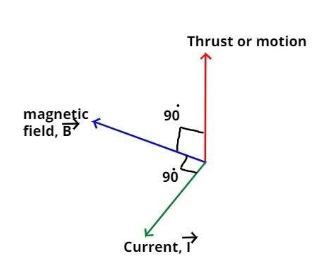
All charged particles on the move generate magnetic fields. Moving point charges, like electrons, generate complicated but well-known magnetic fields that depend on the particle charge, velocity and acceleration.
In concentric circles, magnetic field lines form around a cylindrical current-carrying conductor, like a wire length. One can evaluate the position of such a magnetic field by using the "right hand law" (see figure).
With distance from the wire the magnetic field strength decreases. (For a wire of infinite length the force is inversely proportional to the size)
The magnetic field B for an infinitely long wire is given-
$B = \dfrac{{{\mu _o}I}}{{4\pi R}}$
Magnetic field due to changing electric field
The law of Faraday can be loosely defined as 'a shifting magnetic field produces an electrical field.' This is the concept behind the generator of electricity.
The Law of Ampere notes approximately that 'a shifting electrical field produces a magnetic field.' This rule can therefore be extended to create a magnetic field and drive an electric motor.
So that's the response they need.
Therefore choice (D) is the appropriate answer.
Note – There is a very significant property between a changing magnetic field and a changing electric field, both of which often oscillate together and are perpendicular to one another. Therefore, the electromagnetic waves form also perpendicular to this plane which contains electric and magnetic fields. So in short if the electric field is along the x-axis and magnetic field is along y-axis then the electromagnetic waves thus produced will be along z-axis.
Complete step-by-step answer:
Magnetic field due to moving charges
All charged particles on the move generate magnetic fields. Moving point charges, like electrons, generate complicated but well-known magnetic fields that depend on the particle charge, velocity and acceleration.
In concentric circles, magnetic field lines form around a cylindrical current-carrying conductor, like a wire length. One can evaluate the position of such a magnetic field by using the "right hand law" (see figure).
With distance from the wire the magnetic field strength decreases. (For a wire of infinite length the force is inversely proportional to the size)
The magnetic field B for an infinitely long wire is given-
$B = \dfrac{{{\mu _o}I}}{{4\pi R}}$
Magnetic field due to changing electric field
The law of Faraday can be loosely defined as 'a shifting magnetic field produces an electrical field.' This is the concept behind the generator of electricity.
The Law of Ampere notes approximately that 'a shifting electrical field produces a magnetic field.' This rule can therefore be extended to create a magnetic field and drive an electric motor.
So that's the response they need.
Therefore choice (D) is the appropriate answer.
Note – There is a very significant property between a changing magnetic field and a changing electric field, both of which often oscillate together and are perpendicular to one another. Therefore, the electromagnetic waves form also perpendicular to this plane which contains electric and magnetic fields. So in short if the electric field is along the x-axis and magnetic field is along y-axis then the electromagnetic waves thus produced will be along z-axis.
Recently Updated Pages
Master Class 12 Economics: Engaging Questions & Answers for Success

Master Class 12 Physics: Engaging Questions & Answers for Success
Master Class 12 English: Engaging Questions & Answers for Success
Master Class 12 Social Science: Engaging Questions & Answers for Success
Master Class 12 Maths: Engaging Questions & Answers for Success
Master Class 12 Business Studies: Engaging Questions & Answers for Success
Trending doubts
Which are the Top 10 Largest Countries of the World?
What are the major means of transport Explain each class 12 social science CBSE
Draw a labelled sketch of the human eye class 12 physics CBSE
Why cannot DNA pass through cell membranes class 12 biology CBSE
Differentiate between insitu conservation and exsitu class 12 biology CBSE
Draw a neat and well labeled diagram of TS of ovary class 12 biology CBSE