




A magnetic dipole is acted upon two magnetic fields which are inclined to each other at an angle of $75^{\circ}$. One of its fields has a magnitude of 15 mT. The dipole attains stable equilibrium at an angle $30^{\circ}$with this field. The magnitude of the other field (in mT) is close to:
A. 1
B. 36
C. 11
D. 1060
Answer
 Verified
601.5k+ views
Hint: Magnetic field is the space around the magnet or a moving charge (eg: current carrying wire) in which if another magnet is placed, the magnet will interact with the field and hence will experience some force. Magnetic dipole is nothing but a system of two magnetic poles like north and south poles. A bar magnet is an example of this system.
Formula used:
$\vec \tau = \vec M.\vec B = MBsin\theta$
Complete answer:
A body is said to be in equilibrium if net force on the body is zero. The relation between potential energy and force in a conservative field is given by $F = -\dfrac{dU}{dx}$.
Thus, for the force to be zero, there are three cases:
A. If the potential energy is maximum – This is the condition for unstable equilibrium. In this case, if the body is slightly displaced from its position, it never gets to its original state.
B. If the potential energy is minimum – This is the condition for stable equilibrium. In this case, if the body is slightly displaced from its position, it gets to its original state.
C. If the potential energy is constant – This is the condition for neutral equilibrium. In this case, if the body is slightly displaced from its position, it keeps on moving towards the direction of equilibrium.
Now, as we are asked about stable equilibrium, which means there must not be any force (or torque) on the dipole. Thus the dipole must be in the direction of the net magnetic field as if ($\tau = 0, \theta = 0$).
In other words, we can say that the total magnetic field must be in the direction of dipole length.
That means the magnetic field must not be present in the direction perpendicular to the dipole.
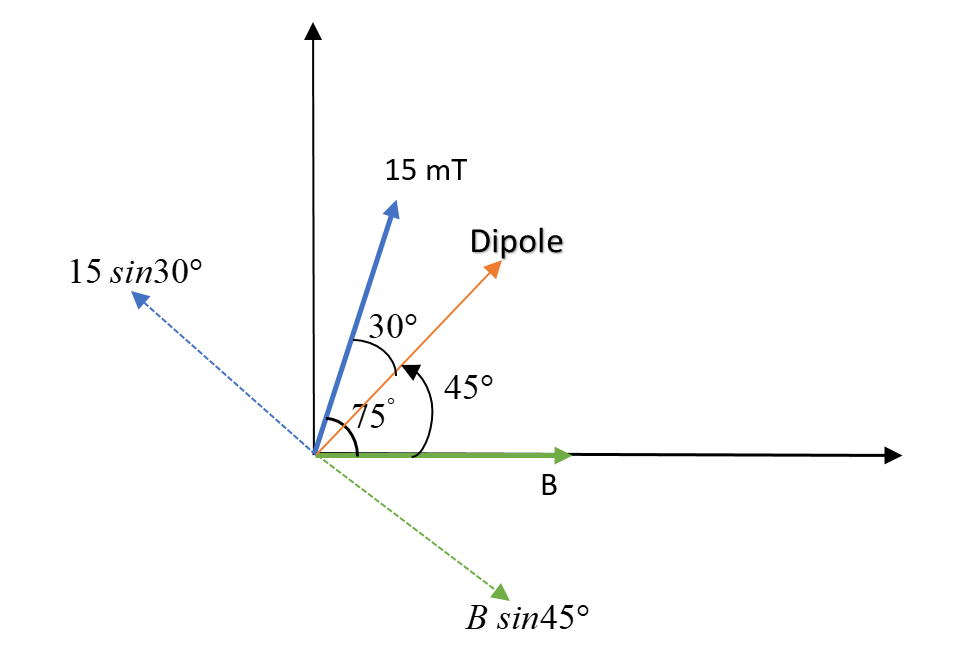
Here, the dipole is shown by orange color. Known field is shown by blue color and the unknown field is shown by green color. The component of fields in direction perpendicular to the dipole is written as:
For Blue: $15 sin30^\circ$
For green: $B sin45^\circ$
Also, they must be equal as there is no field in perpendicular direction of the dipole.
Thus $15 sin 30^\circ = B sin 45^\circ$
$\implies \dfrac{15}{2} = \dfrac{B}{\sqrt 2}$
$\implies B \approx 11 mT$
So, the correct answer is “Option C”.
Note:
When talking about equilibrium, it can be possible if the torque on a rotating body is zero. If it is not zero, the body will keep on rotating and will execute simple harmonic motion. At equilibrium, the net magnetic field on the dipole either must be parallel or anti-parallel to the dipole length.
Formula used:
$\vec \tau = \vec M.\vec B = MBsin\theta$
Complete answer:
A body is said to be in equilibrium if net force on the body is zero. The relation between potential energy and force in a conservative field is given by $F = -\dfrac{dU}{dx}$.
Thus, for the force to be zero, there are three cases:
A. If the potential energy is maximum – This is the condition for unstable equilibrium. In this case, if the body is slightly displaced from its position, it never gets to its original state.
B. If the potential energy is minimum – This is the condition for stable equilibrium. In this case, if the body is slightly displaced from its position, it gets to its original state.
C. If the potential energy is constant – This is the condition for neutral equilibrium. In this case, if the body is slightly displaced from its position, it keeps on moving towards the direction of equilibrium.
Now, as we are asked about stable equilibrium, which means there must not be any force (or torque) on the dipole. Thus the dipole must be in the direction of the net magnetic field as if ($\tau = 0, \theta = 0$).
In other words, we can say that the total magnetic field must be in the direction of dipole length.
That means the magnetic field must not be present in the direction perpendicular to the dipole.
Here, the dipole is shown by orange color. Known field is shown by blue color and the unknown field is shown by green color. The component of fields in direction perpendicular to the dipole is written as:
For Blue: $15 sin30^\circ$
For green: $B sin45^\circ$
Also, they must be equal as there is no field in perpendicular direction of the dipole.
Thus $15 sin 30^\circ = B sin 45^\circ$
$\implies \dfrac{15}{2} = \dfrac{B}{\sqrt 2}$
$\implies B \approx 11 mT$
So, the correct answer is “Option C”.
Note:
When talking about equilibrium, it can be possible if the torque on a rotating body is zero. If it is not zero, the body will keep on rotating and will execute simple harmonic motion. At equilibrium, the net magnetic field on the dipole either must be parallel or anti-parallel to the dipole length.
Recently Updated Pages
Master Class 12 Business Studies: Engaging Questions & Answers for Success

Master Class 12 Chemistry: Engaging Questions & Answers for Success
Master Class 12 Biology: Engaging Questions & Answers for Success
Class 12 Question and Answer - Your Ultimate Solutions Guide
Master Class 11 English: Engaging Questions & Answers for Success
Master Class 11 Maths: Engaging Questions & Answers for Success
Trending doubts
Which is more stable and why class 12 chemistry CBSE
Which are the Top 10 Largest Countries of the World?
Draw a labelled sketch of the human eye class 12 physics CBSE
Differentiate between homogeneous and heterogeneous class 12 chemistry CBSE
What are the major means of transport Explain each class 12 social science CBSE
Sulphuric acid is known as the king of acids State class 12 chemistry CBSE