




A magnet of dipole moment $2\; Am^2$ is deflected through $30^{\circ}$ from magnetic meridian. The required deflecting torque is $({B}_{H}=0.4\times 10^{-4}\; T)$:
A.)$0.4\times 10^{-4}$ Nm
B.)0.4 Nm
C.)$0.2\times 10^{-4}$ Nm
D.)None of these
Answer
 Verified
596.4k+ views
Hint: The torque required can be calculated by the cross product of the magnet dipole moment and horizontal component of magnetic meridian as there is no presence of any other magnetic field.
Formula used:
Torque, $\tau=\vec{\mu} \times \vec{{B}_{H}}$, where $\mu$ is the magnets dipole moment and ${B}_{H}$ is the horizontal component of Earth’s magnetic field.
Complete step by step solution:
We have been given that the dipole moment of the magnet, $\mu=2\; Am^2$ and the horizontal component of the Earth’s magnetic field is ${B}_{H}=0.4\times 10^{-4}\; T$.
It is also given that the angle between the magnet and the magnetic meridian is $30^{\circ}$. So, we can illustrate the condition as follow
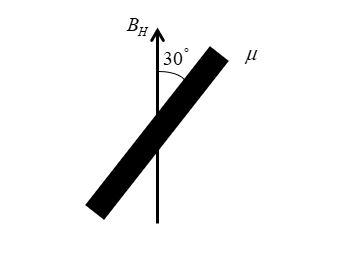
Now, we can find the torque generated by using the formula $\tau=\vec{\mu} \times \vec{{B}_{H}}=\mu {B}_{H} sin\theta$, where $\mu$ is the magnets dipole moment, ${B}_{H}$ is the horizontal component of Earth’s magnetic field and $\theta$ is the angle between the magnet and the magnetic meridian.
Therefore, $\tau=2 \times 0.4\times 10^{-4} sin30^{\circ}=\dfrac{0.8}{2}\times 10^{-4}=0.4\times 10^{-4} Nm$
Hence, option a is the correct answer.
Additional information:
An imaginary line that connects the magnetic north and south poles of the Earth is called a magnetic meridian. A compass needle when suspended freely on the Earth’s surface align itself parallel to the magnetic meridian. although there is some hindrance in their alignment due to the east to west longitude which become complete geodesic and thus magnetic declination comes into picture.
Note:
The orientation of the magnet or say its inclination changes as we move from equator to the poles and is called the angle of dip. This dip is caused by both horizontal and vertical components of the magnetic field. At poles, this dip is $90^{\circ}$ and at the equator, the dip is $0^\circ$.
Formula used:
Torque, $\tau=\vec{\mu} \times \vec{{B}_{H}}$, where $\mu$ is the magnets dipole moment and ${B}_{H}$ is the horizontal component of Earth’s magnetic field.
Complete step by step solution:
We have been given that the dipole moment of the magnet, $\mu=2\; Am^2$ and the horizontal component of the Earth’s magnetic field is ${B}_{H}=0.4\times 10^{-4}\; T$.
It is also given that the angle between the magnet and the magnetic meridian is $30^{\circ}$. So, we can illustrate the condition as follow
Now, we can find the torque generated by using the formula $\tau=\vec{\mu} \times \vec{{B}_{H}}=\mu {B}_{H} sin\theta$, where $\mu$ is the magnets dipole moment, ${B}_{H}$ is the horizontal component of Earth’s magnetic field and $\theta$ is the angle between the magnet and the magnetic meridian.
Therefore, $\tau=2 \times 0.4\times 10^{-4} sin30^{\circ}=\dfrac{0.8}{2}\times 10^{-4}=0.4\times 10^{-4} Nm$
Hence, option a is the correct answer.
Additional information:
An imaginary line that connects the magnetic north and south poles of the Earth is called a magnetic meridian. A compass needle when suspended freely on the Earth’s surface align itself parallel to the magnetic meridian. although there is some hindrance in their alignment due to the east to west longitude which become complete geodesic and thus magnetic declination comes into picture.
Note:
The orientation of the magnet or say its inclination changes as we move from equator to the poles and is called the angle of dip. This dip is caused by both horizontal and vertical components of the magnetic field. At poles, this dip is $90^{\circ}$ and at the equator, the dip is $0^\circ$.
Recently Updated Pages
Master Class 12 Economics: Engaging Questions & Answers for Success

Master Class 12 Physics: Engaging Questions & Answers for Success
Master Class 12 English: Engaging Questions & Answers for Success
Master Class 12 Social Science: Engaging Questions & Answers for Success
Master Class 12 Maths: Engaging Questions & Answers for Success
Master Class 12 Business Studies: Engaging Questions & Answers for Success
Trending doubts
Which are the Top 10 Largest Countries of the World?
What are the major means of transport Explain each class 12 social science CBSE
Draw a labelled sketch of the human eye class 12 physics CBSE
Why cannot DNA pass through cell membranes class 12 biology CBSE
Differentiate between insitu conservation and exsitu class 12 biology CBSE
Draw a neat and well labeled diagram of TS of ovary class 12 biology CBSE