




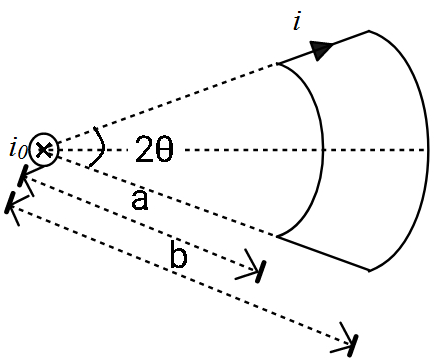
A loop carrying a current i, lying in the plane of the paper, is in the field of long straight wire with current $i_0$ (inward) as shown in figure. If the torque acting on the loop is given by $\tau = \dfrac{\mu_0 i i_0}{x \pi r} [ \sin \theta ](b - a)$. Find x.
Answer
 Verified
579.9k+ views
Hint: There is a wire carrying some current in the direction inside the plane of paper. The magnetic field created by this wire will have no effect on the circular regions of the loop as the magnetic field is tangential (parallel) to circular regions.
Formula used:
If a wire carries a current I, then the magnitude of magnetic field formed around it at a distance of r from it is:
$B = \dfrac{\mu_0 I}{2 \pi r}$.
The force that a current carrying conductor experiences in a magnetic field is:
$\vec{dF} = i \vec{dl} \times \vec{B} $
Complete answer:
Consider a small length dr on both the length segments carrying a current i. Since both of them along the radius of a circle, the magnetic field is perpendicular to both dr elements. Therefore the force on both of them is same and is equal to
$\vec{dF} = i \vec{dr} \times \vec{B} $.
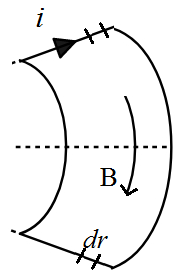
Here B is for the magnetic field produced by the wire carrying current i. Therefore around the wire we have magnetic field given by
$B = \dfrac{\mu_0 i}{2 \pi r}$.
Substituting this value back in the force expression, we get:
$dF = \dfrac{\mu_0 i i_0}{2 \pi r} dr$.
Fleming's left hand rule will help in obtaining the direction of force on both the elements which are inwards and outwards for the two dr.
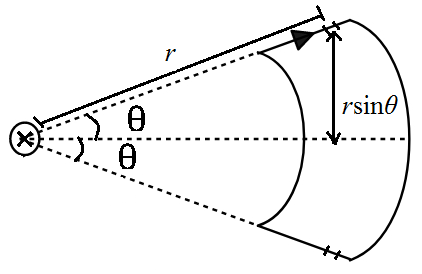
Let the distance of both the elements be r from the straight wire. This will give the distance of the upper and lower element to be $r \sin \theta$ from the axis. So, the torque is
$d \tau = (2 r \sin \theta ) \dfrac{\mu_0 i i_0}{2 \pi r} dr $.
Integrating from limits a to b will give us:
$\tau = \dfrac{\mu_0 i i_0}{ \pi } [ \sin \theta ] \int_a^b dr $
$\implies \tau = \dfrac{\mu_0 i i_0}{ \pi } [ \sin \theta ](b - a)$.
Therefore, in place of x, we must have 1/r so that our expression matches with the one in the question:
Note:
If we use Fleming's left hand rule we can find the direction of force in both the elements. In the upper element, the force is along the direction of i (perpendicular going inside the plane of paper) and as the current in the lower element is in the opposite direction so will be the force i.e., it is out from the plane of paper.
Formula used:
If a wire carries a current I, then the magnitude of magnetic field formed around it at a distance of r from it is:
$B = \dfrac{\mu_0 I}{2 \pi r}$.
The force that a current carrying conductor experiences in a magnetic field is:
$\vec{dF} = i \vec{dl} \times \vec{B} $
Complete answer:
Consider a small length dr on both the length segments carrying a current i. Since both of them along the radius of a circle, the magnetic field is perpendicular to both dr elements. Therefore the force on both of them is same and is equal to
$\vec{dF} = i \vec{dr} \times \vec{B} $.
Here B is for the magnetic field produced by the wire carrying current i. Therefore around the wire we have magnetic field given by
$B = \dfrac{\mu_0 i}{2 \pi r}$.
Substituting this value back in the force expression, we get:
$dF = \dfrac{\mu_0 i i_0}{2 \pi r} dr$.
Fleming's left hand rule will help in obtaining the direction of force on both the elements which are inwards and outwards for the two dr.
Let the distance of both the elements be r from the straight wire. This will give the distance of the upper and lower element to be $r \sin \theta$ from the axis. So, the torque is
$d \tau = (2 r \sin \theta ) \dfrac{\mu_0 i i_0}{2 \pi r} dr $.
Integrating from limits a to b will give us:
$\tau = \dfrac{\mu_0 i i_0}{ \pi } [ \sin \theta ] \int_a^b dr $
$\implies \tau = \dfrac{\mu_0 i i_0}{ \pi } [ \sin \theta ](b - a)$.
Therefore, in place of x, we must have 1/r so that our expression matches with the one in the question:
Note:
If we use Fleming's left hand rule we can find the direction of force in both the elements. In the upper element, the force is along the direction of i (perpendicular going inside the plane of paper) and as the current in the lower element is in the opposite direction so will be the force i.e., it is out from the plane of paper.
Recently Updated Pages
Master Class 12 Economics: Engaging Questions & Answers for Success

Master Class 12 Physics: Engaging Questions & Answers for Success
Master Class 12 English: Engaging Questions & Answers for Success
Master Class 12 Social Science: Engaging Questions & Answers for Success
Master Class 12 Maths: Engaging Questions & Answers for Success
Master Class 12 Business Studies: Engaging Questions & Answers for Success
Trending doubts
Which are the Top 10 Largest Countries of the World?
What are the major means of transport Explain each class 12 social science CBSE
Draw a labelled sketch of the human eye class 12 physics CBSE
Why cannot DNA pass through cell membranes class 12 biology CBSE
Differentiate between insitu conservation and exsitu class 12 biology CBSE
Draw a neat and well labeled diagram of TS of ovary class 12 biology CBSE