



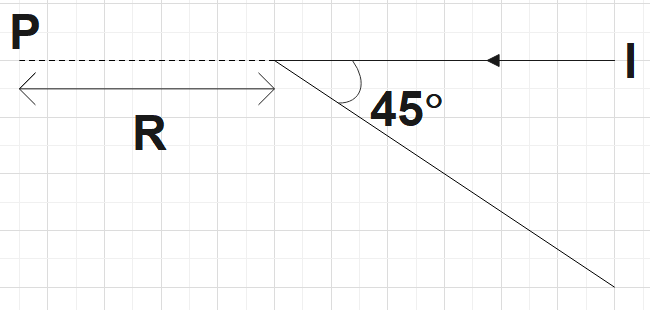
A long straight wire carrying current I is bent at its midpoint to form an angle of $45{}^\circ $ induction of magnetic field at point P distant R from point of bending is equal to:
A. $\dfrac{\left( \sqrt{2}-1 \right){{\mu }_{0}}I}{4\pi R}$
B. $\dfrac{\left( \sqrt{2}+1 \right){{\mu }_{0}}I}{4\pi R}$
C. $\dfrac{\left( \sqrt{2}+1 \right){{\mu }_{0}}I}{4\sqrt{2}\pi R}$
D. $\dfrac{\left( \sqrt{2}-1 \right){{\mu }_{0}}I}{2\sqrt{2}\pi R}$
Answer
 Verified
588.9k+ views
Hint: As a first step, one could read the question well and hence note down the given points carefully. Then you could recall the expression for magnetic field induction as per the given conditions in the question. Then carry out the substitutions accordingly to find the answer.
Formula used:
Magnetic field induction,
$B=\dfrac{{{\mu }_{0}}I}{4\pi d}\left( \sin {{\phi }_{1}}+\sin {{\phi }_{2}} \right)$
Complete step-by-step solution:
In the question, we are given a long straight wire that is carrying current I that is bent at its midpoint forming a $45{}^\circ $angle. We are supposed to find the magnetic field induction at point P that is at a distance R from this point of bending.
Let us recall the expression for magnetic induction given by,
$B=\dfrac{{{\mu }_{0}}I}{4\pi d}\left( \sin {{\phi }_{1}}+\sin {{\phi }_{2}} \right)$…………………………………………. (1)
From the given figure, $d=R\cos 45{}^\circ $
Also, ${{\phi }_{1}}=-{{45}^{0}}$and ${{\phi }_{2}}=90{}^\circ $
One could substitute these values into equation (1) to get,
$B=\dfrac{{{\mu }_{0}}I}{4\pi R\cos 45{}^\circ }\left( \sin \left( -45{}^\circ \right)+\sin 90{}^\circ \right)$
Substituting the sine and cosine of these angles, we would get,
$\Rightarrow B=\dfrac{{{\mu }_{0}}I\sqrt{2}}{4\pi R}\left( 1-\dfrac{1}{\sqrt{2}} \right)$
$\therefore B=\dfrac{\left( \sqrt{2}-1 \right){{\mu }_{0}}I}{4\pi R}$
Therefore, we found the magnetic field induction at the point P due to the given bend wire would be, $B=\dfrac{\left( \sqrt{2}-1 \right){{\mu }_{0}}I}{4\pi R}$
Hence, option A is found to be correct.
Note: We could define electromagnetic or magnetic induction as the production of an electromotive force across an electrical conductor in the vicinity of varying magnetic fields. The man behind the discovery of induction is Michael Faraday and it was mathematically described by maxwell.
Formula used:
Magnetic field induction,
$B=\dfrac{{{\mu }_{0}}I}{4\pi d}\left( \sin {{\phi }_{1}}+\sin {{\phi }_{2}} \right)$
Complete step-by-step solution:
In the question, we are given a long straight wire that is carrying current I that is bent at its midpoint forming a $45{}^\circ $angle. We are supposed to find the magnetic field induction at point P that is at a distance R from this point of bending.
Let us recall the expression for magnetic induction given by,
$B=\dfrac{{{\mu }_{0}}I}{4\pi d}\left( \sin {{\phi }_{1}}+\sin {{\phi }_{2}} \right)$…………………………………………. (1)
From the given figure, $d=R\cos 45{}^\circ $
Also, ${{\phi }_{1}}=-{{45}^{0}}$and ${{\phi }_{2}}=90{}^\circ $
One could substitute these values into equation (1) to get,
$B=\dfrac{{{\mu }_{0}}I}{4\pi R\cos 45{}^\circ }\left( \sin \left( -45{}^\circ \right)+\sin 90{}^\circ \right)$
Substituting the sine and cosine of these angles, we would get,
$\Rightarrow B=\dfrac{{{\mu }_{0}}I\sqrt{2}}{4\pi R}\left( 1-\dfrac{1}{\sqrt{2}} \right)$
$\therefore B=\dfrac{\left( \sqrt{2}-1 \right){{\mu }_{0}}I}{4\pi R}$
Therefore, we found the magnetic field induction at the point P due to the given bend wire would be, $B=\dfrac{\left( \sqrt{2}-1 \right){{\mu }_{0}}I}{4\pi R}$
Hence, option A is found to be correct.
Note: We could define electromagnetic or magnetic induction as the production of an electromotive force across an electrical conductor in the vicinity of varying magnetic fields. The man behind the discovery of induction is Michael Faraday and it was mathematically described by maxwell.
Recently Updated Pages
Which of the following graphs shows the variation of class 12 physics CBSE

Draw a labelled diagram of the human male reproductive class 12 biology CBSE
Describe the experiment to compare the emf of two cells class 12 physics CBSE
What is standard hydrogen electrode
What is conventional current and electric current class 12 physics CBSE
2Bromopentane is treated with an alcoholic KOH solution class 12 chemistry CBSE
Trending doubts
Draw a labelled sketch of the human eye class 12 physics CBSE
Which are the Top 10 Largest Countries of the World?
Differentiate between homogeneous and heterogeneous class 12 chemistry CBSE
Draw ray diagrams each showing i myopic eye and ii class 12 physics CBSE
Which is the correct genotypic ratio of mendel dihybrid class 12 biology CBSE
What is the Full Form of PVC, PET, HDPE, LDPE, PP and PS ?