




A line drawn through the point P (4, 7) cuts the circle \[{x^2} + {y^2} = 9\]at the point A and B. Then PA.PB equal to
Answer
 Verified
602.4k+ views
Hint: When a line is drawn from a point outside of a circle and meets at only one point on the circle then the line is known as a tangent. The tangent is always perpendicular to the line drawn from the radius of the circle to the point of contact of the tangent. When the line is drawn from outside of the circle and it touches two points on the circle then the line is secant.
Complete step-by-step answer:
In the question, the length of the tangent can be determined using the tangent theorem and Pythagoras theorem along with some properties of the circle.
Given the point outside the circle P(4, 7)
The equation of the circle is \[{x^2} + {y^2} = 9\]
The standard equation of a circle is given as\[{x^2} + {y^2} = {r^2}\] , by comparing this equation with the equation of the circle OC we get the radius of the circle, \[r = 3\].
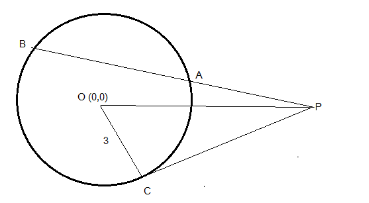
Now find the length OP by determining the distance between two points i.e. OP by
\[
OP = \sqrt {{{\left( {{P_x} - {O_x}} \right)}^2} + {{\left( {{P_y} - {O_y}} \right)}^2}} \\
= \sqrt {{{\left( {4 - 0} \right)}^2} + {{\left( {7 - 0} \right)}^2}} \\
= \sqrt {16 + 49} \\
= \sqrt {65} \\
\]
In \[\vartriangle OPC\], \[\angle C = {90^ \circ }\]so \[\vartriangle OPC\]is right angle triangle hence we can apply Pythagoras theorem which states as:
\[
{\left( {OP} \right)^2} = {\left( {PC} \right)^2} + {\left( {OC} \right)^2} \\
PC = \sqrt {{{\left( {\sqrt {65} } \right)}^2} + {3^2}} \\
= \sqrt {65 + 9} \\
= \sqrt {74} \\
\]
Now use the Tangent secant theorem as:
\[
PA.AB = {\left( {PC} \right)^2} \\
= {\left( {\sqrt {74} } \right)^2} \\
= 74 \\
\]
Hence we can say PA.AB is equal to 74.
Note: Whenever a line is drawn which is tangent to the circle it will always be perpendicular to the radius of the circle. The tangent secant theorem states that the product of the length of the secant outside the circle with secant inside the circle is equal to the square of the length of the tangent from the point outside the circle.
Complete step-by-step answer:
In the question, the length of the tangent can be determined using the tangent theorem and Pythagoras theorem along with some properties of the circle.
Given the point outside the circle P(4, 7)
The equation of the circle is \[{x^2} + {y^2} = 9\]
The standard equation of a circle is given as\[{x^2} + {y^2} = {r^2}\] , by comparing this equation with the equation of the circle OC we get the radius of the circle, \[r = 3\].
Now find the length OP by determining the distance between two points i.e. OP by
\[
OP = \sqrt {{{\left( {{P_x} - {O_x}} \right)}^2} + {{\left( {{P_y} - {O_y}} \right)}^2}} \\
= \sqrt {{{\left( {4 - 0} \right)}^2} + {{\left( {7 - 0} \right)}^2}} \\
= \sqrt {16 + 49} \\
= \sqrt {65} \\
\]
In \[\vartriangle OPC\], \[\angle C = {90^ \circ }\]so \[\vartriangle OPC\]is right angle triangle hence we can apply Pythagoras theorem which states as:
\[
{\left( {OP} \right)^2} = {\left( {PC} \right)^2} + {\left( {OC} \right)^2} \\
PC = \sqrt {{{\left( {\sqrt {65} } \right)}^2} + {3^2}} \\
= \sqrt {65 + 9} \\
= \sqrt {74} \\
\]
Now use the Tangent secant theorem as:
\[
PA.AB = {\left( {PC} \right)^2} \\
= {\left( {\sqrt {74} } \right)^2} \\
= 74 \\
\]
Hence we can say PA.AB is equal to 74.
Note: Whenever a line is drawn which is tangent to the circle it will always be perpendicular to the radius of the circle. The tangent secant theorem states that the product of the length of the secant outside the circle with secant inside the circle is equal to the square of the length of the tangent from the point outside the circle.
Recently Updated Pages
Master Class 9 Social Science: Engaging Questions & Answers for Success

Master Class 9 Science: Engaging Questions & Answers for Success
Master Class 9 Maths: Engaging Questions & Answers for Success
Master Class 9 General Knowledge: Engaging Questions & Answers for Success
Class 9 Question and Answer - Your Ultimate Solutions Guide
Master Class 8 Social Science: Engaging Questions & Answers for Success
Trending doubts
Find the sum of series 1 + 2 + 3 + 4 + 5 + + 100 class 9 maths CBSE
What is the Full Form of ISI and RAW
Fill the blanks with the suitable prepositions 1 The class 9 english CBSE
Difference Between Plant Cell and Animal Cell
Who is eligible for RTE class 9 social science CBSE
What is pollution? How many types of pollution? Define it