




A light wave can travel-
(This question is having multiple correct options.)
A. in vacuum
B. in vacuum only
C. in a material medium
D. in a material medium only
Answer
 Verified
614.7k+ views
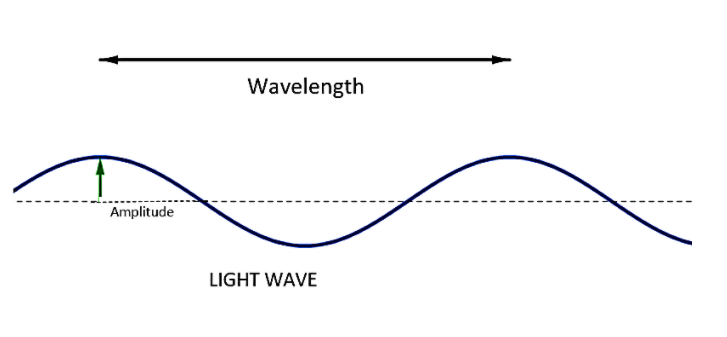
Hint: First of all the basic concepts of a light wave should be known. Light is a transverse wave in which the particles are vibrating in the perpendicular direction of propagation of the wave. The media through which a transverse wave can pass should be known properly to answer this question. There are two answers for this question.
Complete step by step answer:
First of all let us take a look at the basic concepts of a light wave. Light is referred to as a transverse wave as well as an electromagnetic wave that can be visible by the typical human eye. Like all electromagnetic waves, light can travel through vacuum too. Light waves are able to travel through a vacuum, which do not need a medium to travel. In empty space or vacuum, the wave does not dissipate or grow smaller no matter how far it moves, since the wave is not making any interaction with anything else. As a wave gets travelled from a source, it will propagate outward in all directions. As it is not requiring any extra medium to be travelled, the media has no significance in the case of this propagation. Therefore even if it is a material medium, the light wave can travel. The only difference is that the velocity with which the propagation occurs will be different in different mediums. Therefore we can conclude that light can travel through a material medium and vacuum also.
So, the correct answers are “Option A and C”.
Note: The wave nature of light was first determined through experiments on diffraction and the interference. One of light's specific properties is that, in a transparent medium like air, glass it can travel in a straight line. Light is exhibiting characteristics of both waves and particles which is explained as packets of energy called photons.
Complete step by step answer:
First of all let us take a look at the basic concepts of a light wave. Light is referred to as a transverse wave as well as an electromagnetic wave that can be visible by the typical human eye. Like all electromagnetic waves, light can travel through vacuum too. Light waves are able to travel through a vacuum, which do not need a medium to travel. In empty space or vacuum, the wave does not dissipate or grow smaller no matter how far it moves, since the wave is not making any interaction with anything else. As a wave gets travelled from a source, it will propagate outward in all directions. As it is not requiring any extra medium to be travelled, the media has no significance in the case of this propagation. Therefore even if it is a material medium, the light wave can travel. The only difference is that the velocity with which the propagation occurs will be different in different mediums. Therefore we can conclude that light can travel through a material medium and vacuum also.
So, the correct answers are “Option A and C”.
Note: The wave nature of light was first determined through experiments on diffraction and the interference. One of light's specific properties is that, in a transparent medium like air, glass it can travel in a straight line. Light is exhibiting characteristics of both waves and particles which is explained as packets of energy called photons.
Recently Updated Pages
Master Class 12 Business Studies: Engaging Questions & Answers for Success

Master Class 12 Biology: Engaging Questions & Answers for Success
Master Class 12 Chemistry: Engaging Questions & Answers for Success
Class 12 Question and Answer - Your Ultimate Solutions Guide
Master Class 11 Social Science: Engaging Questions & Answers for Success
Master Class 11 English: Engaging Questions & Answers for Success
Trending doubts
Which is more stable and why class 12 chemistry CBSE
Which are the Top 10 Largest Countries of the World?
Draw a labelled sketch of the human eye class 12 physics CBSE
Differentiate between homogeneous and heterogeneous class 12 chemistry CBSE
What are the major means of transport Explain each class 12 social science CBSE
Sulphuric acid is known as the king of acids State class 12 chemistry CBSE