




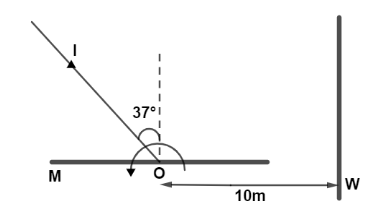
A light ray I is incident on a plane mirror M. The mirror is rotated in direction as shown in figure by an arrow at frequency $\dfrac{9}{\pi }rpm$ the light reflected by mirror is received on the wall at a distance of $10m$ from the axis of rotation. When the angle of incidence becomes $37^\circ $ the speed of the spot a point) on the wall is
A. $10\,m{\sec ^{ - 1}}$
B. $1000\,m{\sec ^{ - 1}}$
C. $500\,m{\sec ^{ - 1}}$
D. None of these
Answer
 Verified
516.9k+ views
Hint: in order to solve this question we need to understand the rotation of reflected light if the plane mirror is rotated. So first a plane mirror is a regular reflection surface from one side and the other side of the mirror is silvered. Now when an incident light falls on a plane mirror at some angle with normal then it gets reflected at the same angle. However, if a plane mirror is rotated by some angle the normal also shifts by the same angle and hence the reflected ray rotates by twice the angle of rotation of the mirror.
Complete step by step answer:
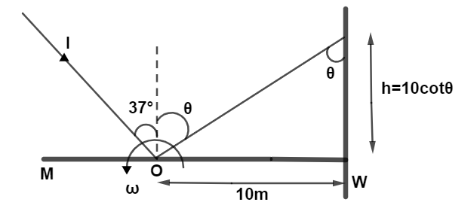
We know that the reflected ray rotates by twice the angle of rotation of the mirror. Since the angular frequency is directly proportional to angle of rotation so if the plane mirror rotates by an angle $\theta $ or with angular velocity $\omega $ then the reflected ray rotates by an angle $2\theta $ or with angular velocity, $\omega ' = 2\omega $
Given frequency, $f = \dfrac{9}{\pi }{\sec ^{ - 1}}$
So $\omega = 2\pi f$
Putting values we get, $\omega = 2\pi \times \dfrac{9}{\pi }$
$\omega = 18rad{\sec ^{ - 1}}$
So reflected rotates by, $\omega ' = 2\omega $
Putting values we get, $\omega ' = 2 \times 18$
$\omega ' = 36\,rad\,{\sec ^{ - 1}}$
Since, $\omega ' = \left| {\dfrac{{d\theta }}{{dt}}} \right|$
$\left| {\dfrac{{d\theta }}{{dt}}} \right| = 36\,rad\,{\sec ^{ - 1}} \to (ii)$
So from trigonometric ratio we can see from diagram, $h = 10\cot \theta $
Here, $h$ is the height of the spot on the wall.
Speed of spot is given by $v = \left| {\dfrac{{dh}}{{dt}}} \right| \to (i)$
Differentiating h with respect to t we get, $\left| {\dfrac{{dh}}{{dt}}} \right| = \left| {\dfrac{{d(10\cot \theta )}}{{dt}}} \right|$
$\left| {\dfrac{{dh}}{{dt}}} \right| = \left| { - 10\cos e{c^2}\theta \dfrac{{d(\theta )}}{{dt}}} \right|$
Since the incident light is at angle $\theta = 37^\circ $. Putting values we get,
$\left| {\dfrac{{dh}}{{dt}}} \right| = \left| { - 10\cos e{c^2}37\dfrac{{d(\theta )}}{{dt}}} \right|$
$\Rightarrow \left| {\dfrac{{dh}}{{dt}}} \right| = \left| { - \dfrac{{10}}{{0.36}}\dfrac{{d(\theta )}}{{dt}}} \right|$
Using (ii) we get,
$\left| {\dfrac{{dh}}{{dt}}} \right| = \left| { - \dfrac{{10}}{{0.36}} \times 36} \right|$
$\therefore \left| {\dfrac{{dh}}{{dt}}} \right| = 1000\,m{\sec ^{ - 1}}$
Using value of $\left| {\dfrac{{dh}}{{dt}}} \right|$ in equation (i) we get, $v = 1000\,m{\sec ^{ - 1}}$
So the correct option is B.
Note: It should be remembered that while the rotation of the reflected ray also rotates, the image size always remains constant and hence the image always forms on spot. Also plane mirrors emphasize regular reflection while in real life we often encounter diffuse reflection. As regular reflection is one in which incident angle is equal to reflected angle while in diffuse reflection it is not equal to reflected angle. Also the angle should always be measured from normal.
Complete step by step answer:
We know that the reflected ray rotates by twice the angle of rotation of the mirror. Since the angular frequency is directly proportional to angle of rotation so if the plane mirror rotates by an angle $\theta $ or with angular velocity $\omega $ then the reflected ray rotates by an angle $2\theta $ or with angular velocity, $\omega ' = 2\omega $
Given frequency, $f = \dfrac{9}{\pi }{\sec ^{ - 1}}$
So $\omega = 2\pi f$
Putting values we get, $\omega = 2\pi \times \dfrac{9}{\pi }$
$\omega = 18rad{\sec ^{ - 1}}$
So reflected rotates by, $\omega ' = 2\omega $
Putting values we get, $\omega ' = 2 \times 18$
$\omega ' = 36\,rad\,{\sec ^{ - 1}}$
Since, $\omega ' = \left| {\dfrac{{d\theta }}{{dt}}} \right|$
$\left| {\dfrac{{d\theta }}{{dt}}} \right| = 36\,rad\,{\sec ^{ - 1}} \to (ii)$
So from trigonometric ratio we can see from diagram, $h = 10\cot \theta $
Here, $h$ is the height of the spot on the wall.
Speed of spot is given by $v = \left| {\dfrac{{dh}}{{dt}}} \right| \to (i)$
Differentiating h with respect to t we get, $\left| {\dfrac{{dh}}{{dt}}} \right| = \left| {\dfrac{{d(10\cot \theta )}}{{dt}}} \right|$
$\left| {\dfrac{{dh}}{{dt}}} \right| = \left| { - 10\cos e{c^2}\theta \dfrac{{d(\theta )}}{{dt}}} \right|$
Since the incident light is at angle $\theta = 37^\circ $. Putting values we get,
$\left| {\dfrac{{dh}}{{dt}}} \right| = \left| { - 10\cos e{c^2}37\dfrac{{d(\theta )}}{{dt}}} \right|$
$\Rightarrow \left| {\dfrac{{dh}}{{dt}}} \right| = \left| { - \dfrac{{10}}{{0.36}}\dfrac{{d(\theta )}}{{dt}}} \right|$
Using (ii) we get,
$\left| {\dfrac{{dh}}{{dt}}} \right| = \left| { - \dfrac{{10}}{{0.36}} \times 36} \right|$
$\therefore \left| {\dfrac{{dh}}{{dt}}} \right| = 1000\,m{\sec ^{ - 1}}$
Using value of $\left| {\dfrac{{dh}}{{dt}}} \right|$ in equation (i) we get, $v = 1000\,m{\sec ^{ - 1}}$
So the correct option is B.
Note: It should be remembered that while the rotation of the reflected ray also rotates, the image size always remains constant and hence the image always forms on spot. Also plane mirrors emphasize regular reflection while in real life we often encounter diffuse reflection. As regular reflection is one in which incident angle is equal to reflected angle while in diffuse reflection it is not equal to reflected angle. Also the angle should always be measured from normal.
Recently Updated Pages
Master Class 12 Business Studies: Engaging Questions & Answers for Success

Master Class 12 Chemistry: Engaging Questions & Answers for Success
Master Class 12 Biology: Engaging Questions & Answers for Success
Class 12 Question and Answer - Your Ultimate Solutions Guide
Master Class 11 English: Engaging Questions & Answers for Success
Master Class 11 Maths: Engaging Questions & Answers for Success
Trending doubts
Which is more stable and why class 12 chemistry CBSE
Which are the Top 10 Largest Countries of the World?
Draw a labelled sketch of the human eye class 12 physics CBSE
Differentiate between homogeneous and heterogeneous class 12 chemistry CBSE
What are the major means of transport Explain each class 12 social science CBSE
Sulphuric acid is known as the king of acids State class 12 chemistry CBSE