




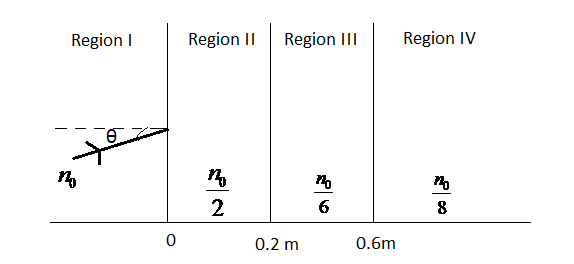
A light beam is travelling from Region I to Region IV (refer figure). The refractive indices in region I, II, III and IV are ${{n}_{0}}$, ${{n}_{0}}/2$, ${{n}_{0}}/6$ and ${{n}_{0}}/8$, respectively. The angle of incidence $\theta $ for which the beam just misses entering region IV is
$A)\ {{\sin }^{-1}}\left( 3/4 \right)$
$B)\ {{\sin }^{-1}}\left( 1/8 \right)$
$C)\ {{\sin }^{-1}}\left( 1/4 \right)$
$D)\ {{\sin }^{-1}}\left( 1/3 \right)$
Answer
 Verified
596.4k+ views
Hint: This problem can be solved by realizing that if the beam just misses entering the region IV, then the angle of incidence for the ray at the interface of region III and region IV must be the critical angle, the relation for which we can find out using Snell’s law for the preceding regions.
Formula used:
${{\theta }_{C}}={{\sin }^{-1}}\left( \dfrac{{{n}_{2}}}{{{n}_{1}}} \right)$
${{n}_{1}}\sin {{\theta }_{1}}={{n}_{2}}\sin {{\theta }_{2}}$
Complete step-by-step answer:
For the light ray to not enter the region IV which has a lower refractive index than region III, it must be internally reflected at the interface at the critical angle.
Let us draw a proper diagram to illustrate this.
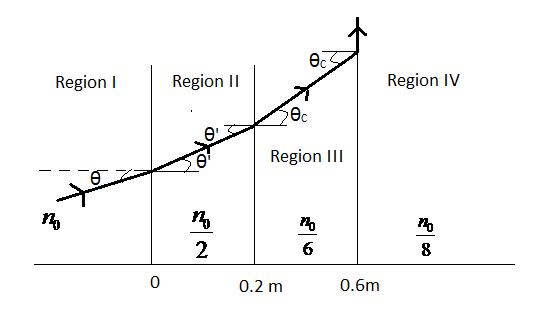
We have marked the angles and used the geometry and properties of alternate interior angles in doing so.
Now, according to Snell’s Law when light goes from a medium of refractive index ${{n}_{1}}$ to a medium of refractive index ${{n}_{2}}$, the angle of incidence ${{\theta }_{1}}$ is related to the angle of refraction ${{\theta }_{2}}$ as
${{n}_{1}}\sin {{\theta }_{1}}={{n}_{2}}\sin {{\theta }_{2}}$ --(1)
Also the critical angle ${{\theta }_{C}}$ for total internal reflection, when light goes from an optically denser medium of refractive index ${{n}_{1}}$ to an optically rarer medium of refractive index ${{n}_{2}}$ is given by
${{\theta }_{C}}={{\sin }^{-1}}\left( \dfrac{{{n}_{2}}}{{{n}_{1}}} \right)$ --(2)
Now, coming back to the question, when light goes from region I to region II, using (1), we get
${{n}_{0}}\sin \theta =\dfrac{{{n}_{0}}}{2}\sin \theta '$
$\therefore \sin \theta =\dfrac{1}{2}\sin \theta '$
$\therefore \sin \theta '=2\sin \theta $ --(3)
Now, when the light goes from region II to region III, using (1), we get
$\dfrac{{{n}_{0}}}{2}\sin \theta '=\dfrac{{{n}_{0}}}{6}\sin {{\theta }_{C}}$
$\therefore \sin \theta '=\dfrac{1}{3}\sin {{\theta }_{C}}$
$\therefore \sin {{\theta }_{C}}=3\sin \theta '$ --(4)
Now, using (2), we get
${{\theta }_{C}}={{\sin }^{-1}}\left( \dfrac{\dfrac{{{n}_{0}}}{8}}{\dfrac{{{n}_{0}}}{6}} \right)={{\sin }^{-1}}\left( \dfrac{6}{8} \right)={{\sin }^{-1}}\left( \dfrac{3}{4} \right)$
$\therefore \sin {{\theta }_{C}}=\dfrac{3}{4}$ --(5)
Putting (5) in (4), we get
$\dfrac{3}{4}=3\sin \theta '$ --(6)
Putting (3) in (6), we get
$\dfrac{3}{4}=3\left( 2\sin \theta \right)$
$\therefore \sin \theta =\dfrac{1}{8}$
$\therefore \theta ={{\sin }^{-1}}\left( \dfrac{1}{8} \right)$
Therefore, the required value of $\theta $ is ${{\sin }^{-1}}\left( \dfrac{1}{8} \right)$.
Therefore, the correct option is $B)\ {{\sin }^{-1}}\left( 1/8 \right)$.
Note: Students might get confused upon seeing the lengths of the region in the figure given in the question. However, they must understand that the critical angle and in general the angles of incidence and refraction have nothing to do with the lengths of the medium but only depend upon their refractive indices. The lengths are given just to confuse students who are not clear with their concepts and make them feel nervous about attempting the question.
Formula used:
${{\theta }_{C}}={{\sin }^{-1}}\left( \dfrac{{{n}_{2}}}{{{n}_{1}}} \right)$
${{n}_{1}}\sin {{\theta }_{1}}={{n}_{2}}\sin {{\theta }_{2}}$
Complete step-by-step answer:
For the light ray to not enter the region IV which has a lower refractive index than region III, it must be internally reflected at the interface at the critical angle.
Let us draw a proper diagram to illustrate this.
We have marked the angles and used the geometry and properties of alternate interior angles in doing so.
Now, according to Snell’s Law when light goes from a medium of refractive index ${{n}_{1}}$ to a medium of refractive index ${{n}_{2}}$, the angle of incidence ${{\theta }_{1}}$ is related to the angle of refraction ${{\theta }_{2}}$ as
${{n}_{1}}\sin {{\theta }_{1}}={{n}_{2}}\sin {{\theta }_{2}}$ --(1)
Also the critical angle ${{\theta }_{C}}$ for total internal reflection, when light goes from an optically denser medium of refractive index ${{n}_{1}}$ to an optically rarer medium of refractive index ${{n}_{2}}$ is given by
${{\theta }_{C}}={{\sin }^{-1}}\left( \dfrac{{{n}_{2}}}{{{n}_{1}}} \right)$ --(2)
Now, coming back to the question, when light goes from region I to region II, using (1), we get
${{n}_{0}}\sin \theta =\dfrac{{{n}_{0}}}{2}\sin \theta '$
$\therefore \sin \theta =\dfrac{1}{2}\sin \theta '$
$\therefore \sin \theta '=2\sin \theta $ --(3)
Now, when the light goes from region II to region III, using (1), we get
$\dfrac{{{n}_{0}}}{2}\sin \theta '=\dfrac{{{n}_{0}}}{6}\sin {{\theta }_{C}}$
$\therefore \sin \theta '=\dfrac{1}{3}\sin {{\theta }_{C}}$
$\therefore \sin {{\theta }_{C}}=3\sin \theta '$ --(4)
Now, using (2), we get
${{\theta }_{C}}={{\sin }^{-1}}\left( \dfrac{\dfrac{{{n}_{0}}}{8}}{\dfrac{{{n}_{0}}}{6}} \right)={{\sin }^{-1}}\left( \dfrac{6}{8} \right)={{\sin }^{-1}}\left( \dfrac{3}{4} \right)$
$\therefore \sin {{\theta }_{C}}=\dfrac{3}{4}$ --(5)
Putting (5) in (4), we get
$\dfrac{3}{4}=3\sin \theta '$ --(6)
Putting (3) in (6), we get
$\dfrac{3}{4}=3\left( 2\sin \theta \right)$
$\therefore \sin \theta =\dfrac{1}{8}$
$\therefore \theta ={{\sin }^{-1}}\left( \dfrac{1}{8} \right)$
Therefore, the required value of $\theta $ is ${{\sin }^{-1}}\left( \dfrac{1}{8} \right)$.
Therefore, the correct option is $B)\ {{\sin }^{-1}}\left( 1/8 \right)$.
Note: Students might get confused upon seeing the lengths of the region in the figure given in the question. However, they must understand that the critical angle and in general the angles of incidence and refraction have nothing to do with the lengths of the medium but only depend upon their refractive indices. The lengths are given just to confuse students who are not clear with their concepts and make them feel nervous about attempting the question.
Recently Updated Pages
Master Class 12 Economics: Engaging Questions & Answers for Success

Master Class 12 Physics: Engaging Questions & Answers for Success
Master Class 12 English: Engaging Questions & Answers for Success
Master Class 12 Social Science: Engaging Questions & Answers for Success
Master Class 12 Maths: Engaging Questions & Answers for Success
Master Class 12 Business Studies: Engaging Questions & Answers for Success
Trending doubts
Which are the Top 10 Largest Countries of the World?
What are the major means of transport Explain each class 12 social science CBSE
Draw a labelled sketch of the human eye class 12 physics CBSE
Why cannot DNA pass through cell membranes class 12 biology CBSE
Differentiate between insitu conservation and exsitu class 12 biology CBSE
Draw a neat and well labeled diagram of TS of ovary class 12 biology CBSE