




A light beam emanating from the point (3, 10) reflects from the straight line 2x+y-6 = 0 then passes through the point (7, 2). Find the equations of the incident and reflected rays.
Answer
 Verified
671.7k+ views
Hint: Let the points (3, 10) and (7, 2) be A and B respectively. We will find the slope of the line ax+by+c = 0 using $\dfrac{-a}{b}$and the slope of the line joining points $A\left( 3,10 \right)\text{ and }B\left( 7,2 \right)$using slope of line joining\[A\left( {{x}_{1}},{{y}_{1}} \right)\text{ and B}\left( {{x}_{2}},{{y}_{2}} \right)\text{ is }=\dfrac{\left( {{y}_{2}}-{{y}_{1}} \right)}{\left( {{x}_{2}}-{{x}_{1}} \right)}.\] If we observe carefully, the line joining A and B is parallel to the given line 2x+y-6 = 0. Let the mid-point of the line segment is D and the point of reflection is C. By using the alternate angle property which states that the alternate angles formed by a transversal at the intersection of two parallel lines are equal, we can conclude that the two triangles$\Delta ACD\text{ , }\Delta BCD$ are congruent and we can conclude that the point of reflection ‘C’ will be the foot of perpendicular from the midpoint ‘D’ of the line segment AB to the given line.
Foot of perpendicular from the point is given by
\[\begin{align}
& \left( {{x}_{1}},{{y}_{1}} \right)\text{ to the line }ax+by+c=0\text{ is given by the formula} \\
& \dfrac{x-{{x}_{1}}}{a}=\dfrac{y-{{y}_{1}}}{b}=\dfrac{-\left( a{{x}_{1}}+b{{y}_{2}}+c \right)}{{{a}^{2}}+{{b}^{2}}} \\
\end{align}\]
After getting the coordinates of C, we can use the points A, B and C to get the required line equations.
Complete step-by-step answer:
Given line L: 2x+y-6 = 0 and the points A (3, 10) and B (7, 2). Let the point of reflection be
C$({{x}_{1}},{{y}_{1}})$.
Slope of a line ax+by+c = 0 is $\dfrac{-a}{b}$
Using the formula, slope of the given line L=0 is $\dfrac{-2}{1}=-2$
Slope of line joining the points$A\left( {{x}_{1}},{{y}_{1}} \right)\text{ and B}\left( {{x}_{2}},{{y}_{2}} \right)\text{ is }=\dfrac{\left( {{y}_{2}}-{{y}_{1}} \right)}{\left( {{x}_{2}}-{{x}_{1}} \right)}$.
Using the formula , slope of the line joining the points A and B is = $\dfrac{\left( 2-10 \right)}{\left( 7-3 \right)}=\dfrac{-8}{4}=-2$. As the slopes are equal, we can conclude that the lines L=0 and AB are parallel.
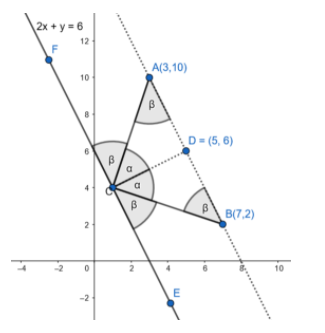
In the above figure, the lines AC and BC act as transversals for the parallel lines L=0 and AB.
From the property of alternate angles in parallel lines, we can conclude that
$\angle BAC=\angle ACF=\angle ABC=\angle BCE=\beta $
Let D be the point which is the point of intersection of the normal to the line L=0 at C and AB
From the property of reflection, $\angle ACD=\angle BCD$.
From the above properties and the common side CD we can conclude that$\Delta ACD\text{ and }\Delta BCD\text{ are congruent}$ and from this, we can conclude that D is the mid-point of AB.
Mid-point of $\left( {{x}_{1}},{{y}_{1}} \right)\text{ and }\left( {{x}_{2}},{{y}_{2}} \right)\text{ is equal to }\left( \dfrac{{{x}_{1}}+{{x}_{2}}}{2},\dfrac{{{y}_{1}}+{{y}_{2}}}{2} \right)$
Using the formula, we get D=$\left( \dfrac{3+7}{2},\dfrac{10+2}{2} \right)=\left( 5,6 \right)$
We know that C is the foot of perpendicular from the point D to the line L=0.
Foot of perpendicular from the point is given by
\[\begin{align}
& \left( {{x}_{1}},{{y}_{1}} \right)\text{ to the line }ax+by+c=0\text{ is given by the formula} \\
& \dfrac{x-{{x}_{1}}}{a}=\dfrac{y-{{y}_{1}}}{b}=\dfrac{-\left( a{{x}_{1}}+b{{y}_{2}}+c \right)}{{{a}^{2}}+{{b}^{2}}} \\
\end{align}\]
Applying the formula, we get the co-ordinates of C,
\[\begin{align}
& \dfrac{x-5}{2}=\dfrac{y-6}{1}=\dfrac{-\left( 2\times 5+1\times 6-6 \right)}{{{2}^{2}}+{{1}^{2}}} \\
& \dfrac{x-5}{2}=\dfrac{y-6}{1}=\dfrac{-\left( 10 \right)}{5} \\
& \dfrac{x-5}{2}=\dfrac{y-6}{1}=-2 \\
& x-5=-2\times 2\text{ ; }y-6=-2 \\
& x=5-4=1\text{ ; }y=6-2=4 \\
& \therefore \text{ C is (1,4)}\text{.} \\
\end{align}\]
The equation of the incident ray is given by the line AC and the equation of the reflected ray is given by the line BC.
Equation of a line passing through
\[\begin{align}
& \left( {{x}_{1}},{{y}_{1}} \right)\text{ and }\left( {{x}_{2}},{{y}_{2}} \right)\text{ is given by } \\
& y-{{y}_{1}}=\left( \dfrac{{{y}_{2}}-{{y}_{1}}}{{{x}_{2}}-{{x}_{1}}} \right)\left( x-{{x}_{1}} \right) \\
\end{align}\]
Applying the above formula to get equation of line AC as
\[\begin{align}
& y-10=\left( \dfrac{4-10}{1-3} \right)\left( x-3 \right) \\
& y-10=\left( \dfrac{-6}{-2} \right)\left( x-3 \right) \\
& y-10=\left( 3 \right)\left( x-3 \right) \\
& y-10=3x-9 \\
& 3x-y+1=0 \\
& \\
\end{align}\]
Equation of line BC can be obtained as
\[\begin{align}
& y-2=\left( \dfrac{4-2}{1-7} \right)\left( x-7 \right) \\
& y-2=\left( \dfrac{2}{-6} \right)\left( x-7 \right) \\
\end{align}\]
\[\begin{align}
& y-2=\left( \dfrac{-1}{3} \right)\left( x-7 \right) \\
& 3y-6=-x+7 \\
& x+3y-13=0 \\
\end{align}\]
$\therefore \text{ The incident and reflected rays are given by }3x-y+1=0\text{ and }x+3y-13=0\text{ respectively}\text{.}$
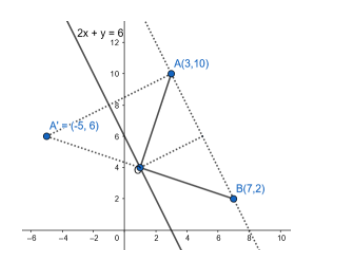
Note: An alternate way of doing this is by the property that the image of the point A with respect to the line L=0 will lie on the reflected line BC which gives us 2 points A’ and B to get the equation of reflected ray and with a similar approach we can get the incident ray.
Foot of perpendicular from the point is given by
\[\begin{align}
& \left( {{x}_{1}},{{y}_{1}} \right)\text{ to the line }ax+by+c=0\text{ is given by the formula} \\
& \dfrac{x-{{x}_{1}}}{a}=\dfrac{y-{{y}_{1}}}{b}=\dfrac{-\left( a{{x}_{1}}+b{{y}_{2}}+c \right)}{{{a}^{2}}+{{b}^{2}}} \\
\end{align}\]
After getting the coordinates of C, we can use the points A, B and C to get the required line equations.
Complete step-by-step answer:
Given line L: 2x+y-6 = 0 and the points A (3, 10) and B (7, 2). Let the point of reflection be
C$({{x}_{1}},{{y}_{1}})$.
Slope of a line ax+by+c = 0 is $\dfrac{-a}{b}$
Using the formula, slope of the given line L=0 is $\dfrac{-2}{1}=-2$
Slope of line joining the points$A\left( {{x}_{1}},{{y}_{1}} \right)\text{ and B}\left( {{x}_{2}},{{y}_{2}} \right)\text{ is }=\dfrac{\left( {{y}_{2}}-{{y}_{1}} \right)}{\left( {{x}_{2}}-{{x}_{1}} \right)}$.
Using the formula , slope of the line joining the points A and B is = $\dfrac{\left( 2-10 \right)}{\left( 7-3 \right)}=\dfrac{-8}{4}=-2$. As the slopes are equal, we can conclude that the lines L=0 and AB are parallel.
In the above figure, the lines AC and BC act as transversals for the parallel lines L=0 and AB.
From the property of alternate angles in parallel lines, we can conclude that
$\angle BAC=\angle ACF=\angle ABC=\angle BCE=\beta $
Let D be the point which is the point of intersection of the normal to the line L=0 at C and AB
From the property of reflection, $\angle ACD=\angle BCD$.
From the above properties and the common side CD we can conclude that$\Delta ACD\text{ and }\Delta BCD\text{ are congruent}$ and from this, we can conclude that D is the mid-point of AB.
Mid-point of $\left( {{x}_{1}},{{y}_{1}} \right)\text{ and }\left( {{x}_{2}},{{y}_{2}} \right)\text{ is equal to }\left( \dfrac{{{x}_{1}}+{{x}_{2}}}{2},\dfrac{{{y}_{1}}+{{y}_{2}}}{2} \right)$
Using the formula, we get D=$\left( \dfrac{3+7}{2},\dfrac{10+2}{2} \right)=\left( 5,6 \right)$
We know that C is the foot of perpendicular from the point D to the line L=0.
Foot of perpendicular from the point is given by
\[\begin{align}
& \left( {{x}_{1}},{{y}_{1}} \right)\text{ to the line }ax+by+c=0\text{ is given by the formula} \\
& \dfrac{x-{{x}_{1}}}{a}=\dfrac{y-{{y}_{1}}}{b}=\dfrac{-\left( a{{x}_{1}}+b{{y}_{2}}+c \right)}{{{a}^{2}}+{{b}^{2}}} \\
\end{align}\]
Applying the formula, we get the co-ordinates of C,
\[\begin{align}
& \dfrac{x-5}{2}=\dfrac{y-6}{1}=\dfrac{-\left( 2\times 5+1\times 6-6 \right)}{{{2}^{2}}+{{1}^{2}}} \\
& \dfrac{x-5}{2}=\dfrac{y-6}{1}=\dfrac{-\left( 10 \right)}{5} \\
& \dfrac{x-5}{2}=\dfrac{y-6}{1}=-2 \\
& x-5=-2\times 2\text{ ; }y-6=-2 \\
& x=5-4=1\text{ ; }y=6-2=4 \\
& \therefore \text{ C is (1,4)}\text{.} \\
\end{align}\]
The equation of the incident ray is given by the line AC and the equation of the reflected ray is given by the line BC.
Equation of a line passing through
\[\begin{align}
& \left( {{x}_{1}},{{y}_{1}} \right)\text{ and }\left( {{x}_{2}},{{y}_{2}} \right)\text{ is given by } \\
& y-{{y}_{1}}=\left( \dfrac{{{y}_{2}}-{{y}_{1}}}{{{x}_{2}}-{{x}_{1}}} \right)\left( x-{{x}_{1}} \right) \\
\end{align}\]
Applying the above formula to get equation of line AC as
\[\begin{align}
& y-10=\left( \dfrac{4-10}{1-3} \right)\left( x-3 \right) \\
& y-10=\left( \dfrac{-6}{-2} \right)\left( x-3 \right) \\
& y-10=\left( 3 \right)\left( x-3 \right) \\
& y-10=3x-9 \\
& 3x-y+1=0 \\
& \\
\end{align}\]
Equation of line BC can be obtained as
\[\begin{align}
& y-2=\left( \dfrac{4-2}{1-7} \right)\left( x-7 \right) \\
& y-2=\left( \dfrac{2}{-6} \right)\left( x-7 \right) \\
\end{align}\]
\[\begin{align}
& y-2=\left( \dfrac{-1}{3} \right)\left( x-7 \right) \\
& 3y-6=-x+7 \\
& x+3y-13=0 \\
\end{align}\]
$\therefore \text{ The incident and reflected rays are given by }3x-y+1=0\text{ and }x+3y-13=0\text{ respectively}\text{.}$
Note: An alternate way of doing this is by the property that the image of the point A with respect to the line L=0 will lie on the reflected line BC which gives us 2 points A’ and B to get the equation of reflected ray and with a similar approach we can get the incident ray.
Recently Updated Pages
Explain the structure of megasporangium class 12 biology CBSE

Why is chloroform kept in dark coloured bottles class 12 chemistry CBSE
Derive the balancing condition of a Wheatstone bri class 12 physics CBSE
Draw VI characteristics of a pn junction diode Explain class 12 physics CBSE
Is it possible to carry pride in ones language too class 12 english CBSE
In a population at Hardy Weinberg equilibrium the allele class 12 biology CBSE
Trending doubts
Draw a labelled sketch of the human eye class 12 physics CBSE
Which are the Top 10 Largest Countries of the World?
Draw ray diagrams each showing i myopic eye and ii class 12 physics CBSE
One megawatt is equal to how many units of electri class 12 physics CBSE
Which is the correct genotypic ratio of mendel dihybrid class 12 biology CBSE
Give 10 examples of unisexual and bisexual flowers