




A letter ‘A’ is constructed of a uniform wire of resistance \[1\,ohm/cm\]. The sides of the letter are \[20\,{\text{cm}}\] long and cross piece in the middle is \[10\,{\text{cm}}\] long while the vertex angle is \[60^\circ \]. The resistance of the letter between the two ends of the legs is:
A. \[\dfrac{{40}}{3}\,\Omega \]
B. \[\dfrac{{80}}{3}\,\Omega \]
C. \[40\,\Omega \]
D. \[10\,\Omega \]
Answer
 Verified
576.9k+ views
Hint: First determine the length of the each part of the wire used to construct letter A. From these lengths, determine the resistance of all the resistance in the letter A. Then draw the equivalent circuit diagram of the circuit formed using resistances in the letter A. Then calculate the net resistance in the circuit using the formula for equivalent resistance of the resistors in series and parallel arrangement.
Formulae used:
The equivalent resistance \[{R_{eq}}\] of the two resistors \[{R_1}\] and \[{R_2}\] connected in series is
\[{R_{eq}} = {R_1} + {R_2}\] …… (1)
The equivalent resistance \[{R_{eq}}\] of the two resistors \[{R_1}\] and \[{R_2}\] connected in parallel is
\[\dfrac{1}{{{R_{eq}}}} = \dfrac{1}{{{R_1}}} + \dfrac{1}{{{R_2}}}\] …… (2)
Complete step by step answer:
We have given that the letter ‘A’ is constructed using a uniform wire of resistance \[1\,ohm/cm\].
\[\dfrac{R}{L} = 1\,ohm/cm\]
The length of the sides of the letter is \[20\,{\text{cm}}\] and the length of the cross piece in the middle is \[10\,{\text{cm}}\]. We have asked to calculate the resistance between the two ends of the legs of letter A. Let us first draw the diagram of the letter A with a simplified equivalent circuit diagram.
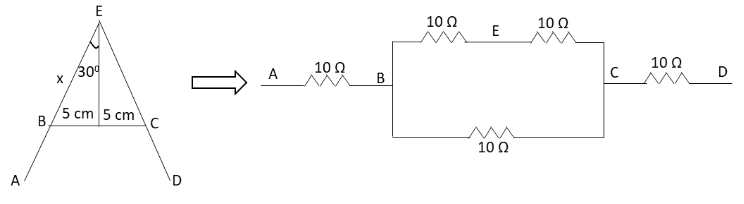
From the above diagram, let us find out the value of x. According to the trigonometric relations, we can write
\[\sin 30^\circ = \dfrac{5}{x}\]
\[ \Rightarrow \dfrac{1}{2} = \dfrac{5}{x}\]
\[ \Rightarrow x = 10\,{\text{cm}}\]
From the above diagram, we can also write
\[{\text{AB}} = {\text{CD}} = {\text{AE}} - x\]
\[ \Rightarrow {\text{AB}} = {\text{CD}} = \left( {20\,{\text{cm}}} \right) - \left( {10\,{\text{cm}}} \right)\]
\[ \Rightarrow {\text{AB}} = {\text{CD}} = 10\,{\text{cm}}\]
The length of every distinct part used in the letter A is the same which is \[10\,{\text{cm}}\].
The resistance of the resistances in the wire is
\[\dfrac{R}{{10\,{\text{cm}}}} = 1\,{\text{ohm/cm}}\]
\[ \Rightarrow R = 10\,\Omega \]
Hence, the resistance of each resistance in every part of the letter A is \[10\,\Omega \].
Let us first determine the equivalent resistance between the points B and C.The equivalent resistance of the upper two resistance according to equation (1) is
\[R' = 10\,\Omega + 10\,\Omega \]
\[ \Rightarrow R' = 20\,\Omega \]
The net resistance across the points B and C according to equation (2) is
\[\dfrac{1}{{{R_{BC}}}} = \dfrac{1}{{10\,\Omega }} + \dfrac{1}{{20\,\Omega }}\]
\[ \Rightarrow {R_{BC}} = \dfrac{{200}}{{30}}\]
\[ \Rightarrow {R_{BC}} = \dfrac{{20}}{3}\,\Omega \]
Hence, the equivalent resistance between the points B and C is \[\dfrac{{20}}{3}\,\Omega \].
Now the net resistance in the whole circuit is
\[{R_{eq}} = 10\,\Omega + \dfrac{{20}}{3}\,\Omega + 10\,\Omega \]
\[ \therefore {R_{eq}} = \dfrac{{80}}{3}\,\Omega \]
Therefore, the resistance of the letter between the two ends of the legs is \[\dfrac{{80}}{3}\,\Omega \].
Hence, the correct option is B.
Note: The students should keep in mind that we have given the value of resistance per unit length and not the resistance of the wire used. Also there are different parts of the wire formed for the construction of the letter A and the resistances for the different parts are considered differently which has the same value as the lengths of the different parts of the wire is the same.
Formulae used:
The equivalent resistance \[{R_{eq}}\] of the two resistors \[{R_1}\] and \[{R_2}\] connected in series is
\[{R_{eq}} = {R_1} + {R_2}\] …… (1)
The equivalent resistance \[{R_{eq}}\] of the two resistors \[{R_1}\] and \[{R_2}\] connected in parallel is
\[\dfrac{1}{{{R_{eq}}}} = \dfrac{1}{{{R_1}}} + \dfrac{1}{{{R_2}}}\] …… (2)
Complete step by step answer:
We have given that the letter ‘A’ is constructed using a uniform wire of resistance \[1\,ohm/cm\].
\[\dfrac{R}{L} = 1\,ohm/cm\]
The length of the sides of the letter is \[20\,{\text{cm}}\] and the length of the cross piece in the middle is \[10\,{\text{cm}}\]. We have asked to calculate the resistance between the two ends of the legs of letter A. Let us first draw the diagram of the letter A with a simplified equivalent circuit diagram.
From the above diagram, let us find out the value of x. According to the trigonometric relations, we can write
\[\sin 30^\circ = \dfrac{5}{x}\]
\[ \Rightarrow \dfrac{1}{2} = \dfrac{5}{x}\]
\[ \Rightarrow x = 10\,{\text{cm}}\]
From the above diagram, we can also write
\[{\text{AB}} = {\text{CD}} = {\text{AE}} - x\]
\[ \Rightarrow {\text{AB}} = {\text{CD}} = \left( {20\,{\text{cm}}} \right) - \left( {10\,{\text{cm}}} \right)\]
\[ \Rightarrow {\text{AB}} = {\text{CD}} = 10\,{\text{cm}}\]
The length of every distinct part used in the letter A is the same which is \[10\,{\text{cm}}\].
The resistance of the resistances in the wire is
\[\dfrac{R}{{10\,{\text{cm}}}} = 1\,{\text{ohm/cm}}\]
\[ \Rightarrow R = 10\,\Omega \]
Hence, the resistance of each resistance in every part of the letter A is \[10\,\Omega \].
Let us first determine the equivalent resistance between the points B and C.The equivalent resistance of the upper two resistance according to equation (1) is
\[R' = 10\,\Omega + 10\,\Omega \]
\[ \Rightarrow R' = 20\,\Omega \]
The net resistance across the points B and C according to equation (2) is
\[\dfrac{1}{{{R_{BC}}}} = \dfrac{1}{{10\,\Omega }} + \dfrac{1}{{20\,\Omega }}\]
\[ \Rightarrow {R_{BC}} = \dfrac{{200}}{{30}}\]
\[ \Rightarrow {R_{BC}} = \dfrac{{20}}{3}\,\Omega \]
Hence, the equivalent resistance between the points B and C is \[\dfrac{{20}}{3}\,\Omega \].
Now the net resistance in the whole circuit is
\[{R_{eq}} = 10\,\Omega + \dfrac{{20}}{3}\,\Omega + 10\,\Omega \]
\[ \therefore {R_{eq}} = \dfrac{{80}}{3}\,\Omega \]
Therefore, the resistance of the letter between the two ends of the legs is \[\dfrac{{80}}{3}\,\Omega \].
Hence, the correct option is B.
Note: The students should keep in mind that we have given the value of resistance per unit length and not the resistance of the wire used. Also there are different parts of the wire formed for the construction of the letter A and the resistances for the different parts are considered differently which has the same value as the lengths of the different parts of the wire is the same.
Recently Updated Pages
Three beakers labelled as A B and C each containing 25 mL of water were taken A small amount of NaOH anhydrous CuSO4 and NaCl were added to the beakers A B and C respectively It was observed that there was an increase in the temperature of the solutions contained in beakers A and B whereas in case of beaker C the temperature of the solution falls Which one of the following statements isarecorrect i In beakers A and B exothermic process has occurred ii In beakers A and B endothermic process has occurred iii In beaker C exothermic process has occurred iv In beaker C endothermic process has occurred

Master Class 12 Social Science: Engaging Questions & Answers for Success
Master Class 12 Physics: Engaging Questions & Answers for Success
Master Class 12 Maths: Engaging Questions & Answers for Success
Master Class 12 Economics: Engaging Questions & Answers for Success
Master Class 12 Chemistry: Engaging Questions & Answers for Success
Three beakers labelled as A B and C each containing 25 mL of water were taken A small amount of NaOH anhydrous CuSO4 and NaCl were added to the beakers A B and C respectively It was observed that there was an increase in the temperature of the solutions contained in beakers A and B whereas in case of beaker C the temperature of the solution falls Which one of the following statements isarecorrect i In beakers A and B exothermic process has occurred ii In beakers A and B endothermic process has occurred iii In beaker C exothermic process has occurred iv In beaker C endothermic process has occurred
Master Class 12 Social Science: Engaging Questions & Answers for Success
Master Class 12 Physics: Engaging Questions & Answers for Success
Trending doubts
Which are the Top 10 Largest Countries of the World?
Draw a labelled sketch of the human eye class 12 physics CBSE
Explain the structure of megasporangium class 12 biology CBSE
What are the major means of transport Explain each class 12 social science CBSE
Differentiate between homogeneous and heterogeneous class 12 chemistry CBSE
Sulphuric acid is known as the king of acids State class 12 chemistry CBSE