




A length of wire carries a steady current, is bent first to form a plane circular coil of one turn, same length now bent more sharply to give three turns of smaller radius. Magnetic field becomes at centre:
A) 3 times
B) 1/3 times
C) 9 times
D) Unchanged
Answer
 Verified
599.1k+ views
Hint: When a current carrying conductor is placed in space, a magnetic field is produced around it. In order to calculate the magnitude of the magnetic field, we have to use the Biot Savart’s law and apply it for the case of a circular coil with n turns. The mathematical form of Biot Savart’s law is given by:
Magnetic field at point at a distance of r, due to current carrying line element, $Idl$
$dB = \dfrac{{{\mu _0}}}{{4\pi }}\dfrac{{I \cdot dl}}{{{r^3}}}$
where ${\mu _0}$ = absolute permeability.
Complete answer:
Biot Savart’s law gives us an insight about the term magnetic field that arises due to presence of electric current.
Consider a line element in a conductor $dl$ through which current is flowing and an arbitrary point P at a distance of r from the conductor
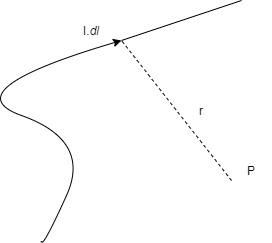
It states that, the magnetic field due to the line element $dl$is given by –
$dB \propto \dfrac{{I \cdot dl}}{{{r^3}}}$
By removing the proportionality symbol , we have –
$dB = \dfrac{{{\mu _0}}}{{4\pi }}\dfrac{{I \cdot dl}}{{{r^3}}}$
where ${\mu _0}$ = absolute permeability.
By applying the Biot Savart’s law for a circular coil of n turns and integrating, we obtain the expression for the magnetic field at the centre of the coil as follows:
$\Rightarrow B = \dfrac{{{\mu _0}ni}}{{2r}}$
where ${\mu _0}$ = absolute permeability, $i$ = current flowing through the coil and r = radius of the coil.
Now, if the straight is bent into coil of one turn, the magnetic field at the centre of the coil of radius ${r_1}$ and number of turns, n = 1 is –
$\Rightarrow {B_1} = \dfrac{{{\mu _0}i}}{{2{r_1}}}$
Similarly, if the wire is bent three-times into radius ${r_2}$ ,
Number of turns, n = 3
The magnetic field at the centre due to the coil is given by –
$\Rightarrow {B_2} = \dfrac{{{\mu _0}3i}}{{2{r_2}}}$
Given that a single has been coiled into 3 turns from the same wire that is wound into a single turn, the radius becomes one-third of that of the coil of one turn. Hence,
$\Rightarrow {r_2} = \dfrac{{{r_1}}}{3}$
Substituting, we have –
$\Rightarrow {B_2} = \dfrac{{{\mu _0}3i}}{{2{r_1}}} \times 3$
By considering their ratio –
$\Rightarrow \dfrac{{{B_2}}}{{{B_1}}} = \dfrac{{\dfrac{{{\mu _0}3i}}{{2{r_1}}} \times 3}}{{\dfrac{{{\mu _0}i}}{{2{r_1}}}}} = 3 \times 3 = 9$
Thus, the magnetic field increases by 9 times.
Hence, the correct option is Option C.
Note: In competitive exams, for different numbers such as “same wire gives four, five or even six turns” , the students can use this shortcut. The magnetic field increases by the square of the number of turns mentioned in the question. For example, if the straight is turned n times, the magnetic field increases by ${n^2}$ times.
Magnetic field at point at a distance of r, due to current carrying line element, $Idl$
$dB = \dfrac{{{\mu _0}}}{{4\pi }}\dfrac{{I \cdot dl}}{{{r^3}}}$
where ${\mu _0}$ = absolute permeability.
Complete answer:
Biot Savart’s law gives us an insight about the term magnetic field that arises due to presence of electric current.
Consider a line element in a conductor $dl$ through which current is flowing and an arbitrary point P at a distance of r from the conductor
It states that, the magnetic field due to the line element $dl$is given by –
$dB \propto \dfrac{{I \cdot dl}}{{{r^3}}}$
By removing the proportionality symbol , we have –
$dB = \dfrac{{{\mu _0}}}{{4\pi }}\dfrac{{I \cdot dl}}{{{r^3}}}$
where ${\mu _0}$ = absolute permeability.
By applying the Biot Savart’s law for a circular coil of n turns and integrating, we obtain the expression for the magnetic field at the centre of the coil as follows:
$\Rightarrow B = \dfrac{{{\mu _0}ni}}{{2r}}$
where ${\mu _0}$ = absolute permeability, $i$ = current flowing through the coil and r = radius of the coil.
Now, if the straight is bent into coil of one turn, the magnetic field at the centre of the coil of radius ${r_1}$ and number of turns, n = 1 is –
$\Rightarrow {B_1} = \dfrac{{{\mu _0}i}}{{2{r_1}}}$
Similarly, if the wire is bent three-times into radius ${r_2}$ ,
Number of turns, n = 3
The magnetic field at the centre due to the coil is given by –
$\Rightarrow {B_2} = \dfrac{{{\mu _0}3i}}{{2{r_2}}}$
Given that a single has been coiled into 3 turns from the same wire that is wound into a single turn, the radius becomes one-third of that of the coil of one turn. Hence,
$\Rightarrow {r_2} = \dfrac{{{r_1}}}{3}$
Substituting, we have –
$\Rightarrow {B_2} = \dfrac{{{\mu _0}3i}}{{2{r_1}}} \times 3$
By considering their ratio –
$\Rightarrow \dfrac{{{B_2}}}{{{B_1}}} = \dfrac{{\dfrac{{{\mu _0}3i}}{{2{r_1}}} \times 3}}{{\dfrac{{{\mu _0}i}}{{2{r_1}}}}} = 3 \times 3 = 9$
Thus, the magnetic field increases by 9 times.
Hence, the correct option is Option C.
Note: In competitive exams, for different numbers such as “same wire gives four, five or even six turns” , the students can use this shortcut. The magnetic field increases by the square of the number of turns mentioned in the question. For example, if the straight is turned n times, the magnetic field increases by ${n^2}$ times.
Recently Updated Pages
Master Class 12 Economics: Engaging Questions & Answers for Success

Master Class 12 English: Engaging Questions & Answers for Success
Master Class 12 Social Science: Engaging Questions & Answers for Success
Master Class 12 Maths: Engaging Questions & Answers for Success
Master Class 12 Physics: Engaging Questions & Answers for Success
Master Class 12 Business Studies: Engaging Questions & Answers for Success
Trending doubts
Draw ray diagrams each showing i myopic eye and ii class 12 physics CBSE
The ratio of E to B in electromagnetic waves is equal class 12 physics CBSE
Sulphuric acid is known as the king of acids State class 12 chemistry CBSE
The atomic mass of potassium is 391 What is the mass class 12 chemistry CBSE
Drive an expression for the electric field due to an class 12 physics CBSE
Short note Soil Erosion class 12 biology CBSE