




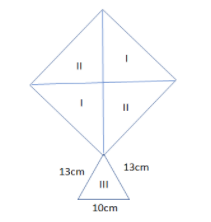
A kite in the shape of a square with a diagonal 40 cm and isosceles triangle of base 10 cm and equal sides 13 cm each is to be made of three different shades as shown in the figure. How much paper of each shade has been used to make the kite?
Answer
 Verified
619.8k+ views
Hint: First, we know from area A of the square as $A=\dfrac{1}{2}\times {{d}^{2}}$. Then, the region I and II are similar from the figure and get the half of total value of square for region I and II. Then, by using the heron’s formula for the region III that is triangle as $A=\sqrt{s\left( s-a \right)\left( s-b \right)\left( s-c \right)}$ to get the region III.
Complete step-by-step answer:
In this question, we are supposed to find how much paper of each shade has been used to make the kite with a shape of square with a diagonal 40 cm and isosceles triangle of base 10 cm and equal sides 13 cm each.
Now, from the given figure we know that the shape of the kite is square with diagonal(d) as 40 cm.
Now, we know from area A of the square that:
$A=\dfrac{1}{2}\times {{d}^{2}}$
So, by substituting the value of diagonal as 40 cm, we get:
$\begin{align}
& A=\dfrac{1}{2}\times {{\left( 40 \right)}^{2}} \\
& \Rightarrow A=\dfrac{1}{2}\times 1600 \\
& \Rightarrow A=800 \\
\end{align}$
So, the area of the kite with region I and II is $800c{{m}^{2}}$.
Now, the region I and II are similar from the figure.
So, the area of region I and II each is:
$\dfrac{800}{2}=400$
So, the area of the region I and II is 400 cm square each.
Now, by using the heron’s formula for the region III that is triangle as:
$\begin{align}
& s=\dfrac{13+13+10}{2} \\
& \Rightarrow s=\dfrac{36}{2} \\
& \Rightarrow s=18 \\
\end{align}$
Now, to get the area of the region III, we get:
$A=\sqrt{s\left( s-a \right)\left( s-b \right)\left( s-c \right)}$
Now, substitute the value of s as calculated above and values of a, b and c from the sides of triangle as:
$\begin{align}
& A=\sqrt{18\left( 18-13 \right)\left( 18-13 \right)\left( 18-10 \right)} \\
& \Rightarrow A=\sqrt{18\times 5\times 5\times 8} \\
& \Rightarrow A=\sqrt{3600} \\
& \Rightarrow A=60 \\
\end{align}$
So, the area of the region III is 60 cm square.
Hence, the area of the paper required for region I and II is $400c{{m}^{2}}$ each and area of paper required for region III is $60c{{m}^{2}}$.
Note:Now, to solve these types of questions we need to know some of the basic formulas of the figures and the heron’s formula. So, the basic formulas are as:
Area of the square with diagonal d as $A=\dfrac{1}{2}\times {{d}^{2}}$
Area of the triangle by heron’s formulas is as $A=\sqrt{s\left( s-a \right)\left( s-b \right)\left( s-c \right)}$.
Complete step-by-step answer:
In this question, we are supposed to find how much paper of each shade has been used to make the kite with a shape of square with a diagonal 40 cm and isosceles triangle of base 10 cm and equal sides 13 cm each.
Now, from the given figure we know that the shape of the kite is square with diagonal(d) as 40 cm.
Now, we know from area A of the square that:
$A=\dfrac{1}{2}\times {{d}^{2}}$
So, by substituting the value of diagonal as 40 cm, we get:
$\begin{align}
& A=\dfrac{1}{2}\times {{\left( 40 \right)}^{2}} \\
& \Rightarrow A=\dfrac{1}{2}\times 1600 \\
& \Rightarrow A=800 \\
\end{align}$
So, the area of the kite with region I and II is $800c{{m}^{2}}$.
Now, the region I and II are similar from the figure.
So, the area of region I and II each is:
$\dfrac{800}{2}=400$
So, the area of the region I and II is 400 cm square each.
Now, by using the heron’s formula for the region III that is triangle as:
$\begin{align}
& s=\dfrac{13+13+10}{2} \\
& \Rightarrow s=\dfrac{36}{2} \\
& \Rightarrow s=18 \\
\end{align}$
Now, to get the area of the region III, we get:
$A=\sqrt{s\left( s-a \right)\left( s-b \right)\left( s-c \right)}$
Now, substitute the value of s as calculated above and values of a, b and c from the sides of triangle as:
$\begin{align}
& A=\sqrt{18\left( 18-13 \right)\left( 18-13 \right)\left( 18-10 \right)} \\
& \Rightarrow A=\sqrt{18\times 5\times 5\times 8} \\
& \Rightarrow A=\sqrt{3600} \\
& \Rightarrow A=60 \\
\end{align}$
So, the area of the region III is 60 cm square.
Hence, the area of the paper required for region I and II is $400c{{m}^{2}}$ each and area of paper required for region III is $60c{{m}^{2}}$.
Note:Now, to solve these types of questions we need to know some of the basic formulas of the figures and the heron’s formula. So, the basic formulas are as:
Area of the square with diagonal d as $A=\dfrac{1}{2}\times {{d}^{2}}$
Area of the triangle by heron’s formulas is as $A=\sqrt{s\left( s-a \right)\left( s-b \right)\left( s-c \right)}$.
Recently Updated Pages
Master Class 12 Business Studies: Engaging Questions & Answers for Success

Master Class 12 Biology: Engaging Questions & Answers for Success
Master Class 12 Chemistry: Engaging Questions & Answers for Success
Class 12 Question and Answer - Your Ultimate Solutions Guide
Master Class 11 Social Science: Engaging Questions & Answers for Success
Master Class 11 English: Engaging Questions & Answers for Success
Trending doubts
Find the sum of series 1 + 2 + 3 + 4 + 5 + + 100 class 9 maths CBSE
Fill the blanks with the suitable prepositions 1 The class 9 english CBSE
Difference Between Plant Cell and Animal Cell
How many hours before the closure of election must class 9 social science CBSE
What is pollution? How many types of pollution? Define it
Name 10 Living and Non living things class 9 biology CBSE