




A jar of height h is filled with a transparent liquid of refractive index μ. At the center of the jar on the bottom surface is a dot. Find the minimum diameter of a disc, such that when it is placed on the top surface symmetrically about the center, dot is invisible.
Answer
 Verified
574.8k+ views
Hint: To solve this question, we have to apply the rule of total internal reflection. Using the condition for this effect, and applying mathematics on the geometry of the figure, we can get the answer.
Formula used: The formula used in this solution is
$\Rightarrow {i_C} = {\sin ^{ - 1}}\left( {\dfrac{1}{\mu }} \right)$, here ${i_C}$ is the critical angle of incidence for a light ray travelling from a medium of refractive index$\mu $to the air.
Complete step by step solution:
Let the minimum diameter of the disc be $d$. The situation is represented in the figure below.
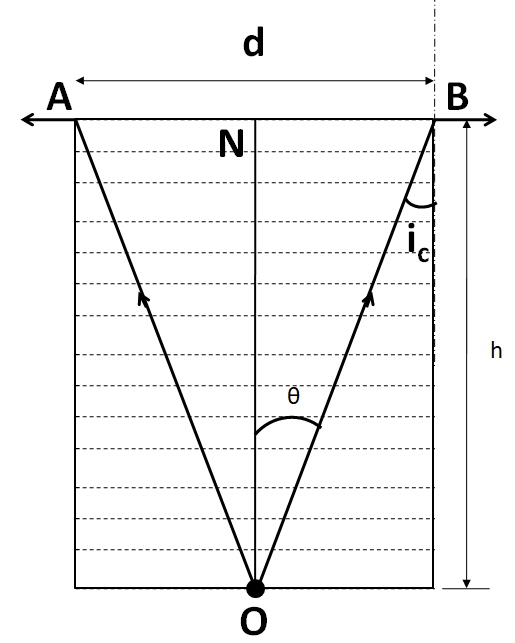
As we can see that the rays are emerging out of the dot at the centre of the jar. The topmost layer of water is an interface, which is separating two mediums, air and water. So the rays emerging out undergo refraction.
For the dot to be invisible outside the jar, none of the rays should come out of the jar. This is only possible when these rays bounce back into the jar, or they slip along the topmost layer of water.
Or in other words, these rays should undergo total internal reflection.
We know that for this effect to take place, the angle of incidence should be greater or equal to the critical angle of incidence ${i_C}$. For the minimum diameter of the disc, we take it equal to ${i_C}$.
From the figure we can see that
$\Rightarrow \theta = {i_C}$ (Alternate interior angles) …………….(i)
As the dot is present at the centre of the jar, so in the above figure
$\Rightarrow AN = BN = d/2$ ………………..(ii)
In triangle BON
$\Rightarrow \sin \theta = \dfrac{{BN}}{{OB}}$ ………………..(iii)
By Pythagoras theorem, we have
$\Rightarrow O{B^2} = B{N^2} + O{N^2}$
$\Rightarrow O{B^2} = {\left( {\dfrac{d}{2}} \right)^2} + {h^2}$
Taking under root, we get
$\Rightarrow OB = \sqrt {{{\dfrac{d}{4}}^2} + {h^2}} $
$\Rightarrow OB = \dfrac{1}{2}\sqrt {{d^2} + 4{h^2}} $ …………………….(iv)
Putting (ii) and (iv) in (iii)
$\Rightarrow \sin \theta = \dfrac{{d/2}}{{\dfrac{1}{2}\sqrt {{d^2} + 4{h^2}} }}$
$\Rightarrow \sin \theta = \dfrac{d}{{\sqrt {{d^2} + 4{h^2}} }}$
From (i)
$\Rightarrow \sin {i_C} = \dfrac{d}{{\sqrt {{d^2} + 4{h^2}} }}$ …………………..(v)
We know that the critical angle of incidence is given by
$\Rightarrow {i_C} = {\sin ^{ - 1}}\left( {\dfrac{1}{\mu }} \right)$
Taking sine both the sides
$\Rightarrow \sin {i_C} = \dfrac{1}{\mu }$ ………………….(vi)
Putting (vi) in (v)
$\Rightarrow \dfrac{1}{\mu } = \dfrac{d}{{\sqrt {{d^2} + 4{h^2}} }}$
Taking square on both the sides
$\Rightarrow \dfrac{1}{{{\mu ^2}}} = \dfrac{{{d^2}}}{{{d^2} + 4{h^2}}}$
On cross multiplying, we get
$\Rightarrow {d^2} + 4{h^2} = {\mu ^2}{d^2}$
Subtracting${d^2}$ from both sides
$\Rightarrow 4{h^2} = {\mu ^2}{d^2} - {d^2}$
$\Rightarrow 4{h^2} = {d^2}\left( {{\mu ^2} - 1} \right)$
Dividing by $\left( {{\mu ^2} - 1} \right)$
$\Rightarrow \dfrac{{4{h^2}}}{{\left( {1 - {\mu ^2}} \right)}} = {d^2}$
Finally, taking square root on both the sides, we get
$\Rightarrow d = \dfrac{{2h}}{{\sqrt {1 - {\mu ^2}} }}$
Hence, the minimum required diameter of the disc is equal to$\dfrac{{2h}}{{\sqrt {1 - {\mu ^2}} }}$.
Note:
Before using the effect of total internal reflection, always check its condition. The condition for total internal reflection to take place is that the light ray should be travelling from an optically denser medium to an optically rarer medium. In this question, the light ray from the dot was travelling from water, an optically denser medium to air, an optically rarer medium. So we could make use of this phenomenon.
Formula used: The formula used in this solution is
$\Rightarrow {i_C} = {\sin ^{ - 1}}\left( {\dfrac{1}{\mu }} \right)$, here ${i_C}$ is the critical angle of incidence for a light ray travelling from a medium of refractive index$\mu $to the air.
Complete step by step solution:
Let the minimum diameter of the disc be $d$. The situation is represented in the figure below.
As we can see that the rays are emerging out of the dot at the centre of the jar. The topmost layer of water is an interface, which is separating two mediums, air and water. So the rays emerging out undergo refraction.
For the dot to be invisible outside the jar, none of the rays should come out of the jar. This is only possible when these rays bounce back into the jar, or they slip along the topmost layer of water.
Or in other words, these rays should undergo total internal reflection.
We know that for this effect to take place, the angle of incidence should be greater or equal to the critical angle of incidence ${i_C}$. For the minimum diameter of the disc, we take it equal to ${i_C}$.
From the figure we can see that
$\Rightarrow \theta = {i_C}$ (Alternate interior angles) …………….(i)
As the dot is present at the centre of the jar, so in the above figure
$\Rightarrow AN = BN = d/2$ ………………..(ii)
In triangle BON
$\Rightarrow \sin \theta = \dfrac{{BN}}{{OB}}$ ………………..(iii)
By Pythagoras theorem, we have
$\Rightarrow O{B^2} = B{N^2} + O{N^2}$
$\Rightarrow O{B^2} = {\left( {\dfrac{d}{2}} \right)^2} + {h^2}$
Taking under root, we get
$\Rightarrow OB = \sqrt {{{\dfrac{d}{4}}^2} + {h^2}} $
$\Rightarrow OB = \dfrac{1}{2}\sqrt {{d^2} + 4{h^2}} $ …………………….(iv)
Putting (ii) and (iv) in (iii)
$\Rightarrow \sin \theta = \dfrac{{d/2}}{{\dfrac{1}{2}\sqrt {{d^2} + 4{h^2}} }}$
$\Rightarrow \sin \theta = \dfrac{d}{{\sqrt {{d^2} + 4{h^2}} }}$
From (i)
$\Rightarrow \sin {i_C} = \dfrac{d}{{\sqrt {{d^2} + 4{h^2}} }}$ …………………..(v)
We know that the critical angle of incidence is given by
$\Rightarrow {i_C} = {\sin ^{ - 1}}\left( {\dfrac{1}{\mu }} \right)$
Taking sine both the sides
$\Rightarrow \sin {i_C} = \dfrac{1}{\mu }$ ………………….(vi)
Putting (vi) in (v)
$\Rightarrow \dfrac{1}{\mu } = \dfrac{d}{{\sqrt {{d^2} + 4{h^2}} }}$
Taking square on both the sides
$\Rightarrow \dfrac{1}{{{\mu ^2}}} = \dfrac{{{d^2}}}{{{d^2} + 4{h^2}}}$
On cross multiplying, we get
$\Rightarrow {d^2} + 4{h^2} = {\mu ^2}{d^2}$
Subtracting${d^2}$ from both sides
$\Rightarrow 4{h^2} = {\mu ^2}{d^2} - {d^2}$
$\Rightarrow 4{h^2} = {d^2}\left( {{\mu ^2} - 1} \right)$
Dividing by $\left( {{\mu ^2} - 1} \right)$
$\Rightarrow \dfrac{{4{h^2}}}{{\left( {1 - {\mu ^2}} \right)}} = {d^2}$
Finally, taking square root on both the sides, we get
$\Rightarrow d = \dfrac{{2h}}{{\sqrt {1 - {\mu ^2}} }}$
Hence, the minimum required diameter of the disc is equal to$\dfrac{{2h}}{{\sqrt {1 - {\mu ^2}} }}$.
Note:
Before using the effect of total internal reflection, always check its condition. The condition for total internal reflection to take place is that the light ray should be travelling from an optically denser medium to an optically rarer medium. In this question, the light ray from the dot was travelling from water, an optically denser medium to air, an optically rarer medium. So we could make use of this phenomenon.
Recently Updated Pages
Master Class 12 Economics: Engaging Questions & Answers for Success

Master Class 12 Physics: Engaging Questions & Answers for Success
Master Class 12 English: Engaging Questions & Answers for Success
Master Class 12 Social Science: Engaging Questions & Answers for Success
Master Class 12 Maths: Engaging Questions & Answers for Success
Master Class 12 Business Studies: Engaging Questions & Answers for Success
Trending doubts
Which are the Top 10 Largest Countries of the World?
What are the major means of transport Explain each class 12 social science CBSE
Draw a labelled sketch of the human eye class 12 physics CBSE
Why cannot DNA pass through cell membranes class 12 biology CBSE
Differentiate between insitu conservation and exsitu class 12 biology CBSE
Draw a neat and well labeled diagram of TS of ovary class 12 biology CBSE