




A hydrocarbon of molecular formula ${{C}_{5}}{{H}_{10}}$ on monochlorination gives one product and on chlorination gives three products (excluding the stereoisomers). Identify the hydrocarbon.
Answer
 Verified
654k+ views
Hint: It is an alicyclic hydrocarbon and a highly flammable compound. This compound is made by the cracking of cyclohexane in the presence of high temperature and pressure.
Complete step by step answer:
- This question is done basically by a hit and trial method.
- From the first part of the question which is the molecular formula, ${{C}_{5}}{{H}_{10}}$ comes under the general formula of ${{C}_{n}}{{H}_{2n}}$.
- From here we can get to know that the compound is either an alkene or a cyclic compound.
- So, the possible molecules are pentene and cyclopentane.
- From this point, we can look at the second part of the question, which says that the monochlorination of this compound should give only one product.
- In case of pentene (whether it is 1-pentene or 2-pentene), there are two $\alpha $-hydrogens and so, on monochlorination, there will be two different products formed.


- Above given are the structures of pentene. The reaction is given as,
\[C{{H}_{2}}=CHC{{H}_{2}}C{{H}_{2}}C{{H}_{3}}+HCl\to Cl-C{{H}_{2}}-C{{H}_{2}}C{{H}_{2}}C{{H}_{2}}C{{H}_{3}}+C{{H}_{3}}-\underset{\underset{Cl}{\mathop{|}}\,}{\mathop{CH}}\,-C{{H}_{2}}C{{H}_{2}}C{{H}_{3}}\]
-As we can see above, monochlorination of 1-pentene results in two different products. Similar reaction will take place for 2-pentene as well.
- So, we can now check the monochlorination product of cyclopentane.

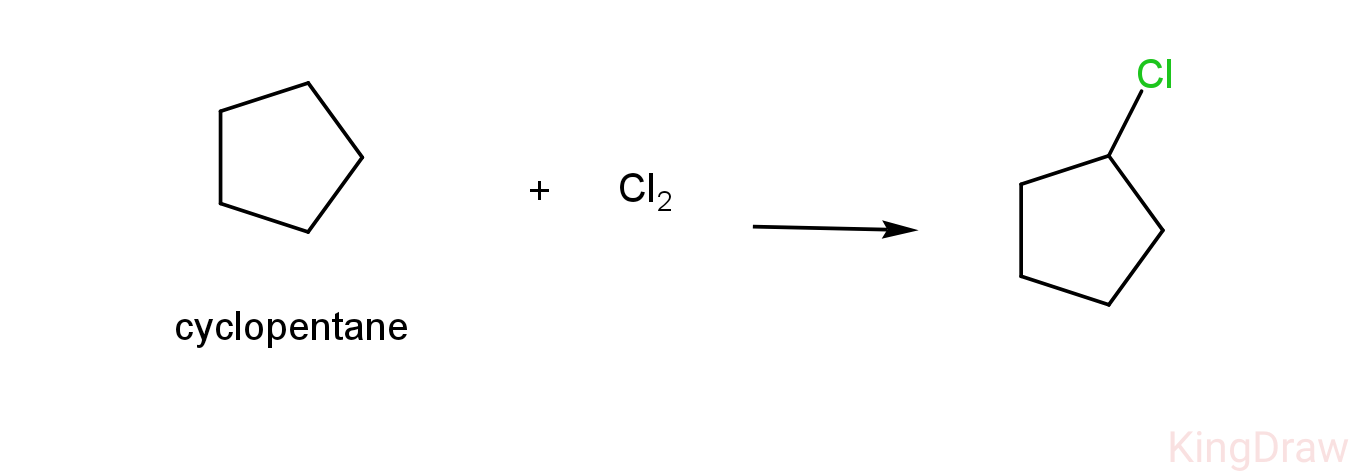
-As we can see above, cyclopentane reacts with chlorine to form only one product which is 1-chlorocyclopentane.
- Now, to confirm the compound, we can see the next part of the question which says that on dichlorination it should give three products
- Given below is the dichlorination of cyclopentane.
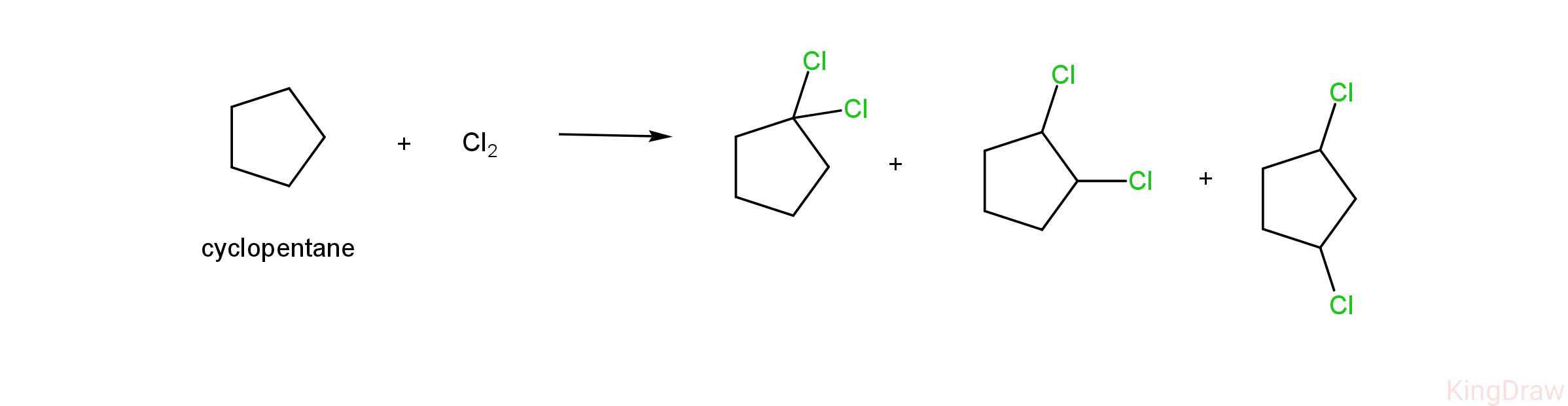
- As we can see, the dichlorination of cyclopentane results in the formation of three products, which are 1,1-dichlorocyclopentane, 1,2 -dichlorocyclopentane and 1,3-dichlorocyclopentane.
- Therefore , we can conclude that cyclopentane is the compound having the molecular formula of C5H10, on monochlorination giving one product (1-chloro cyclopentane) and on dichlorination gives three products (1,1-dichloro cyclopentane, 1,2 -dichlorocyclopentane and 1,3- dichlorocyclopentane)
- So, the answer is Cyclopentane.
Note: Monochlorination and dichlorination both the reaction proceeds under different sets of conditions. Monochlorination of cyclopentane occurs with $C{{l}_{2}}$ in the presence of light ($h\upsilon $) whereas dichlorination of cyclopentene occurs when excess of $C{{l}_{2}}$ is provided in the presence of light ($h\upsilon $).
Complete step by step answer:
- This question is done basically by a hit and trial method.
- From the first part of the question which is the molecular formula, ${{C}_{5}}{{H}_{10}}$ comes under the general formula of ${{C}_{n}}{{H}_{2n}}$.
- From here we can get to know that the compound is either an alkene or a cyclic compound.
- So, the possible molecules are pentene and cyclopentane.
- From this point, we can look at the second part of the question, which says that the monochlorination of this compound should give only one product.
- In case of pentene (whether it is 1-pentene or 2-pentene), there are two $\alpha $-hydrogens and so, on monochlorination, there will be two different products formed.
- Above given are the structures of pentene. The reaction is given as,
\[C{{H}_{2}}=CHC{{H}_{2}}C{{H}_{2}}C{{H}_{3}}+HCl\to Cl-C{{H}_{2}}-C{{H}_{2}}C{{H}_{2}}C{{H}_{2}}C{{H}_{3}}+C{{H}_{3}}-\underset{\underset{Cl}{\mathop{|}}\,}{\mathop{CH}}\,-C{{H}_{2}}C{{H}_{2}}C{{H}_{3}}\]
-As we can see above, monochlorination of 1-pentene results in two different products. Similar reaction will take place for 2-pentene as well.
- So, we can now check the monochlorination product of cyclopentane.
-As we can see above, cyclopentane reacts with chlorine to form only one product which is 1-chlorocyclopentane.
- Now, to confirm the compound, we can see the next part of the question which says that on dichlorination it should give three products
- Given below is the dichlorination of cyclopentane.
- As we can see, the dichlorination of cyclopentane results in the formation of three products, which are 1,1-dichlorocyclopentane, 1,2 -dichlorocyclopentane and 1,3-dichlorocyclopentane.
- Therefore , we can conclude that cyclopentane is the compound having the molecular formula of C5H10, on monochlorination giving one product (1-chloro cyclopentane) and on dichlorination gives three products (1,1-dichloro cyclopentane, 1,2 -dichlorocyclopentane and 1,3- dichlorocyclopentane)
- So, the answer is Cyclopentane.
Note: Monochlorination and dichlorination both the reaction proceeds under different sets of conditions. Monochlorination of cyclopentane occurs with $C{{l}_{2}}$ in the presence of light ($h\upsilon $) whereas dichlorination of cyclopentene occurs when excess of $C{{l}_{2}}$ is provided in the presence of light ($h\upsilon $).
Recently Updated Pages
Which of the following graphs shows the variation of class 12 physics CBSE

Draw a labelled diagram of the human male reproductive class 12 biology CBSE
Describe the experiment to compare the emf of two cells class 12 physics CBSE
What is standard hydrogen electrode
What is conventional current and electric current class 12 physics CBSE
2Bromopentane is treated with an alcoholic KOH solution class 12 chemistry CBSE
Trending doubts
Draw a labelled sketch of the human eye class 12 physics CBSE
Which are the Top 10 Largest Countries of the World?
Differentiate between homogeneous and heterogeneous class 12 chemistry CBSE
Draw ray diagrams each showing i myopic eye and ii class 12 physics CBSE
Which is the correct genotypic ratio of mendel dihybrid class 12 biology CBSE
What is the Full Form of PVC, PET, HDPE, LDPE, PP and PS ?