




A hollow dielectric sphere has $R_{1}$ and $R_{2}$ as its inner and outer radii. The total charge carried by the sphere is $+Q$ which is uniformly distributed throughout the dielectric sphere between $R_{1}$ and $R_{2}$ . The electric field $R_{1} < r < R_{2}$ is given by:
\[\begin{align}
& A.\dfrac{Q}{4\pi r{{\varepsilon }_{0}}{{R}_{1}}} \\
& B.\dfrac{Q}{4\pi r{{\varepsilon }_{0}}r} \\
& C.\dfrac{Q}{4\pi r{{\varepsilon }_{0}}R_{1}^{2}} \\
& D.\dfrac{Q({{r}^{3}}-R_{1}^{2})}{4\pi r{{\varepsilon }_{0}}{{r}^{2}}(R_{2}^{3}-R_{1}^{3})} \\
\end{align}\]
Answer
 Verified
653.1k+ views
Hint: Electric field is the electric force due to a unit positive charge which is at rest would exert on its surrounding. Then to find the electric field inside the shell we can use the formula of electric field. Since here, we have a spherical sphere, we can use the volume density of to calculate the charge on the sphere.
Formula used:
$E=\dfrac{F}{q}$
Complete step by step answer:
Consider a spherical sphere that has $R_{1}$ and $R_{2}$ as its inner and outer radii, given that the charge $Q$ be uniformly distributed throughout the sphere. Let $r$ be such that $R_{1} < r < R_{2}$ as shown in the figure. Also let this region contain some $q$ charge.
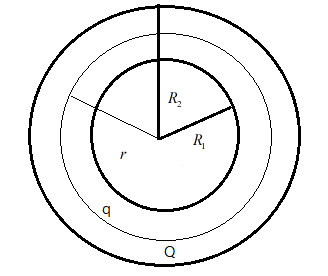
Let us assume that $\rho$ is the volume density of the hollow sphere, it is the ratio between the charge and the volume of the sphere, then we can say that $\rho=\dfrac{Q}{\dfrac{4\pi}{3}(R_{2}^{3}-R_{1}^{3})}$
We can then say that the charge $q=\rho\times\dfrac{4}{3}\pi(r^{3}-R_{1}^{3})=\dfrac{Q}{\dfrac{4\pi}{3}(R_{2}^{3}-R_{1}^{3})}\times\dfrac{4}{3}\pi(r^{3}-R_{1}^{3})=
\dfrac{Q(r^{3}-R_{1}^{3})}{(R_{2}^{3}-R_{1}^{3})}$
$\implies q=\dfrac{Q(r^{3}-R_{1}^{3})}{(R_{2}^{3}-R_{1}^{3})}$
We know that electric field $E$ is the electric force per unit charge, then $E=\dfrac{kq}{r^{2}}$ where, $r$ is the distance between the charge and $k=\dfrac{1}{4\pi\epsilon_{0}}$ which is a constant and $r$ is the distance between the unit charges.
Substituting for $q$, we get $E=\dfrac{1}{4\pi\epsilon_{0}r^{2}} \times\left(\dfrac{Q(r^{3}-R_{1}^{3})}{(R_{2}^{3}-R_{1}^{3})}\right)$
Hence the answer is option \[D.\dfrac{Q({{r}^{3}}-R_{1}^{2})}{4\pi r{{\varepsilon }_{0}}{{r}^{2}}(R_{2}^{3}-R_{1}^{3})}\]
Additional information:
Electric field is in the direction of the force. Usually, the electric field of a point positive charge is radially outwards, whereas the electric field of a point negative charge is radially inwards to the charge. However, the electric field also depends on the symmetry of the charge carrying conductor
So, the correct answer is “Option A”.
Note:
We can also use gauss law to solve the problem as we need to calculate the electric field due to a charge. From Gauss law, we know that the total electric flux through a closed surface is equal to $\dfrac{1}{\epsilon_{0}}$ times the charge enclosed in the surface, and it is given by $\Phi_{E}=\dfrac{q}{\epsilon_{0}}$.
Formula used:
$E=\dfrac{F}{q}$
Complete step by step answer:
Consider a spherical sphere that has $R_{1}$ and $R_{2}$ as its inner and outer radii, given that the charge $Q$ be uniformly distributed throughout the sphere. Let $r$ be such that $R_{1} < r < R_{2}$ as shown in the figure. Also let this region contain some $q$ charge.
Let us assume that $\rho$ is the volume density of the hollow sphere, it is the ratio between the charge and the volume of the sphere, then we can say that $\rho=\dfrac{Q}{\dfrac{4\pi}{3}(R_{2}^{3}-R_{1}^{3})}$
We can then say that the charge $q=\rho\times\dfrac{4}{3}\pi(r^{3}-R_{1}^{3})=\dfrac{Q}{\dfrac{4\pi}{3}(R_{2}^{3}-R_{1}^{3})}\times\dfrac{4}{3}\pi(r^{3}-R_{1}^{3})=
\dfrac{Q(r^{3}-R_{1}^{3})}{(R_{2}^{3}-R_{1}^{3})}$
$\implies q=\dfrac{Q(r^{3}-R_{1}^{3})}{(R_{2}^{3}-R_{1}^{3})}$
We know that electric field $E$ is the electric force per unit charge, then $E=\dfrac{kq}{r^{2}}$ where, $r$ is the distance between the charge and $k=\dfrac{1}{4\pi\epsilon_{0}}$ which is a constant and $r$ is the distance between the unit charges.
Substituting for $q$, we get $E=\dfrac{1}{4\pi\epsilon_{0}r^{2}} \times\left(\dfrac{Q(r^{3}-R_{1}^{3})}{(R_{2}^{3}-R_{1}^{3})}\right)$
Hence the answer is option \[D.\dfrac{Q({{r}^{3}}-R_{1}^{2})}{4\pi r{{\varepsilon }_{0}}{{r}^{2}}(R_{2}^{3}-R_{1}^{3})}\]
Additional information:
Electric field is in the direction of the force. Usually, the electric field of a point positive charge is radially outwards, whereas the electric field of a point negative charge is radially inwards to the charge. However, the electric field also depends on the symmetry of the charge carrying conductor
So, the correct answer is “Option A”.
Note:
We can also use gauss law to solve the problem as we need to calculate the electric field due to a charge. From Gauss law, we know that the total electric flux through a closed surface is equal to $\dfrac{1}{\epsilon_{0}}$ times the charge enclosed in the surface, and it is given by $\Phi_{E}=\dfrac{q}{\epsilon_{0}}$.
Recently Updated Pages
Which of the following graphs shows the variation of class 12 physics CBSE

Draw a labelled diagram of the human male reproductive class 12 biology CBSE
Describe the experiment to compare the emf of two cells class 12 physics CBSE
What is standard hydrogen electrode
What is conventional current and electric current class 12 physics CBSE
2Bromopentane is treated with an alcoholic KOH solution class 12 chemistry CBSE
Trending doubts
Which are the Top 10 Largest Countries of the World?
Differentiate between internal fertilization and external class 12 biology CBSE
What is the Full Form of 1.DPT 2.DDT 3.BCG
Differentiate between lanthanoids and actinoids class 12 chemistry CBSE
Sketch and label the Malpighian body class 12 biology CBSE
Why is the cell called the structural and functional class 12 biology CBSE