




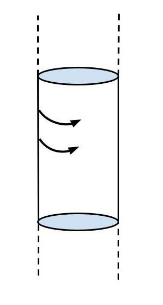
A hollow cylinder having infinite length and carrying uniform current per unit length \[\lambda \]along the circumference as shown. Magnetic field inside the cylinder is:
A. $\dfrac{{{\mu _0}\lambda }}{2}$
B. ${\mu _0}\lambda $
C. $2{\mu _0}\lambda $
D. None
Answer
 Verified
522k+ views
Hint:To answer this question, which is based on Biot-Savart's formula, we must first understand it in general. In physics, specifically electromagnetic, the Biot-Savart law describes the magnetic field generated by a continuous electric current. It connects the magnitude, direction, length, and proximity of the electric current to the magnetic field.
Complete step by step answer:
Given that there is current flowing around its circumference.We already know that there will be a magnetic field inside the cylinder is,
$\dfrac{{{\mu _0}}}{{4\pi }}\dfrac{{2I'}}{{r'}}$
Where \[I'\] denotes the direction of flow of current and \[r'\] denotes the distance from the centre.
$\lambda $ is the current length per unit, thus;
\[\lambda {\text{ }} = \;\dfrac{I}{{2\pi r\;}}\;\]
Therefore, from here we will deduce equation for $I$
\[ \Rightarrow I = \;\lambda 2\pi r\]
At $r'$ distance from the center, the current inside the cylinder is: \[{\text{I' = }}\lambda {\text{2}}\pi r{\text{'}}\]
We've now inserted the value into the equation.
\[{{\text{B}}_{{\text{(inside) }}}}{\text{ = }}\dfrac{{{\mu _0}}}{{4\pi }}\dfrac{{2I'}}{{r'}} \\
\Rightarrow {{\text{B}}_{{\text{(inside) }}}} = \dfrac{{{\mu _0}}}{{4\pi }}\left( {2 \times \lambda \times \dfrac{{2\pi r'}}{{r'}}} \right) \\
\therefore {{\text{B}}_{{\text{(inside) }}}} = \lambda {\mu _0} \]
Therefore, magnetic field inside the cylinder is \[\lambda {\mu _0}\]
So, the correct option is B.
Additional Information: Biot-Savart Law's Importance;
The following are some of the advantages of the Biot-Savart law:
1. In electrostatics, the Biot-Savart law is comparable to Coulomb's law.
2. The law also applies to very small current-carrying conductors.
3. The law applies to current distributions that are symmetrical.
Note:It's important to understand that the Biot–Savart law is vital to magnetostatics, serving in a similar way to Coulomb's law in electrostatics. When magnetostatics is not applicable, Jefimenko's equations should be used instead of the Biot–Savart law. The law is consistent with both Ampère's circuital law and Gauss's law for magnetism in the magnetostatic approximation.
Complete step by step answer:
Given that there is current flowing around its circumference.We already know that there will be a magnetic field inside the cylinder is,
$\dfrac{{{\mu _0}}}{{4\pi }}\dfrac{{2I'}}{{r'}}$
Where \[I'\] denotes the direction of flow of current and \[r'\] denotes the distance from the centre.
$\lambda $ is the current length per unit, thus;
\[\lambda {\text{ }} = \;\dfrac{I}{{2\pi r\;}}\;\]
Therefore, from here we will deduce equation for $I$
\[ \Rightarrow I = \;\lambda 2\pi r\]
At $r'$ distance from the center, the current inside the cylinder is: \[{\text{I' = }}\lambda {\text{2}}\pi r{\text{'}}\]
We've now inserted the value into the equation.
\[{{\text{B}}_{{\text{(inside) }}}}{\text{ = }}\dfrac{{{\mu _0}}}{{4\pi }}\dfrac{{2I'}}{{r'}} \\
\Rightarrow {{\text{B}}_{{\text{(inside) }}}} = \dfrac{{{\mu _0}}}{{4\pi }}\left( {2 \times \lambda \times \dfrac{{2\pi r'}}{{r'}}} \right) \\
\therefore {{\text{B}}_{{\text{(inside) }}}} = \lambda {\mu _0} \]
Therefore, magnetic field inside the cylinder is \[\lambda {\mu _0}\]
So, the correct option is B.
Additional Information: Biot-Savart Law's Importance;
The following are some of the advantages of the Biot-Savart law:
1. In electrostatics, the Biot-Savart law is comparable to Coulomb's law.
2. The law also applies to very small current-carrying conductors.
3. The law applies to current distributions that are symmetrical.
Note:It's important to understand that the Biot–Savart law is vital to magnetostatics, serving in a similar way to Coulomb's law in electrostatics. When magnetostatics is not applicable, Jefimenko's equations should be used instead of the Biot–Savart law. The law is consistent with both Ampère's circuital law and Gauss's law for magnetism in the magnetostatic approximation.
Recently Updated Pages
Master Class 12 Business Studies: Engaging Questions & Answers for Success

Master Class 12 Chemistry: Engaging Questions & Answers for Success
Master Class 12 Biology: Engaging Questions & Answers for Success
Class 12 Question and Answer - Your Ultimate Solutions Guide
Master Class 11 English: Engaging Questions & Answers for Success
Master Class 11 Maths: Engaging Questions & Answers for Success
Trending doubts
Which is more stable and why class 12 chemistry CBSE
Which are the Top 10 Largest Countries of the World?
Draw a labelled sketch of the human eye class 12 physics CBSE
Differentiate between homogeneous and heterogeneous class 12 chemistry CBSE
What are the major means of transport Explain each class 12 social science CBSE
Sulphuric acid is known as the king of acids State class 12 chemistry CBSE