




A helium nucleus makes a full rotation of radius $0 \cdot 8{\text{m}}$ in two seconds. Find the value of the magnetic field at the centre of the circle.
A) $\dfrac{{{{10}^{ - 19}}}}{{{\mu _0}}}$
B) ${10^{ - 19}}{\mu _0}$
C) $2 \times {10^{ - 10}}{\mu _0}$
D) $\dfrac{{2 \times {{10}^{ - 10}}}}{{{\mu _0}}}$
Answer
 Verified
606.6k+ views
Hint: The magnetic field at the centre of a current-carrying circular loop circle is known to be proportional to the current in the loop and inversely proportional to the radius of the loop. The helium nucleus has a charge of two protons. The motion of a charge produces an electric current.
Formulas used:
-The current produced by the motion of a charge is given by, $I = \dfrac{q}{t}$ where $q$ is the moving charge and $t$ is the interval of time.
-The magnetic field at the centre of a current-carrying circular loop is given by, $B = \dfrac{{{\mu _0}I}}{{2r}}$ where ${\mu _0}$ is the permeability of free space, $I$ is the current in the loop and $r$ is the radius of the loop.
Complete step by step solution:
Step 1: Sketch a figure depicting the problem at hand.
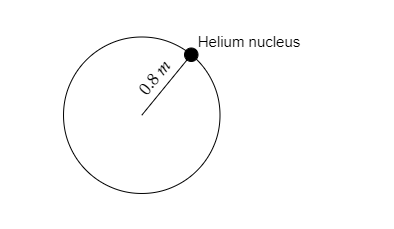
The circle described by the rotation of the helium nucleus can be considered as a current-carrying circular loop.
The radius of the circle is given to be $r = 0 \cdot 8{\text{m}}$ .
The time taken for a full rotation is given to be $t = 2{\text{s}}$ .
Step 2: Obtain the current generated due to the rotation of the helium nucleus.
Since the helium nucleus has a charge $q = 2e$ ( $e$ is the charge of a proton), its motion along a circle will generate a current.
This current can be expressed as $I = \dfrac{{2e}}{t}$ --------- (1)
Substituting for $e = 1 \cdot 6 \times {10^{ - 19}}{\text{C}}$ and $t = 2{\text{s}}$ in equation (1) we get, $I = \dfrac{{2 \times 1 \cdot 6 \times {{10}^{ - 19}}}}{2} = 1 \cdot 6 \times {10^{ - 19}}{\text{A}}$
Thus the current in the circular loop is obtained to be $I = 1 \cdot 6 \times {10^{ - 19}}{\text{A}}$ .
Step 3: Express the magnetic field present at the centre of the circle described by the helium nucleus.
Since the circle around which the helium nucleus rotates is considered as a current-carrying circular loop, the magnetic field at the centre of this circle can be expressed as $B = \dfrac{{{\mu _0}I}}{{2r}}$ ------- (2) where ${\mu _0}$ is the permeability of free space.
Substituting for $I = 1 \cdot 6 \times {10^{ - 19}}{\text{A}}$ and $r = 0 \cdot 8{\text{m}}$ in equation (2) we get, $B = \dfrac{{{\mu _0} \times 1 \cdot 6 \times {{10}^{ - 19}}}}{{2 \times 0 \cdot 8}} = \dfrac{{{\mu _0} \times 1 \cdot 6 \times {{10}^{ - 19}}}}{{1 \cdot 6}} = {\mu _0} \times {10^{ - 19}}{\text{T}}$
$\therefore $ the magnetic field at the centre is obtained to be ${10^{ - 19}}{\mu _0}{\text{T}}$ .
So the correct option is B.
Note: A helium nucleus consists of two protons and two neutrons. Neutrons are chargeless particles. So the positive charge of the helium nucleus will be entirely due to the charge of the two protons. A proton has the same charge as that of an electron but will be positive. The charge of an electron is $e = - 1 \cdot 6 \times {10^{ - 19}}{\text{C}}$ , so for a proton it will be $e = 1 \cdot 6 \times {10^{ - 19}}{\text{C}}$ .
Formulas used:
-The current produced by the motion of a charge is given by, $I = \dfrac{q}{t}$ where $q$ is the moving charge and $t$ is the interval of time.
-The magnetic field at the centre of a current-carrying circular loop is given by, $B = \dfrac{{{\mu _0}I}}{{2r}}$ where ${\mu _0}$ is the permeability of free space, $I$ is the current in the loop and $r$ is the radius of the loop.
Complete step by step solution:
Step 1: Sketch a figure depicting the problem at hand.
The circle described by the rotation of the helium nucleus can be considered as a current-carrying circular loop.
The radius of the circle is given to be $r = 0 \cdot 8{\text{m}}$ .
The time taken for a full rotation is given to be $t = 2{\text{s}}$ .
Step 2: Obtain the current generated due to the rotation of the helium nucleus.
Since the helium nucleus has a charge $q = 2e$ ( $e$ is the charge of a proton), its motion along a circle will generate a current.
This current can be expressed as $I = \dfrac{{2e}}{t}$ --------- (1)
Substituting for $e = 1 \cdot 6 \times {10^{ - 19}}{\text{C}}$ and $t = 2{\text{s}}$ in equation (1) we get, $I = \dfrac{{2 \times 1 \cdot 6 \times {{10}^{ - 19}}}}{2} = 1 \cdot 6 \times {10^{ - 19}}{\text{A}}$
Thus the current in the circular loop is obtained to be $I = 1 \cdot 6 \times {10^{ - 19}}{\text{A}}$ .
Step 3: Express the magnetic field present at the centre of the circle described by the helium nucleus.
Since the circle around which the helium nucleus rotates is considered as a current-carrying circular loop, the magnetic field at the centre of this circle can be expressed as $B = \dfrac{{{\mu _0}I}}{{2r}}$ ------- (2) where ${\mu _0}$ is the permeability of free space.
Substituting for $I = 1 \cdot 6 \times {10^{ - 19}}{\text{A}}$ and $r = 0 \cdot 8{\text{m}}$ in equation (2) we get, $B = \dfrac{{{\mu _0} \times 1 \cdot 6 \times {{10}^{ - 19}}}}{{2 \times 0 \cdot 8}} = \dfrac{{{\mu _0} \times 1 \cdot 6 \times {{10}^{ - 19}}}}{{1 \cdot 6}} = {\mu _0} \times {10^{ - 19}}{\text{T}}$
$\therefore $ the magnetic field at the centre is obtained to be ${10^{ - 19}}{\mu _0}{\text{T}}$ .
So the correct option is B.
Note: A helium nucleus consists of two protons and two neutrons. Neutrons are chargeless particles. So the positive charge of the helium nucleus will be entirely due to the charge of the two protons. A proton has the same charge as that of an electron but will be positive. The charge of an electron is $e = - 1 \cdot 6 \times {10^{ - 19}}{\text{C}}$ , so for a proton it will be $e = 1 \cdot 6 \times {10^{ - 19}}{\text{C}}$ .
Recently Updated Pages
Master Class 12 Economics: Engaging Questions & Answers for Success

Master Class 12 English: Engaging Questions & Answers for Success
Master Class 12 Social Science: Engaging Questions & Answers for Success
Master Class 12 Maths: Engaging Questions & Answers for Success
Master Class 12 Physics: Engaging Questions & Answers for Success
Master Class 9 General Knowledge: Engaging Questions & Answers for Success
Trending doubts
Which are the Top 10 Largest Countries of the World?
Draw a labelled sketch of the human eye class 12 physics CBSE
Differentiate between homogeneous and heterogeneous class 12 chemistry CBSE
Sulphuric acid is known as the king of acids State class 12 chemistry CBSE
Why is the cell called the structural and functional class 12 biology CBSE
Draw ray diagrams each showing i myopic eye and ii class 12 physics CBSE