




A heat engine undergoes a process in which its internal energy decreases by $400\,J$ and it gives out $150\,J$ of heat. During the process
A. It does 250 J of work and its temperature rises
B. It does 250 J of work and its temperature falls
C. It does 550 J of work and its temperature rises
D. It does 550 J of work and its temperature falls
Answer
 Verified
548.4k+ views
Hint: A heat engine is a device that converts heat energy into mechanical energy. It does this by undergoing some certain process in which it takes heat energy from a heat source and then converts some of the heat energy into useful work and releases the rest heat energy to the heat sink.
Complete step by step answer:
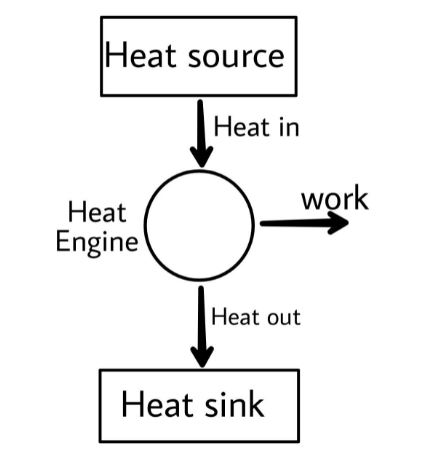
In the above diagram the engine takes heat energy from a heat source and then converts some of the heat into useful work and releases the rest to the heat sink. Now by the basic concept of thermodynamics we know that the internal energy of the system is a function of temperature only (directly proportional to the temperature of the system) and it does not alter itself unless the temperature is altered.
In this question the internal energy of the system decreases which means that the temperature also falls down to some extent. Now the engine’s internal energy is decreased by a factor of $400J$ and it releases $150J$ (to the heat sink) which means the rest of the missing energy is utilized as useful work.
Work done $400\,J - 150\,J = 250\,J$
Work done $ = 250\,J$
So, the correct answer is option B.
Note: Heat engines mostly work on this principle giving part of heat as useful work and the rest to the heat sink, here we have ignored any kind of energy loss due to friction. If the friction force is taken into encounter, then the heat taken from the heat source is divided into three parts, one part used to get useful work, the other part is released to the heat sink and the last part is dissipated as energy loss due to friction.
Complete step by step answer:
In the above diagram the engine takes heat energy from a heat source and then converts some of the heat into useful work and releases the rest to the heat sink. Now by the basic concept of thermodynamics we know that the internal energy of the system is a function of temperature only (directly proportional to the temperature of the system) and it does not alter itself unless the temperature is altered.
In this question the internal energy of the system decreases which means that the temperature also falls down to some extent. Now the engine’s internal energy is decreased by a factor of $400J$ and it releases $150J$ (to the heat sink) which means the rest of the missing energy is utilized as useful work.
Work done $400\,J - 150\,J = 250\,J$
Work done $ = 250\,J$
So, the correct answer is option B.
Note: Heat engines mostly work on this principle giving part of heat as useful work and the rest to the heat sink, here we have ignored any kind of energy loss due to friction. If the friction force is taken into encounter, then the heat taken from the heat source is divided into three parts, one part used to get useful work, the other part is released to the heat sink and the last part is dissipated as energy loss due to friction.
Recently Updated Pages
If x a + bt + ct2 where x is in meters and t is in class 11 physics CBSE

A car covers the first half distance between two places class 11 physics CBSE
The resultant of two vectors overrightarrow P and overrightarrow class 11 physics CBSE
Find the value of cos 135 class 11 maths CBSE
A mass M is held in place by an applied force F and class 11 physics CBSE
A solution of glucose in water is labelled as 10 dfracwv class 11 chemistry CBSE
Trending doubts
Find the value of the expression given below sin 30circ class 11 maths CBSE
What is the maximum height of a projectile class 11 physics CBSE
Derive an expression for maximum height and range of class 11 physics CBSE
Describe various types of epithelial tissues with the class 11 biology CBSE
Lysosomes are known as suicidal bags of cell why class 11 biology CBSE
State and derive law of conservation of momentum class 11 physics CBSE