



A half-wave rectifier is used to convert 50 Hz A.C to D.C voltage. The number of pulses per second in the rectified voltage are:
A. 50
B. 25
C. 75
D. 100
Answer
 Verified
594k+ views
Hint: A rectifier is a device or arrangement of electrical instruments which is used to convert AC (Alternating current) to DC (Direct current). The semiconductor diode, also called p-n junction diode, plays a major role in the working of a rectifier as it allows current flow only in a single direction and blocks the current in the other direction. Conversion of AC to DC is a very important part of many instruments which we use in our day to day life.
Complete step by step answer:
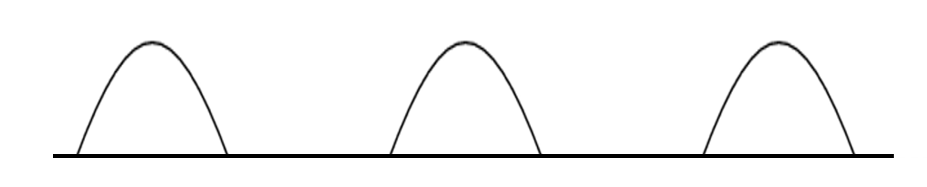
In a half-wave rectifier, alternating current in only one direction gets rectified. P-n junction blocks the other part of the current to give current only in a single direction, hence it vanishes its alternating property.
Alternating current before rectification:
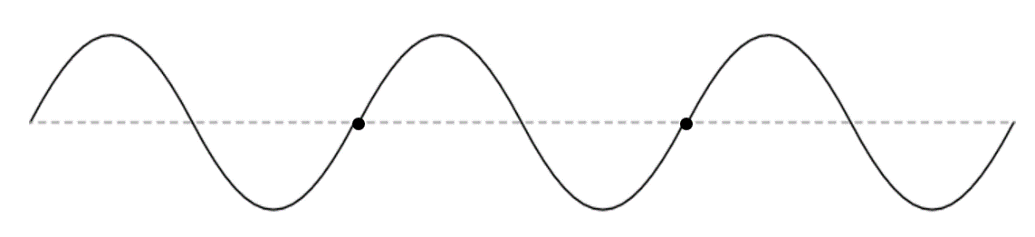
Alternating current after rectification from a half-wave rectifier:
Now, 50 Hz means that current or voltage will change its direction from + to – 50 times in 1 second.
In other words, it will complete 50 cycles per second.
A cycle is:
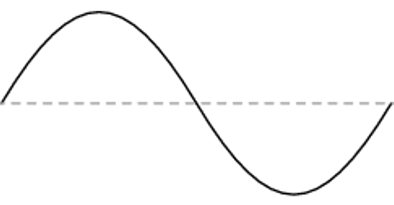
But after rectification, the lower half of the cycle will get erased. So for that part of the cycle, the voltage will remain to be zero. There’s no effect on the cycle length. Hence the number of pulses before and after rectification will remain the same in half-wave rectification.
So, the correct answer is “Option A”.
Note:
It is important to note that ideally, there is no change in amplitude or frequency of the original wave. The chance of mistake is that students might think that the second wave is also AC, but ac doesn’t mean fluctuating amplitude. If the current changes its direction, i.e. from positive to negative, or above x-axis to lower x-axis, then only we can say that the current is alternating.
Complete step by step answer:
In a half-wave rectifier, alternating current in only one direction gets rectified. P-n junction blocks the other part of the current to give current only in a single direction, hence it vanishes its alternating property.
Alternating current before rectification:
Alternating current after rectification from a half-wave rectifier:
Now, 50 Hz means that current or voltage will change its direction from + to – 50 times in 1 second.
In other words, it will complete 50 cycles per second.
A cycle is:
But after rectification, the lower half of the cycle will get erased. So for that part of the cycle, the voltage will remain to be zero. There’s no effect on the cycle length. Hence the number of pulses before and after rectification will remain the same in half-wave rectification.
So, the correct answer is “Option A”.
Note:
It is important to note that ideally, there is no change in amplitude or frequency of the original wave. The chance of mistake is that students might think that the second wave is also AC, but ac doesn’t mean fluctuating amplitude. If the current changes its direction, i.e. from positive to negative, or above x-axis to lower x-axis, then only we can say that the current is alternating.
Recently Updated Pages
Master Class 12 Economics: Engaging Questions & Answers for Success

Master Class 12 Physics: Engaging Questions & Answers for Success
Master Class 12 English: Engaging Questions & Answers for Success
Master Class 12 Social Science: Engaging Questions & Answers for Success
Master Class 12 Maths: Engaging Questions & Answers for Success
Master Class 12 Business Studies: Engaging Questions & Answers for Success
Trending doubts
Which are the Top 10 Largest Countries of the World?
What are the major means of transport Explain each class 12 social science CBSE
Draw a labelled sketch of the human eye class 12 physics CBSE
Why cannot DNA pass through cell membranes class 12 biology CBSE
Differentiate between insitu conservation and exsitu class 12 biology CBSE
Draw a neat and well labeled diagram of TS of ovary class 12 biology CBSE