




A graph plotted by taking ${T^2}$ on $y - $axis and $L$ on $x - $axis is an experiment of simple pendulum is a straight the what relationship between ${T^2}$ and $L$ does the graph represent?
Answer
 Verified
585.6k+ views
Hint: A simple pendulum always undergoes oscillatory motion. The only force acting on the pendulum is it’s self-weight. The pendulum’s time period is dependent on the length of the pendulum.
Complete answer:
Let us draw the free body diagram of the pendulum.
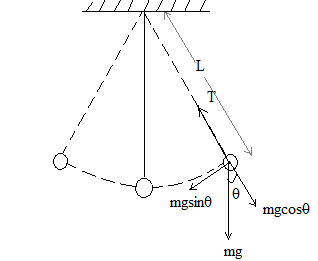
So let us assume that the angle \[\theta \] is very small. Thus we can write;
$s = L \times \theta $
Here $s$ is the displacement or arc length suspending the angle $\theta $ and length $L$.
Also the restoring force will be $F \approx mg\theta $ ---------- 🡪( $\because \theta \approx 0 \Rightarrow \sin \theta \approx \theta $ )
Now substituting $\theta = \dfrac{s}{L}$ in the above equation we get;
$\Rightarrow F = \dfrac{{mgs}}{L}$
Now restoring force can be written as \[F = kx = ks\] as the displacement is $s$
Thus we get;
$\Rightarrow k = \dfrac{{mg}}{L}$
Now we know that the time period of oscillation is given by;
$\Rightarrow T = 2\pi \sqrt {\dfrac{m}{k}} $
So, substituting the value of $k$ in the equation we get;
$\Rightarrow T = \sqrt {\dfrac{m}{{\left( {\dfrac{{mg}}{L}} \right)}}} $
Thus simplifying the above equation we get;
$\Rightarrow T = 2\pi \sqrt {\dfrac{L}{g}} $
Now, let us square both the sides of the above equation;
$\Rightarrow {T^2} = 4{\pi ^2}\dfrac{L}{g}$
So, we can say that
$\Rightarrow {T^2} = aL$ where $a = \dfrac{{4{\pi ^2}}}{g}$ is a positive constant.
The above equation is an equation of straight line.
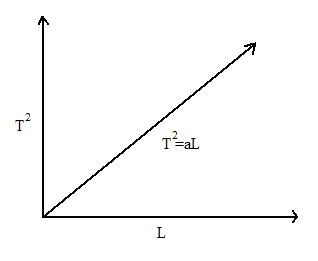
The above diagram is the graph of the ${T^2}$ as ordinate and $L$ as abscissa.
Thus we say that ${T^2}$ increases with increase in $L$.
Note: The time period of a pendulum is independent of the mass of the pendulum and is only dependent on the length of the pendulum. Here we derived the equation for time period by assuming the angle is too small. The assumption $\theta \approx \sin \theta $ is only possible when the angle is very small.
Complete answer:
Let us draw the free body diagram of the pendulum.
So let us assume that the angle \[\theta \] is very small. Thus we can write;
$s = L \times \theta $
Here $s$ is the displacement or arc length suspending the angle $\theta $ and length $L$.
Also the restoring force will be $F \approx mg\theta $ ---------- 🡪( $\because \theta \approx 0 \Rightarrow \sin \theta \approx \theta $ )
Now substituting $\theta = \dfrac{s}{L}$ in the above equation we get;
$\Rightarrow F = \dfrac{{mgs}}{L}$
Now restoring force can be written as \[F = kx = ks\] as the displacement is $s$
Thus we get;
$\Rightarrow k = \dfrac{{mg}}{L}$
Now we know that the time period of oscillation is given by;
$\Rightarrow T = 2\pi \sqrt {\dfrac{m}{k}} $
So, substituting the value of $k$ in the equation we get;
$\Rightarrow T = \sqrt {\dfrac{m}{{\left( {\dfrac{{mg}}{L}} \right)}}} $
Thus simplifying the above equation we get;
$\Rightarrow T = 2\pi \sqrt {\dfrac{L}{g}} $
Now, let us square both the sides of the above equation;
$\Rightarrow {T^2} = 4{\pi ^2}\dfrac{L}{g}$
So, we can say that
$\Rightarrow {T^2} = aL$ where $a = \dfrac{{4{\pi ^2}}}{g}$ is a positive constant.
The above equation is an equation of straight line.
The above diagram is the graph of the ${T^2}$ as ordinate and $L$ as abscissa.
Thus we say that ${T^2}$ increases with increase in $L$.
Note: The time period of a pendulum is independent of the mass of the pendulum and is only dependent on the length of the pendulum. Here we derived the equation for time period by assuming the angle is too small. The assumption $\theta \approx \sin \theta $ is only possible when the angle is very small.
Recently Updated Pages
Master Class 11 Social Science: Engaging Questions & Answers for Success

Master Class 11 English: Engaging Questions & Answers for Success
Master Class 11 Maths: Engaging Questions & Answers for Success
Master Class 11 Chemistry: Engaging Questions & Answers for Success
Master Class 11 Biology: Engaging Questions & Answers for Success
Master Class 11 Physics: Engaging Questions & Answers for Success
Trending doubts
Differentiate between an exothermic and an endothermic class 11 chemistry CBSE
One Metric ton is equal to kg A 10000 B 1000 C 100 class 11 physics CBSE
Difference Between Prokaryotic Cells and Eukaryotic Cells
There are 720 permutations of the digits 1 2 3 4 5 class 11 maths CBSE
Draw a diagram of a plant cell and label at least eight class 11 biology CBSE
Two of the body parts which do not appear in MRI are class 11 biology CBSE