




A girl walks 4km towards west, then she walks 3km in the direction of 30 east of north and stops. Determine the girl's displacement from her initial point of departure.
Answer
 Verified
631.2k+ views
Hint:Assume that the girl starts from the origin. Take east as the positive direction of the x-axis, west as the negative direction of the x-axis, north as the positive direction of the y-axis and south as the negative direction of the y-axis. Find the coordinates of the final position in this coordinate system and find the net displacement using the distance formula. Alternatively, write each displacement vector in $\mathbf{i}$ and $\mathbf{j}$ vectors and then find the net displacement vector. Take modulus to find the magnitude of the net displacement.
Complete step-by-step answer:
Let the girl start from origin O. The east, west, north and south directions are taken as shown in the diagram.
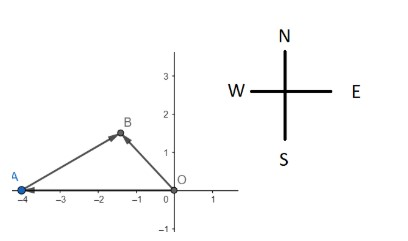
Let A be the position of the girl when she moves 4 km in west direction and B the position of the girl when she moves 3km in 30 east of north direction as shown in the diagram above.
Hence the coordinates of A are (-4,0)
We know that the slope of the line is given by $\tan\theta$ where $\theta$ is an inclination of angle made by line with x-axis .
Here $\theta$ is $30{}^\circ$ then the slope of the line AB is $\tan 30{}^\circ =\dfrac{1}{\sqrt{3}}$
We know by the parametric form of the equation of a line if a point A on a line is at a distance of r from another point $B\left( {{x}_{1}},{{y}_{1}} \right)$ from the line, then the coordinates of A are given by $A\equiv \left( {{x}_{1}}+r\cos \theta ,{{y}_{1}}+r\sin \theta \right)$, where $\theta $ is the angle between the vector BA and the positive direction of the x-axis
Hence by the parametric form of the equation of a line, the equation of line AB is
$\left( -4+r\cos 30{}^\circ ,0+r\sin 30{}^\circ \right)=\left( -4+\dfrac{r\sqrt{3}}{2},\dfrac{r}{2} \right)$, where r is a parameter(the distance of a point on the line above the x-axis from A).
Now, we have for point B, r=3
We know distance between two points is given by formula $\sqrt{(x_2-x_1)^2+(y_2-y_1)^2}$
Hence, we have
$B\equiv \left( -4+\dfrac{3\sqrt{3}}{2},\dfrac{3}{2} \right)$
Hence, we have $OB=\sqrt{{{\left( -4+\dfrac{3\sqrt{3}}{2} \right)}^{2}}+{{\left( \dfrac{3}{2} \right)}^{2}}}=\sqrt{16+\dfrac{27}{4}-12\sqrt{3}+\dfrac{9}{4}}=\sqrt{\dfrac{64+27+9-48\sqrt{3}}{4}}$
Hence, we have
$OB=\sqrt{\dfrac{100-48\sqrt{3}}{4}}=\sqrt{25-12\sqrt{3}}$, which is the magnitude of the net displacement.
Also, the direction of the net displacement is ${{\tan }^{-1}}\left( \dfrac{-4+\dfrac{3\sqrt{3}}{2}}{\dfrac{3}{2}} \right)={{\tan }^{-1}}\dfrac{-8+3\sqrt{3}}{3}$
Note: Alternative solution:
We have $\mathbf{OA}=-4\mathbf{i}$
We know that if a vector of magnitude r makes an angle of $\theta $ with the positive direction of the x-axis, then the vector is given by $r\cos \theta \mathbf{i}+r\sin \theta \mathbf{j}$.
Hence, we have
$\mathbf{AB}=\left( 3 \right)\cos 30{}^\circ \mathbf{i}+3\sin 30{}^\circ \mathbf{j}=\dfrac{3\sqrt{3}}{2}\mathbf{i}+\dfrac{3}{2}\mathbf{j}$
Now from triangle law of vector addition, we have
$\mathbf{OB}=\mathbf{OA}+\mathbf{AB}=-4\mathbf{i}+\dfrac{3\sqrt{3}}{2}\mathbf{i}+\dfrac{3}{2}\mathbf{j}=\left( -4+\dfrac{3\sqrt{3}}{2} \right)\mathbf{i}+\dfrac{3}{2}\mathbf{j}$
We know that the magnitude of the vector $\mathbf{v}=a\mathbf{i}+b\mathbf{j}$ is given by $r=\sqrt{{{a}^{2}}+{{b}^{2}}}$ and the angle made by the vector with the positive direction of the x-axis is given by $\phi ={{\tan }^{-1}}\dfrac{b}{a}$.
Hence the magnitude of the displacement OB $=\sqrt{{{\left( -4+\dfrac{3\sqrt{3}}{2} \right)}^{2}}+{{\left( \dfrac{3}{2} \right)}^{2}}}=\sqrt{25-12\sqrt{3}}$ and the direction of the net displacement OB $={{\tan }^{-1}}\dfrac{-8+3\sqrt{3}}{3}$ radians North of East.
Complete step-by-step answer:
Let the girl start from origin O. The east, west, north and south directions are taken as shown in the diagram.
Let A be the position of the girl when she moves 4 km in west direction and B the position of the girl when she moves 3km in 30 east of north direction as shown in the diagram above.
Hence the coordinates of A are (-4,0)
We know that the slope of the line is given by $\tan\theta$ where $\theta$ is an inclination of angle made by line with x-axis .
Here $\theta$ is $30{}^\circ$ then the slope of the line AB is $\tan 30{}^\circ =\dfrac{1}{\sqrt{3}}$
We know by the parametric form of the equation of a line if a point A on a line is at a distance of r from another point $B\left( {{x}_{1}},{{y}_{1}} \right)$ from the line, then the coordinates of A are given by $A\equiv \left( {{x}_{1}}+r\cos \theta ,{{y}_{1}}+r\sin \theta \right)$, where $\theta $ is the angle between the vector BA and the positive direction of the x-axis
Hence by the parametric form of the equation of a line, the equation of line AB is
$\left( -4+r\cos 30{}^\circ ,0+r\sin 30{}^\circ \right)=\left( -4+\dfrac{r\sqrt{3}}{2},\dfrac{r}{2} \right)$, where r is a parameter(the distance of a point on the line above the x-axis from A).
Now, we have for point B, r=3
We know distance between two points is given by formula $\sqrt{(x_2-x_1)^2+(y_2-y_1)^2}$
Hence, we have
$B\equiv \left( -4+\dfrac{3\sqrt{3}}{2},\dfrac{3}{2} \right)$
Hence, we have $OB=\sqrt{{{\left( -4+\dfrac{3\sqrt{3}}{2} \right)}^{2}}+{{\left( \dfrac{3}{2} \right)}^{2}}}=\sqrt{16+\dfrac{27}{4}-12\sqrt{3}+\dfrac{9}{4}}=\sqrt{\dfrac{64+27+9-48\sqrt{3}}{4}}$
Hence, we have
$OB=\sqrt{\dfrac{100-48\sqrt{3}}{4}}=\sqrt{25-12\sqrt{3}}$, which is the magnitude of the net displacement.
Also, the direction of the net displacement is ${{\tan }^{-1}}\left( \dfrac{-4+\dfrac{3\sqrt{3}}{2}}{\dfrac{3}{2}} \right)={{\tan }^{-1}}\dfrac{-8+3\sqrt{3}}{3}$
Note: Alternative solution:
We have $\mathbf{OA}=-4\mathbf{i}$
We know that if a vector of magnitude r makes an angle of $\theta $ with the positive direction of the x-axis, then the vector is given by $r\cos \theta \mathbf{i}+r\sin \theta \mathbf{j}$.
Hence, we have
$\mathbf{AB}=\left( 3 \right)\cos 30{}^\circ \mathbf{i}+3\sin 30{}^\circ \mathbf{j}=\dfrac{3\sqrt{3}}{2}\mathbf{i}+\dfrac{3}{2}\mathbf{j}$
Now from triangle law of vector addition, we have
$\mathbf{OB}=\mathbf{OA}+\mathbf{AB}=-4\mathbf{i}+\dfrac{3\sqrt{3}}{2}\mathbf{i}+\dfrac{3}{2}\mathbf{j}=\left( -4+\dfrac{3\sqrt{3}}{2} \right)\mathbf{i}+\dfrac{3}{2}\mathbf{j}$
We know that the magnitude of the vector $\mathbf{v}=a\mathbf{i}+b\mathbf{j}$ is given by $r=\sqrt{{{a}^{2}}+{{b}^{2}}}$ and the angle made by the vector with the positive direction of the x-axis is given by $\phi ={{\tan }^{-1}}\dfrac{b}{a}$.
Hence the magnitude of the displacement OB $=\sqrt{{{\left( -4+\dfrac{3\sqrt{3}}{2} \right)}^{2}}+{{\left( \dfrac{3}{2} \right)}^{2}}}=\sqrt{25-12\sqrt{3}}$ and the direction of the net displacement OB $={{\tan }^{-1}}\dfrac{-8+3\sqrt{3}}{3}$ radians North of East.
Recently Updated Pages
Master Class 12 Business Studies: Engaging Questions & Answers for Success

Master Class 12 Biology: Engaging Questions & Answers for Success
Master Class 12 Chemistry: Engaging Questions & Answers for Success
Class 12 Question and Answer - Your Ultimate Solutions Guide
Master Class 11 Social Science: Engaging Questions & Answers for Success
Master Class 11 English: Engaging Questions & Answers for Success
Trending doubts
Which is more stable and why class 12 chemistry CBSE
Which are the Top 10 Largest Countries of the World?
Draw a labelled sketch of the human eye class 12 physics CBSE
Differentiate between homogeneous and heterogeneous class 12 chemistry CBSE
What are the major means of transport Explain each class 12 social science CBSE
Sulphuric acid is known as the king of acids State class 12 chemistry CBSE