




How is a galvanometer converted into a voltmeter and an ammeter? Draw the relevant diagrams and find the resistance of the arrangement in each case. Take the resistance of the galvanometer as $G$.
Answer
 Verified
538.8k+ views
Hint: First of all, here we will understand about galvanometers, ammeters and voltmeters. We know that a galvanometer is a device used to detect small electric current flowing through the circuit whereas an ammeter is a device used to measure the amount of current flowing in the circuit. A voltmeter is a device used to measure the potential difference. And then we will draw the diagram and then find the resistance of the circuit.
Complete step by step answer:
Conversion of galvanometer into voltmeter: To convert a galvanometer into a voltmeter we simply add a high resistance in series with and here we go we have a voltmeter and below given is its circuit diagram.
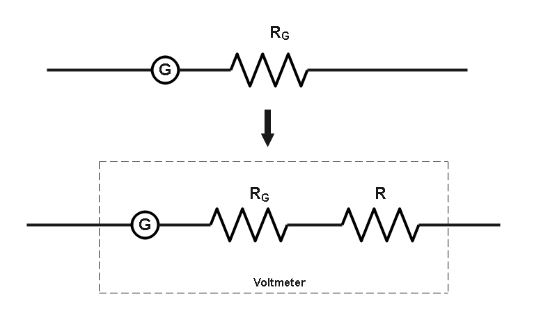
Now resistance of the arrangement:Here we can easily add the resistance as it is in series.Therefore, ${R_v} = {R_G} + R$
Conversion of galvanometer into ammeter: To convert galvanometer into an ammeter we simply add a low resistance called shunt in parallel combination with and here we go we have an ammeter and below given is its circuit diagram.
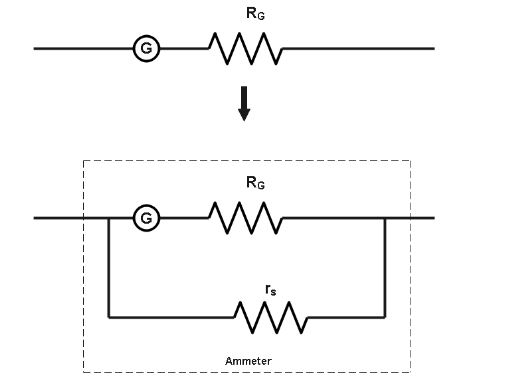
Now resistance of the arrangement: Here we can easily add the resistance as it is in parallel and we will apply a parallel combination.Therefore, \[{R_A} = \dfrac{{G{r_s}}}{{G + {r_s}}}\]
Note: Voltmeter is a high resistance device and it is always connected in parallel with the circuit element across which the potential difference can be calculated and an ideal voltmeter has an infinite amount of resistance. An ammeter is a low resistance device and it is always connected in series combination to the circuit and an ideal ammeter has no resistance, meaning zero resistance.
Complete step by step answer:
Conversion of galvanometer into voltmeter: To convert a galvanometer into a voltmeter we simply add a high resistance in series with and here we go we have a voltmeter and below given is its circuit diagram.
Now resistance of the arrangement:Here we can easily add the resistance as it is in series.Therefore, ${R_v} = {R_G} + R$
Conversion of galvanometer into ammeter: To convert galvanometer into an ammeter we simply add a low resistance called shunt in parallel combination with and here we go we have an ammeter and below given is its circuit diagram.
Now resistance of the arrangement: Here we can easily add the resistance as it is in parallel and we will apply a parallel combination.Therefore, \[{R_A} = \dfrac{{G{r_s}}}{{G + {r_s}}}\]
Note: Voltmeter is a high resistance device and it is always connected in parallel with the circuit element across which the potential difference can be calculated and an ideal voltmeter has an infinite amount of resistance. An ammeter is a low resistance device and it is always connected in series combination to the circuit and an ideal ammeter has no resistance, meaning zero resistance.
Recently Updated Pages
Master Class 12 Economics: Engaging Questions & Answers for Success

Master Class 12 Social Science: Engaging Questions & Answers for Success
Master Class 12 English: Engaging Questions & Answers for Success
Master Class 12 Maths: Engaging Questions & Answers for Success
Master Class 12 Physics: Engaging Questions & Answers for Success
Master Class 12 Biology: Engaging Questions & Answers for Success
Trending doubts
Draw a labelled sketch of the human eye class 12 physics CBSE
Which are the Top 10 Largest Countries of the World?
Draw ray diagrams each showing i myopic eye and ii class 12 physics CBSE
Which is the correct genotypic ratio of mendel dihybrid class 12 biology CBSE
Differentiate between homogeneous and heterogeneous class 12 chemistry CBSE
Which animal never drinks water in its entire life class 12 biology CBSE