




A fruit grower can use two types of fertilizer in his garden, brand P and brand Q. The amounts (in kg) of nitrogen, phosphoric acid, potash, and chlorine in a bag of each brand are given in the table. Tests indicate that the garden needs at least 240 kg of phosphoric acid, at least 270 kg of potash and at most 310 kg of chlorine.
If the grower wants to minimize the amount of nitrogen added to the garden, how many bags of each brand should be used? What is the minimum amount of nitrogen added in the garden?
Kg per bag Brand P Brand Q Nitrogen 3 3.5 Phosphoric acid 1 2 Potash 3 1.5 Chlorine 1.5 2
| Kg per bag | Brand P | Brand Q |
| Nitrogen | 3 | 3.5 |
| Phosphoric acid | 1 | 2 |
| Potash | 3 | 1.5 |
| Chlorine | 1.5 | 2 |
Answer
 Verified
585k+ views
Hint: Here we will first find the constraint equations from the data given in the question. Then we will find the objective function for the minimum amount of nitrogen. We will plot the constraints in the graph and then find the corner points. We will then check at which corner point the objective function is minimum.
Complete step-by-step answer:
First, we will assume the number of packages of brand P required and the package of brand Q required. Therefore
Let \[X\] be the number of packages of brand P required and \[Y\] be the number of packages of brand Q required.
Now we will make the conditional statements from the data given in the question.
It is given that the garden needs at least 240 kg of phosphoric acid. Since the bag of brand P contains 1 kg and the bag of brand Q contains 2 kg of Phosphoric acid. So, from this we will form an equation, we get
\[X + 2Y \ge 240\]…………………….\[\left( 1 \right)\]
It is given that the garden needs at least 270 kg of potash. Since the bag of brand P contains 3 kg and the bag of brand Q contains 1.5 kg of potash. So, from this we will form an equation, we get
\[3X + 1.5Y \ge 270\]
Dividing both sides by \[1.5\], we get
$\Rightarrow$ \[2X + Y \ge 180\]…………………….\[\left( 2 \right)\]
It is given that the garden needs at most 310 kg of chlorine. Since the bag of brand P contains 1.5 kg and the bag of brand Q contains 2 kg of chlorine. So, from this we will form an equation, we get
\[1.5X + 2Y \le 310\]…………………….\[\left( 3 \right)\]
Also we know that the quantity of the packages required cannot be negative. Therefore, we get
\[X \ge 0\] and \[Y \ge 0\]…………………….\[\left( 4 \right)\]
Now we have to make the objective function of the equation. As we have the minimum amount of nitrogen added in the garden. It is given that the Bag of brand P contains 3 kg of Nitrogen and Bag of brand Q contains \[3.5\] kg of Nitrogen.
Therefore, the objective function is \[Z = 3X + 3.5Y\].
Now we have to plot all the equations constraints from the equations \[\left( 1 \right)\], \[\left( 2 \right)\], \[\left( 3 \right)\] and \[\left( 4 \right)\] in the graph to get the feasible region.
Now we will get all the corner points and check at what point the value of minimum amount of nitrogen.
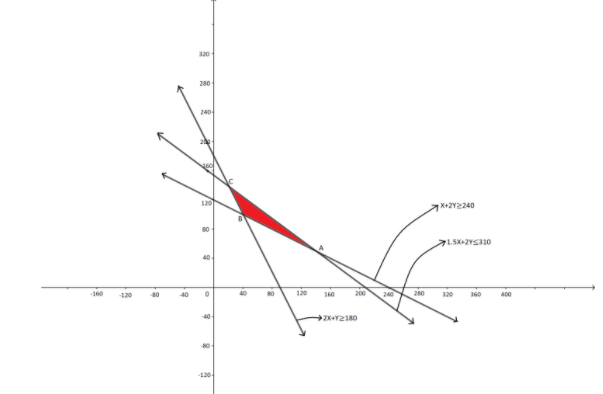
Hence, there are three corner points of the feasible region i.e. \[A\left( {140,50} \right),B\left( {40,100} \right),C\left( {20,140} \right)\].
Now, we will find the value of the objective function at every corner point and find that corner point at which the objective function is minimum. Therefore, we get
Objective function at corner point \[A\left( {140,50} \right)\] is
$\Rightarrow$ \[Z = 3\left( {140} \right) + 3.5\left( {50} \right) = 595\]
Objective function at corner point \[B\left( {40,100} \right)\] is
$\Rightarrow$ \[Z = 3\left( {40} \right) + 3.5\left( {100} \right) = 470\]
Objective function at corner point \[C\left( {20,140} \right)\] is
$\Rightarrow$ \[Z = 3\left( {20} \right) + 3.5\left( {140} \right) = 550\]
So, we can clearly see that the objective function is minimum at corner point \[B\left( {40,100} \right)\] i.e. at \[X = 40\] and \[Y = 100\].
Hence, the number of packages of brand P required are 40 and the package of brand Q required are 100 to minimize the amount of nitrogen added in the garden.
Hence, the minimum amount of nitrogen added in the garden is equal to 470kg.
Note: Here we have to note that the constraints equation should be formed carefully. While forming the equations we don’t have to convert the amount given in Kg into any other measuring units. We have to note that we cannot take the origin as the corner point then the value of the objective function will be zero.
Feasible region is the search space or the solution space where the value of the objective function is optimal. Maximum and the minimum value of the objective function are generally at the corner points of the feasible region.
Complete step-by-step answer:
First, we will assume the number of packages of brand P required and the package of brand Q required. Therefore
Let \[X\] be the number of packages of brand P required and \[Y\] be the number of packages of brand Q required.
Now we will make the conditional statements from the data given in the question.
It is given that the garden needs at least 240 kg of phosphoric acid. Since the bag of brand P contains 1 kg and the bag of brand Q contains 2 kg of Phosphoric acid. So, from this we will form an equation, we get
\[X + 2Y \ge 240\]…………………….\[\left( 1 \right)\]
It is given that the garden needs at least 270 kg of potash. Since the bag of brand P contains 3 kg and the bag of brand Q contains 1.5 kg of potash. So, from this we will form an equation, we get
\[3X + 1.5Y \ge 270\]
Dividing both sides by \[1.5\], we get
$\Rightarrow$ \[2X + Y \ge 180\]…………………….\[\left( 2 \right)\]
It is given that the garden needs at most 310 kg of chlorine. Since the bag of brand P contains 1.5 kg and the bag of brand Q contains 2 kg of chlorine. So, from this we will form an equation, we get
\[1.5X + 2Y \le 310\]…………………….\[\left( 3 \right)\]
Also we know that the quantity of the packages required cannot be negative. Therefore, we get
\[X \ge 0\] and \[Y \ge 0\]…………………….\[\left( 4 \right)\]
Now we have to make the objective function of the equation. As we have the minimum amount of nitrogen added in the garden. It is given that the Bag of brand P contains 3 kg of Nitrogen and Bag of brand Q contains \[3.5\] kg of Nitrogen.
Therefore, the objective function is \[Z = 3X + 3.5Y\].
Now we have to plot all the equations constraints from the equations \[\left( 1 \right)\], \[\left( 2 \right)\], \[\left( 3 \right)\] and \[\left( 4 \right)\] in the graph to get the feasible region.
Now we will get all the corner points and check at what point the value of minimum amount of nitrogen.
Hence, there are three corner points of the feasible region i.e. \[A\left( {140,50} \right),B\left( {40,100} \right),C\left( {20,140} \right)\].
Now, we will find the value of the objective function at every corner point and find that corner point at which the objective function is minimum. Therefore, we get
Objective function at corner point \[A\left( {140,50} \right)\] is
$\Rightarrow$ \[Z = 3\left( {140} \right) + 3.5\left( {50} \right) = 595\]
Objective function at corner point \[B\left( {40,100} \right)\] is
$\Rightarrow$ \[Z = 3\left( {40} \right) + 3.5\left( {100} \right) = 470\]
Objective function at corner point \[C\left( {20,140} \right)\] is
$\Rightarrow$ \[Z = 3\left( {20} \right) + 3.5\left( {140} \right) = 550\]
So, we can clearly see that the objective function is minimum at corner point \[B\left( {40,100} \right)\] i.e. at \[X = 40\] and \[Y = 100\].
Hence, the number of packages of brand P required are 40 and the package of brand Q required are 100 to minimize the amount of nitrogen added in the garden.
Hence, the minimum amount of nitrogen added in the garden is equal to 470kg.
Note: Here we have to note that the constraints equation should be formed carefully. While forming the equations we don’t have to convert the amount given in Kg into any other measuring units. We have to note that we cannot take the origin as the corner point then the value of the objective function will be zero.
Feasible region is the search space or the solution space where the value of the objective function is optimal. Maximum and the minimum value of the objective function are generally at the corner points of the feasible region.
Recently Updated Pages
Three beakers labelled as A B and C each containing 25 mL of water were taken A small amount of NaOH anhydrous CuSO4 and NaCl were added to the beakers A B and C respectively It was observed that there was an increase in the temperature of the solutions contained in beakers A and B whereas in case of beaker C the temperature of the solution falls Which one of the following statements isarecorrect i In beakers A and B exothermic process has occurred ii In beakers A and B endothermic process has occurred iii In beaker C exothermic process has occurred iv In beaker C endothermic process has occurred

Master Class 12 Social Science: Engaging Questions & Answers for Success
Master Class 12 Physics: Engaging Questions & Answers for Success
Master Class 12 Maths: Engaging Questions & Answers for Success
Master Class 12 Economics: Engaging Questions & Answers for Success
Master Class 12 Chemistry: Engaging Questions & Answers for Success
Three beakers labelled as A B and C each containing 25 mL of water were taken A small amount of NaOH anhydrous CuSO4 and NaCl were added to the beakers A B and C respectively It was observed that there was an increase in the temperature of the solutions contained in beakers A and B whereas in case of beaker C the temperature of the solution falls Which one of the following statements isarecorrect i In beakers A and B exothermic process has occurred ii In beakers A and B endothermic process has occurred iii In beaker C exothermic process has occurred iv In beaker C endothermic process has occurred
Master Class 12 Social Science: Engaging Questions & Answers for Success
Master Class 12 Physics: Engaging Questions & Answers for Success
Trending doubts
Which are the Top 10 Largest Countries of the World?
Draw a labelled sketch of the human eye class 12 physics CBSE
What are the major means of transport Explain each class 12 social science CBSE
Differentiate between homogeneous and heterogeneous class 12 chemistry CBSE
Sulphuric acid is known as the king of acids State class 12 chemistry CBSE
Why should a magnesium ribbon be cleaned before burning class 12 chemistry CBSE