




When a forward bias is applied to a p-n junction, it.
Answer
 Verified
519.9k+ views
Hint: A p-n junction diode device is made when a p-type semiconductor is fused to an n-type semiconductor forming a potential barrier voltage across the diode junction. Generally, it’s a semiconductor device that controls the flow of current in a circuit. In the forward bias condition, a negative voltage is applied on the N-side and is connected with a negative voltage, and P-side is connected with a positive voltage.
Complete answer:
In the p-n junction diode, a depletion region is made due to the recombination of holes and electrons. Electrons from the n side move towards the p side, and holes from the p side move towards the n side to make the depletion region. As a result, an electric field in the opposite direction is formed whenever the external voltage is applied; this is often nothing but barrier potential.
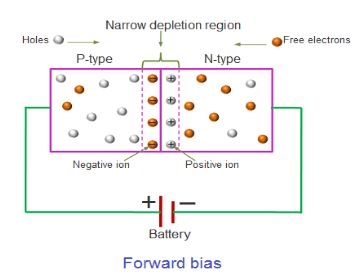
In forward biasing, the p-type is connected with the positive terminal and thus the n-type is connected with the negative terminal of the battery then, the holes in the p-type region and therefore the electrons within the n-type region are pushed towards the junction which reduces the width of the depletion layer. Also the distance between the diffused holes and electrons decreases which ends up in a decrease in field within the depletion region. Hence, the potential barrier decreases.
Note: The width of the depletion layer in a p-n junction diode decreases in forward bias because of the repulsion of carriers from battery terminals, holes from p-type, and electrons from n-type. Now, due to the small number of ions within the depletion region, its potential decreases.
Complete answer:
In the p-n junction diode, a depletion region is made due to the recombination of holes and electrons. Electrons from the n side move towards the p side, and holes from the p side move towards the n side to make the depletion region. As a result, an electric field in the opposite direction is formed whenever the external voltage is applied; this is often nothing but barrier potential.
In forward biasing, the p-type is connected with the positive terminal and thus the n-type is connected with the negative terminal of the battery then, the holes in the p-type region and therefore the electrons within the n-type region are pushed towards the junction which reduces the width of the depletion layer. Also the distance between the diffused holes and electrons decreases which ends up in a decrease in field within the depletion region. Hence, the potential barrier decreases.
Note: The width of the depletion layer in a p-n junction diode decreases in forward bias because of the repulsion of carriers from battery terminals, holes from p-type, and electrons from n-type. Now, due to the small number of ions within the depletion region, its potential decreases.
Recently Updated Pages
Master Class 12 Business Studies: Engaging Questions & Answers for Success

Master Class 12 Chemistry: Engaging Questions & Answers for Success
Master Class 12 Biology: Engaging Questions & Answers for Success
Class 12 Question and Answer - Your Ultimate Solutions Guide
Master Class 11 English: Engaging Questions & Answers for Success
Master Class 11 Social Science: Engaging Questions & Answers for Success
Trending doubts
Which are the Top 10 Largest Countries of the World?
The total number of vertebrae in man is a30 b31 c32 class 12 biology CBSE
Draw a labelled sketch of the human eye class 12 physics CBSE
The number of cranial nerves in a frog is A 10 pairs class 12 biology CBSE
Differentiate between homogeneous and heterogeneous class 12 chemistry CBSE
Differentiate between Pyramid of energy and pyramid class 12 biology CBSE