




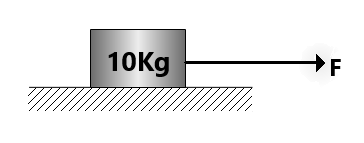
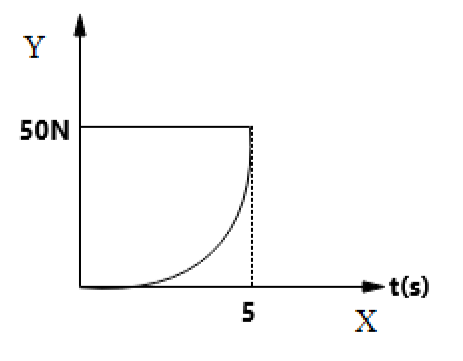
A force F is applied to the initially stationary cart. The variation of force with time is shown in the figure. The speed of cart at $t=5s$ is?
A. $10m{{s}^{-1}}$
B. $8.33m{{s}^{-1}}$
C. $2m{{s}^{-1}}$
D. Zero
Answer
 Verified
601.2k+ views
Hint:We are given the force-time graph of a body going under non-uniformly accelerated motion. For a body going under non-uniformly accelerated motion, the Newton’s equations of motion cannot be used. A non-uniformly accelerated motion is one where the body accelerates or decelerates at any instances of time during the observed motion. Thus, in this case we take the instantaneous velocity of the body under consideration.
Complete step-by-step solution:
The slope on the position-time graph is equal to the instantaneous velocity. This is a way of finding instantaneous velocity without using calculus.
The equation of the given parabolic graph is:
$\begin{align}
& F\propto {{t}^{2}} \\
& \Rightarrow F=k{{t}^{2}} \\
\end{align}$
Where,
$F=$ force (on y-axis)
$t=$time (on x-axis)
$k=$proportionality constant
$\begin{align}
& \Rightarrow 50=k{{\left( 5 \right)}^{2}} \\
& \Rightarrow k=2 \\
\end{align}$
$\therefore F=2{{t}^{2}}$
We also know that, $F=ma$
Where,
$m=$mass of body $=10Kg$(here)
$a=$acceleration of body
$\begin{align}
& \Rightarrow ma=2{{t}^{2}} \\
& \Rightarrow \left( 10 \right)a=2{{t}^{2}} \\
\end{align}$
$\Rightarrow a=0.2{{t}^{2}}$ …………….. equation (1)
To find the instantaneous velocity \[\left( {{V}_{\text{instantaneous}}} \right)\], we have to divide an infinitesimally-small displacement with an infinitesimally-small time interval which would practically be equal to an indeterminate form of limit (or $\dfrac{0}{0}$). Hence, sir Isaac Newton invented a whole new form of mathematics called calculus.
$\begin{align}
& {{V}_{\text{instantaneous}}}=\underset{h\to 0}{\mathop{\lim }}\,\dfrac{x\left( t+h \right)-x\left( t \right)}{h} \\
& \text{Or }{{V}_{\text{instantaneous}}}=\dfrac{dx}{dt} \\
\end{align}$
Similarly, instantaneous acceleration, ${{a}_{\text{instantaneous}}}=\dfrac{dv}{dt}$
$\begin{align}
& \Rightarrow \int{dv}=\int{{{a}_{\text{instantaneous}}}.dt} \\
& \Rightarrow v=\int{{{a}_{\text{instantaneous}}}.dt} \\
\end{align}$
From equation (1),
$\Rightarrow v=\int\limits_{0}^{t}{0.2{{t}^{2}}.dt}$
At $t=5s,$
$\Rightarrow v=\int\limits_{0}^{5}{0.2{{t}^{2}}.dt}$
$\Rightarrow v=0.2\left[ \dfrac{{{t}^{3}}}{3} \right]_{0}^{5}$
$\begin{align}
& \Rightarrow v=0.2\left( \dfrac{{{5}^{3}}-{{0}^{3}}}{3} \right) \\
& \Rightarrow v=0.2\left( \dfrac{125}{3} \right) \\
& \Rightarrow v=8.33m{{s}^{-1}} \\
\end{align}$
The speed of the cart at $t=5s$ is $8.33m{{s}^{-1}}$.
Therefore, the correct option is (B) $8.33m{{s}^{-1}}$.
Note:
The instantaneous velocity is the velocity of an object at a particular moment in time. This is different from the average velocity of the object. The average velocity is equal to the total displacement divided by the total time taken during the motion. It does not change with the acceleration or deceleration of the object taking place during the motion.
Complete step-by-step solution:
The slope on the position-time graph is equal to the instantaneous velocity. This is a way of finding instantaneous velocity without using calculus.
The equation of the given parabolic graph is:
$\begin{align}
& F\propto {{t}^{2}} \\
& \Rightarrow F=k{{t}^{2}} \\
\end{align}$
Where,
$F=$ force (on y-axis)
$t=$time (on x-axis)
$k=$proportionality constant
$\begin{align}
& \Rightarrow 50=k{{\left( 5 \right)}^{2}} \\
& \Rightarrow k=2 \\
\end{align}$
$\therefore F=2{{t}^{2}}$
We also know that, $F=ma$
Where,
$m=$mass of body $=10Kg$(here)
$a=$acceleration of body
$\begin{align}
& \Rightarrow ma=2{{t}^{2}} \\
& \Rightarrow \left( 10 \right)a=2{{t}^{2}} \\
\end{align}$
$\Rightarrow a=0.2{{t}^{2}}$ …………….. equation (1)
To find the instantaneous velocity \[\left( {{V}_{\text{instantaneous}}} \right)\], we have to divide an infinitesimally-small displacement with an infinitesimally-small time interval which would practically be equal to an indeterminate form of limit (or $\dfrac{0}{0}$). Hence, sir Isaac Newton invented a whole new form of mathematics called calculus.
$\begin{align}
& {{V}_{\text{instantaneous}}}=\underset{h\to 0}{\mathop{\lim }}\,\dfrac{x\left( t+h \right)-x\left( t \right)}{h} \\
& \text{Or }{{V}_{\text{instantaneous}}}=\dfrac{dx}{dt} \\
\end{align}$
Similarly, instantaneous acceleration, ${{a}_{\text{instantaneous}}}=\dfrac{dv}{dt}$
$\begin{align}
& \Rightarrow \int{dv}=\int{{{a}_{\text{instantaneous}}}.dt} \\
& \Rightarrow v=\int{{{a}_{\text{instantaneous}}}.dt} \\
\end{align}$
From equation (1),
$\Rightarrow v=\int\limits_{0}^{t}{0.2{{t}^{2}}.dt}$
At $t=5s,$
$\Rightarrow v=\int\limits_{0}^{5}{0.2{{t}^{2}}.dt}$
$\Rightarrow v=0.2\left[ \dfrac{{{t}^{3}}}{3} \right]_{0}^{5}$
$\begin{align}
& \Rightarrow v=0.2\left( \dfrac{{{5}^{3}}-{{0}^{3}}}{3} \right) \\
& \Rightarrow v=0.2\left( \dfrac{125}{3} \right) \\
& \Rightarrow v=8.33m{{s}^{-1}} \\
\end{align}$
The speed of the cart at $t=5s$ is $8.33m{{s}^{-1}}$.
Therefore, the correct option is (B) $8.33m{{s}^{-1}}$.
Note:
The instantaneous velocity is the velocity of an object at a particular moment in time. This is different from the average velocity of the object. The average velocity is equal to the total displacement divided by the total time taken during the motion. It does not change with the acceleration or deceleration of the object taking place during the motion.
Recently Updated Pages
Master Class 12 Business Studies: Engaging Questions & Answers for Success

Master Class 12 Chemistry: Engaging Questions & Answers for Success
Master Class 12 Biology: Engaging Questions & Answers for Success
Class 12 Question and Answer - Your Ultimate Solutions Guide
Master Class 11 English: Engaging Questions & Answers for Success
Master Class 11 Social Science: Engaging Questions & Answers for Success
Trending doubts
Which are the Top 10 Largest Countries of the World?
Draw a labelled sketch of the human eye class 12 physics CBSE
Differentiate between homogeneous and heterogeneous class 12 chemistry CBSE
Differentiate between Pyramid of energy and pyramid class 12 biology CBSE
Why is the cell called the structural and functional class 12 biology CBSE
Draw the diagram of the pyramid of energy Explain In class 12 biology CBSE