




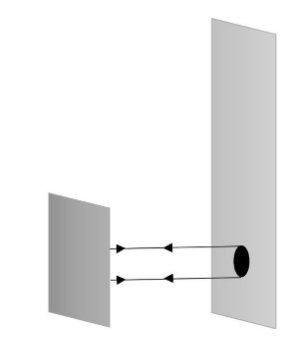
A flat mirror M is arranged parallel to a wall W at a distance 1m from it. The light produced by a point source S kept on the wall is reflected by the mirror and produces a light spot on the wall. The mirror moves with velocity ‘v’ towards the wall.
A. The spot light will move with the speed v on the wall.
B. The spot of light will not move on the wall.
C. As the mirror comes closer, the spot will become larger and shift away from the wall with speed larger then v.
D. The size of the light spot on the wall remains the same.
Answer
 Verified
637.8k+ views
Hint: Magnification of a mirror, lens or any device may be defined as the measure of how enlarged the image is. Mathematically it is defined as the ratio of height of image to the height of object. If a mirror, which produces both enlarged and diminished images of the object (for example: Concave mirror), magnification could be lesser than or greater than unity.
Formula used:
$m = \dfrac vu = \dfrac{h_i}{h_o}$
Complete Answer:
Here, we are asked about the effect on dimensions (size) of the image on the wall. In case of a plane mirror, we know it has a property that the image distance must be equal to object distance. Hence, in this case, $u = v$, thus magnification
$|m|= \dfrac vu= 1$
Hence we can say the ratio of height of image and object is 1 or size of image is equal to size of object.
Hence option D. is correct, since the movement of the mirror will only change the image and object distance of the object, ratio still being the same.
Further, the situation could be described in the figure:
 [Smaller = mirror; Larger = wall]
Now, if the mirror starts moving, as both mirror and wall are parallel, there won’t be any deflection in the height of the image. Hence the spot won’t move either.
Hence option B. is also correct.
Note: The height of image defines the size of image and if the size of image remains the same, the image can never move on the wall. Students should also remember that the focal length of a mirror is infinity. Hence one can also prove $u = v$ by using mirror formula.
Formula used:
$m = \dfrac vu = \dfrac{h_i}{h_o}$
Complete Answer:
Here, we are asked about the effect on dimensions (size) of the image on the wall. In case of a plane mirror, we know it has a property that the image distance must be equal to object distance. Hence, in this case, $u = v$, thus magnification
$|m|= \dfrac vu= 1$
Hence we can say the ratio of height of image and object is 1 or size of image is equal to size of object.
Hence option D. is correct, since the movement of the mirror will only change the image and object distance of the object, ratio still being the same.
Further, the situation could be described in the figure:
Now, if the mirror starts moving, as both mirror and wall are parallel, there won’t be any deflection in the height of the image. Hence the spot won’t move either.
Hence option B. is also correct.
Note: The height of image defines the size of image and if the size of image remains the same, the image can never move on the wall. Students should also remember that the focal length of a mirror is infinity. Hence one can also prove $u = v$ by using mirror formula.
Recently Updated Pages
Basicity of sulphurous acid and sulphuric acid are

Master Class 12 Economics: Engaging Questions & Answers for Success
Master Class 12 Biology: Engaging Questions & Answers for Success
Master Class 11 English: Engaging Questions & Answers for Success
Master Class 11 Physics: Engaging Questions & Answers for Success
Master Class 11 Computer Science: Engaging Questions & Answers for Success
Trending doubts
Draw a labelled sketch of the human eye class 12 physics CBSE
Why is the cell called the structural and functional class 12 biology CBSE
Draw ray diagrams each showing i myopic eye and ii class 12 physics CBSE
Which are the Top 10 Largest Countries of the World?
Differentiate between homogeneous and heterogeneous class 12 chemistry CBSE
Which is the correct genotypic ratio of mendel dihybrid class 12 biology CBSE