




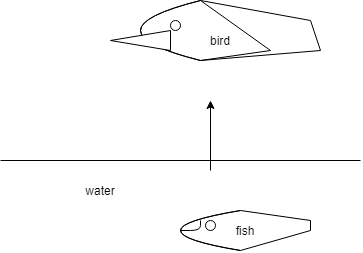
A fish is vertically below a flying bird moving vertically down toward the water surface. The bird will appear to the fish to be
A) Moving faster than its speed and also away from the real distance
B) Moving faster than its real speed and nearer than its real distance
C) Moving slower than its real speed and also nearer than its real distance
D) Moving slower than its real speed and away from the real distance.
Answer
 Verified
611.7k+ views
Hint:In refraction when an object is submerged into another medium say water then the light has to travel from the rare medium which is air to the denser medium and hence it bends from the real path. The real depth is more from what it is observed and this same case follows for the speed also.
Step by step solution:
Step 1:
Before we start let us see what refraction is, as it is going to play an important role in solving the question.
Refraction of light: Refraction of light states that deflection from a straight path undergone by a light ray or energy wave in passing obliquely from one medium (such as air) into another (such as glass) in which its velocity is different
Its formula is based on Snell’s law. If i is the angle of incidence and r is the angle of refraction then according to Snell’s law, $\dfrac{{\sin i}}{{\sin r}} = cons\tan t = \mu $. This value is termed as the refractive index of the second medium with respect to the first medium. The index of refraction of a material depends on the material’s properties.
Step 2:
From the question:
The fish is watching the bird. This means the light rays are coming from the bird to the eyes to the fish.
The surface of water will act as a plane surface
Then, refraction at a plane surface is given by$\dfrac{1}{{{\mu _{water}}}} = \dfrac{{Real{\text{ }}depth{\text{ }}}}{{Apparent{\text{ }}depth}}$ ……. (1)
In similar way it is also written as $\dfrac{1}{{{\mu _{water}}}}$ =$\dfrac{{real{\text{ speed }}}}{{apparent{\text{ speed}}}}$ ……. (2)
In refraction the real depth is more than the apparent depth, in the similar way in equation 2 also the real speed will be more than the apparent speed.
Hence, the speed and the distance both are increasing. Therefore, the bird will appear to be moving fast and also its distance will be more than the real distance.
So option A is the correct answer.
Note:The most common way to see the refraction is the example of the coin in a glass which is full of water. During the refraction when light rays are falling from rarer medium to the denser medium then the rays will bend toward the normal and when it goes from denser medium to the rarer medium then it bends away from the normal.
Step by step solution:
Step 1:
Before we start let us see what refraction is, as it is going to play an important role in solving the question.
Refraction of light: Refraction of light states that deflection from a straight path undergone by a light ray or energy wave in passing obliquely from one medium (such as air) into another (such as glass) in which its velocity is different
Its formula is based on Snell’s law. If i is the angle of incidence and r is the angle of refraction then according to Snell’s law, $\dfrac{{\sin i}}{{\sin r}} = cons\tan t = \mu $. This value is termed as the refractive index of the second medium with respect to the first medium. The index of refraction of a material depends on the material’s properties.
Step 2:
From the question:
The fish is watching the bird. This means the light rays are coming from the bird to the eyes to the fish.
The surface of water will act as a plane surface
Then, refraction at a plane surface is given by$\dfrac{1}{{{\mu _{water}}}} = \dfrac{{Real{\text{ }}depth{\text{ }}}}{{Apparent{\text{ }}depth}}$ ……. (1)
In similar way it is also written as $\dfrac{1}{{{\mu _{water}}}}$ =$\dfrac{{real{\text{ speed }}}}{{apparent{\text{ speed}}}}$ ……. (2)
In refraction the real depth is more than the apparent depth, in the similar way in equation 2 also the real speed will be more than the apparent speed.
Hence, the speed and the distance both are increasing. Therefore, the bird will appear to be moving fast and also its distance will be more than the real distance.
So option A is the correct answer.
Note:The most common way to see the refraction is the example of the coin in a glass which is full of water. During the refraction when light rays are falling from rarer medium to the denser medium then the rays will bend toward the normal and when it goes from denser medium to the rarer medium then it bends away from the normal.
Recently Updated Pages
Master Class 12 Economics: Engaging Questions & Answers for Success

Master Class 12 English: Engaging Questions & Answers for Success
Master Class 12 Social Science: Engaging Questions & Answers for Success
Master Class 12 Maths: Engaging Questions & Answers for Success
Master Class 12 Physics: Engaging Questions & Answers for Success
Master Class 12 Business Studies: Engaging Questions & Answers for Success
Trending doubts
Which are the Top 10 Largest Countries of the World?
Draw a labelled sketch of the human eye class 12 physics CBSE
Differentiate between homogeneous and heterogeneous class 12 chemistry CBSE
Sulphuric acid is known as the king of acids State class 12 chemistry CBSE
Why is the cell called the structural and functional class 12 biology CBSE
Draw ray diagrams each showing i myopic eye and ii class 12 physics CBSE