




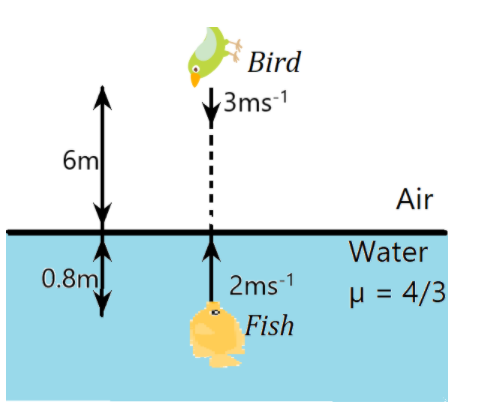
A fish F, in the pond is at a depth of 0.8m from the water surface and is moving vertically upward with velocity 2ms-1. At the same instant, a bird B is at a height of 6m from the water surface and is moving downward with the velocity 3ms-1. At this instant, both are on the same vertical line as shown in the figure. Which of the following statements are correct?
A. Height of B, observed by F from itself, is equal to 5.30m
B. Depth of F, observed by B from itself, is equal to 6.60m
C. Height of B, observed by F from itself, is equal to 8.80m
D. Depth of F, observed by B from itself, is equal to 4.50m
Answer
 Verified
612.9k+ views
Hint: The question is clearly asking for actual depth and height at which the objects are viewed with respect to each other. They're the sum of apparent and real, depth and height respectively. Firstly, we need to find the apparent quantities and then add them to the actual quantities. The velocity does not affect the apparent depth or apparent height.
Formula used:
$\dfrac{{{d'}}}{{{\mu '}}} = \dfrac{d}{\mu }$
$\dfrac{h}{\mu } = \dfrac{{{h'}}}{{{\mu '}}}$
Complete answer:
It is given in the question, that the real depth of the F (fish) is 0.8m. The apparent depth of the fish is given by
$\dfrac{{{d'}}}{{{\mu '}}} = \dfrac{d}{\mu }$
Where
${d'}$ is the apparent depth of F
$d$ is the real depth
${\mu '}$ is the refractive index of air
$\mu $ is the refractive index of water
Substituting the values given in the question, we have
$\eqalign{
& {\dfrac{d}{{{\mu '}}}'} = \dfrac{d}{\mu } \cr
& \Rightarrow {d'} = \dfrac{{0.8}}{{\dfrac{4}{3}}} \times 1 = 0.6m \cr} $
Thus, the depth of F, seen by B from itself, is equivalent to$0.6 + 6 = 6.6m$
Similarly, the apparent height can be found,
$\eqalign{
& \dfrac{h}{\mu } = \dfrac{{{h'}}}{{{\mu '}}} \cr
& \Rightarrow h = \mu \times \dfrac{{{h'}}}{{{\mu '}}} = \dfrac{4}{3} \times \dfrac{6}{1} = 8m \cr} $
Here:
$h$ is the apparent height of B
${h'}$ is the real height
${\mu '}$ is the refractive index of air
$\mu $ is the refractive index of water
Thus, the height of B, seen by F from itself, is equivalent to $8 + 0.8 = 8.8m$
Therefore, the correct options are B and C.
Note:
If you find the apparent height and apparent depth to be confusing, understand that $length \propto \mu $. So, apparent length $ \propto $µ of the medium from which the image is viewed. The same applies for real length,
Real length $ \propto $µ of medium in which object is present.
We always assume that the refractive index of air is 1, least mentioned.
The humblest way to approach the problem would be by understanding refractive indices. As the refractive index of water is greater than that of air, we would actually see the image of F at a closer distance than the actual depth. So, B will observe F, from a distance <6.8m. But the change will be tiny, not too huge. By this method we’ll arrive at option B.
Now using the same approach, we would actually see the image of B at a farther distance than the actual height, which leaves us with option C.
Formula used:
$\dfrac{{{d'}}}{{{\mu '}}} = \dfrac{d}{\mu }$
$\dfrac{h}{\mu } = \dfrac{{{h'}}}{{{\mu '}}}$
Complete answer:
It is given in the question, that the real depth of the F (fish) is 0.8m. The apparent depth of the fish is given by
$\dfrac{{{d'}}}{{{\mu '}}} = \dfrac{d}{\mu }$
Where
${d'}$ is the apparent depth of F
$d$ is the real depth
${\mu '}$ is the refractive index of air
$\mu $ is the refractive index of water
Substituting the values given in the question, we have
$\eqalign{
& {\dfrac{d}{{{\mu '}}}'} = \dfrac{d}{\mu } \cr
& \Rightarrow {d'} = \dfrac{{0.8}}{{\dfrac{4}{3}}} \times 1 = 0.6m \cr} $
Thus, the depth of F, seen by B from itself, is equivalent to$0.6 + 6 = 6.6m$
Similarly, the apparent height can be found,
$\eqalign{
& \dfrac{h}{\mu } = \dfrac{{{h'}}}{{{\mu '}}} \cr
& \Rightarrow h = \mu \times \dfrac{{{h'}}}{{{\mu '}}} = \dfrac{4}{3} \times \dfrac{6}{1} = 8m \cr} $
Here:
$h$ is the apparent height of B
${h'}$ is the real height
${\mu '}$ is the refractive index of air
$\mu $ is the refractive index of water
Thus, the height of B, seen by F from itself, is equivalent to $8 + 0.8 = 8.8m$
Therefore, the correct options are B and C.
Note:
If you find the apparent height and apparent depth to be confusing, understand that $length \propto \mu $. So, apparent length $ \propto $µ of the medium from which the image is viewed. The same applies for real length,
Real length $ \propto $µ of medium in which object is present.
We always assume that the refractive index of air is 1, least mentioned.
The humblest way to approach the problem would be by understanding refractive indices. As the refractive index of water is greater than that of air, we would actually see the image of F at a closer distance than the actual depth. So, B will observe F, from a distance <6.8m. But the change will be tiny, not too huge. By this method we’ll arrive at option B.
Now using the same approach, we would actually see the image of B at a farther distance than the actual height, which leaves us with option C.
Recently Updated Pages
Master Class 12 Business Studies: Engaging Questions & Answers for Success

Master Class 12 Chemistry: Engaging Questions & Answers for Success
Master Class 12 Biology: Engaging Questions & Answers for Success
Class 12 Question and Answer - Your Ultimate Solutions Guide
Master Class 11 Social Science: Engaging Questions & Answers for Success
Master Class 11 Chemistry: Engaging Questions & Answers for Success
Trending doubts
Which are the Top 10 Largest Countries of the World?
Draw a labelled sketch of the human eye class 12 physics CBSE
Name the crygenes that control cotton bollworm and class 12 biology CBSE
Differentiate between homogeneous and heterogeneous class 12 chemistry CBSE
Ribosomal RNA is actively synthesised in A Nucleoplasm class 12 biology CBSE
How many molecules of ATP and NADPH are required information class 12 biology CBSE