




A field is in the shape of a trapezium having parallel sides 90 m and 30 m. These sides meet the third side at right angles. The length of the fourth side is 100 m. If it costs Rs4 to plough $1{m^2}$ of the field, find the total cost of ploughing the field.
Answer
 Verified
620.1k+ views
Hint – In order to solve this problem you need to find the total area of the field and then you have to multiply it with 4 to get the right answer. As the cost of ploughing $1{m^2}$ is Rs4.
Complete step by step solution:
The figure of the field can be drawn as:
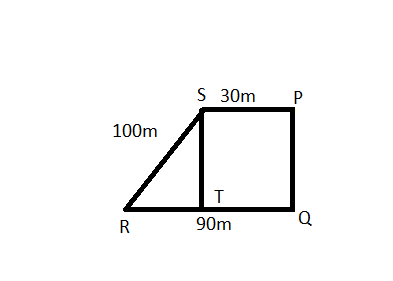
Let the field in the shape of a trapezium be PQRS where PS || QR and angle P & angle Q are 90 degrees. Here PS = 30 m, RQ = 90 m & SR = 100 m
We need to find the height of trapezium PQ.
For that only we have drawn the perpendicular ST on RQ.
Since SP = TQ.
We can find the length of RT = RQ – SP = 90 – 30 = 60m
Now we will apply Pythagoras Theorem in triangle SRT to find ST.
So, we got
$
S{T^2} = R{S^2} - R{T^2} \\
S{T^2} = {100^2} - {60^2} \\
S{T^2} = 10000 - 3600 \\
S{T^2} = 6400 \\
ST = 80m \\
$
We got ST = 80m.
We know that ST = PQ = Height of trapezium.
So, the area of trapezium is half of height multiplied by the sum of parallel sides.
That is $\dfrac{1}{2} \times PQ \times (PS + RQ)$
$
\Rightarrow \dfrac{1}{2} \times 80 \times (30 + 90) \\
\Rightarrow 40 \times 120 = 4800{m^2} \\
$
So we got the area of trapezium as $4800{m^2}$.
As we know the cost of ploughing is Rs4 per meter square.
So, the total cost is,
4800 x 4 = 19200Rs.
Hence we need Rs19200 to plough the field of the given dimension.
Note – Finding the area in such problems is an important task. To find the area we need to calculate all the required data with the help of information provided then we need to calculate the area. Drawing the figure in such problems will help you a lot in getting the right answer. This problem can be constructed for various figures so you need to remember the area of various symmetric figures that will help you to calculate the area of various asymmetric figures.
Complete step by step solution:
The figure of the field can be drawn as:
Let the field in the shape of a trapezium be PQRS where PS || QR and angle P & angle Q are 90 degrees. Here PS = 30 m, RQ = 90 m & SR = 100 m
We need to find the height of trapezium PQ.
For that only we have drawn the perpendicular ST on RQ.
Since SP = TQ.
We can find the length of RT = RQ – SP = 90 – 30 = 60m
Now we will apply Pythagoras Theorem in triangle SRT to find ST.
So, we got
$
S{T^2} = R{S^2} - R{T^2} \\
S{T^2} = {100^2} - {60^2} \\
S{T^2} = 10000 - 3600 \\
S{T^2} = 6400 \\
ST = 80m \\
$
We got ST = 80m.
We know that ST = PQ = Height of trapezium.
So, the area of trapezium is half of height multiplied by the sum of parallel sides.
That is $\dfrac{1}{2} \times PQ \times (PS + RQ)$
$
\Rightarrow \dfrac{1}{2} \times 80 \times (30 + 90) \\
\Rightarrow 40 \times 120 = 4800{m^2} \\
$
So we got the area of trapezium as $4800{m^2}$.
As we know the cost of ploughing is Rs4 per meter square.
So, the total cost is,
4800 x 4 = 19200Rs.
Hence we need Rs19200 to plough the field of the given dimension.
Note – Finding the area in such problems is an important task. To find the area we need to calculate all the required data with the help of information provided then we need to calculate the area. Drawing the figure in such problems will help you a lot in getting the right answer. This problem can be constructed for various figures so you need to remember the area of various symmetric figures that will help you to calculate the area of various asymmetric figures.
Recently Updated Pages
Three beakers labelled as A B and C each containing 25 mL of water were taken A small amount of NaOH anhydrous CuSO4 and NaCl were added to the beakers A B and C respectively It was observed that there was an increase in the temperature of the solutions contained in beakers A and B whereas in case of beaker C the temperature of the solution falls Which one of the following statements isarecorrect i In beakers A and B exothermic process has occurred ii In beakers A and B endothermic process has occurred iii In beaker C exothermic process has occurred iv In beaker C endothermic process has occurred

Master Class 9 Social Science: Engaging Questions & Answers for Success
Master Class 9 Science: Engaging Questions & Answers for Success
Master Class 9 Maths: Engaging Questions & Answers for Success
Master Class 9 General Knowledge: Engaging Questions & Answers for Success
Class 9 Question and Answer - Your Ultimate Solutions Guide
Three beakers labelled as A B and C each containing 25 mL of water were taken A small amount of NaOH anhydrous CuSO4 and NaCl were added to the beakers A B and C respectively It was observed that there was an increase in the temperature of the solutions contained in beakers A and B whereas in case of beaker C the temperature of the solution falls Which one of the following statements isarecorrect i In beakers A and B exothermic process has occurred ii In beakers A and B endothermic process has occurred iii In beaker C exothermic process has occurred iv In beaker C endothermic process has occurred
Master Class 9 Social Science: Engaging Questions & Answers for Success
Master Class 9 Science: Engaging Questions & Answers for Success
Trending doubts
Find the sum of series 1 + 2 + 3 + 4 + 5 + + 100 class 9 maths CBSE
Fill the blanks with the suitable prepositions 1 The class 9 english CBSE
Difference Between Plant Cell and Animal Cell
What is pollution? How many types of pollution? Define it
Name 10 Living and Non living things class 9 biology CBSE
Which are the Top 10 Largest States of India?