




A duster weighs 0.5 N. It is pressed against a vertical board with a horizontal force of 11 N. If the coefficient of friction is 0.5, the minimum force that must be applied on the duster parallel to the board to move it upwards is
A. 0.4 N
B. 0.7 N
C. 6 N
D. 7 N
Answer
 Verified
593.4k+ views
Hint: We can draw the free body diagram for the given duster. The gravitational force due to weight and the frictional force with the surface tend to resist the motion of the duster. The minimum force required to move the duster upwards is equal to the sum of these forces.
Complete step by step answer:
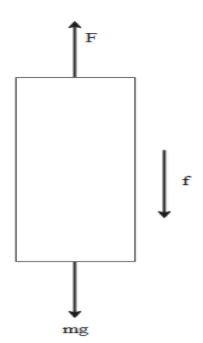
The following free body diagram shows a duster which has been pressed against a vertical board with a force of 11 N. This normal force decides the amount of the friction between the board and the duster. Therefore, we can write
$N = 11N$
If the coefficient of friction between the board and the duster is given as
$\mu = 0.5$
Then the force of friction between the board and the duster can be written as
$f = \mu N = 0.5 \times 11 = 5.5N$
Also the force due to weight of the duster acts along the direction of the frictional force and resists the motion of the duster. It value is given as
$mg = 0.5N$
The minimum force that must be applied in the upward direction in order to move the duster upwards along the board is signified as F. Based on the free body diagram, we can write the following equation for the forces.
$F = f + mg$
Inserting the known values, we obtain
$F = 5.5N + 0.5N = 6N$
This is the minimum force that must be applied on the duster parallel to the board to move it upwards.
Hence, the correct answer is option C.
Note:
It should be noted that when an object is placed horizontally on a horizontal surface, then the frictional force is due to the weight of the object which produces a normal force. In our case, we have pressed the duster on a vertical surface to produce a normal force which creates friction between the board and the duster.
Complete step by step answer:
The following free body diagram shows a duster which has been pressed against a vertical board with a force of 11 N. This normal force decides the amount of the friction between the board and the duster. Therefore, we can write
$N = 11N$
If the coefficient of friction between the board and the duster is given as
$\mu = 0.5$
Then the force of friction between the board and the duster can be written as
$f = \mu N = 0.5 \times 11 = 5.5N$
Also the force due to weight of the duster acts along the direction of the frictional force and resists the motion of the duster. It value is given as
$mg = 0.5N$
The minimum force that must be applied in the upward direction in order to move the duster upwards along the board is signified as F. Based on the free body diagram, we can write the following equation for the forces.
$F = f + mg$
Inserting the known values, we obtain
$F = 5.5N + 0.5N = 6N$
This is the minimum force that must be applied on the duster parallel to the board to move it upwards.
Hence, the correct answer is option C.
Note:
It should be noted that when an object is placed horizontally on a horizontal surface, then the frictional force is due to the weight of the object which produces a normal force. In our case, we have pressed the duster on a vertical surface to produce a normal force which creates friction between the board and the duster.
Recently Updated Pages
Basicity of sulphurous acid and sulphuric acid are

Master Class 11 Business Studies: Engaging Questions & Answers for Success
Master Class 11 Computer Science: Engaging Questions & Answers for Success
Master Class 11 Economics: Engaging Questions & Answers for Success
Master Class 11 Social Science: Engaging Questions & Answers for Success
Master Class 11 English: Engaging Questions & Answers for Success
Trending doubts
The largest wind power cluster is located in the state class 11 social science CBSE
Explain zero factorial class 11 maths CBSE
Which among the following are examples of coming together class 11 social science CBSE
Can anyone list 10 advantages and disadvantages of friction
State the laws of reflection of light
Draw a diagram of a plant cell and label at least eight class 11 biology CBSE