




A DNA segment has a total of 1000 nucleotides, out of which 240 of them are adenine containing nucleotides. How many pyrimidine bases this DNA segment possesses?
Draw a diagrammatic sketch of a portion of the DNA segment to support your answer.
Answer
 Verified
586.5k+ views
Hint: To get the answer to this question, one should know about Chargaff’s rules of base pairing. He has given 2 basic rules of base pairing which are universal. Chargaff’s rules state that DNA from any living organism should have a 1:1 stoichiometric ratio of purines and pyrimidine bases.
Complete answer:
Let’s go through Chargaff’s rules for base pairing first. Pyrimidines are A (adenine) and G (guanine) and purines are C (cytosine) and T (thymine)/ U (uracil). Adenine always pairs (hydrogen bond) with Thymine in DNA and Cytosine always pairs with Guanine.
1. Purines and pyrimidines base pairs are in equal amounts. The amount of A and G is always equal to the amount of C and T.
2. The amount of A is always equal to T and the amount of guanine is always equal to cytosine.
Now, coming back to our first question, it is given that sample DNA has 1000 nucleotides which means 1000 nucleotides with a mixture of 4 (A, C, T, G) bases. From which 240 nucleotides are A (adenine). So, according to Chargaff’s 2nd rule, adenine always pairs with Thymine which means there are 240 adenine bases and 240 thymine bases. So, the total adenine and thymine bases are 480. The remaining 520 bases consist of guanine and cytosine. We know that the amount of C is equal to G (2nd rule). So, the total C nucleotides are 260 and G nucleotides are 260. Now, the total purines (A and G) are 240+260= 500. And the total pyrimidines are 500 nucleotides in the given sample DNA.
Diagram for the second question is given below that supports our answer.
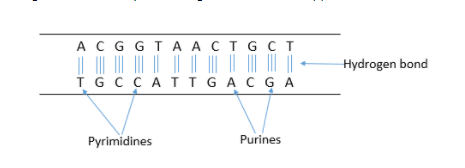
Note: Always remember that A pairs with T with two hydrogen bonds and known as weak bases. On the other hand, G always pairs with C with three hydrogen bonds and is known as strong bases. Adenine, guanine, cytosine, and thymine/ uracil are universal bases.
Complete answer:
Let’s go through Chargaff’s rules for base pairing first. Pyrimidines are A (adenine) and G (guanine) and purines are C (cytosine) and T (thymine)/ U (uracil). Adenine always pairs (hydrogen bond) with Thymine in DNA and Cytosine always pairs with Guanine.
1. Purines and pyrimidines base pairs are in equal amounts. The amount of A and G is always equal to the amount of C and T.
2. The amount of A is always equal to T and the amount of guanine is always equal to cytosine.
Now, coming back to our first question, it is given that sample DNA has 1000 nucleotides which means 1000 nucleotides with a mixture of 4 (A, C, T, G) bases. From which 240 nucleotides are A (adenine). So, according to Chargaff’s 2nd rule, adenine always pairs with Thymine which means there are 240 adenine bases and 240 thymine bases. So, the total adenine and thymine bases are 480. The remaining 520 bases consist of guanine and cytosine. We know that the amount of C is equal to G (2nd rule). So, the total C nucleotides are 260 and G nucleotides are 260. Now, the total purines (A and G) are 240+260= 500. And the total pyrimidines are 500 nucleotides in the given sample DNA.
Diagram for the second question is given below that supports our answer.
Note: Always remember that A pairs with T with two hydrogen bonds and known as weak bases. On the other hand, G always pairs with C with three hydrogen bonds and is known as strong bases. Adenine, guanine, cytosine, and thymine/ uracil are universal bases.
Recently Updated Pages
Master Class 12 Social Science: Engaging Questions & Answers for Success

Master Class 12 Physics: Engaging Questions & Answers for Success
Master Class 12 Maths: Engaging Questions & Answers for Success
Master Class 12 Economics: Engaging Questions & Answers for Success
Master Class 12 Chemistry: Engaging Questions & Answers for Success
Master Class 12 Business Studies: Engaging Questions & Answers for Success
Trending doubts
Which are the Top 10 Largest Countries of the World?
Draw a labelled sketch of the human eye class 12 physics CBSE
Explain the structure of megasporangium class 12 biology CBSE
What are the major means of transport Explain each class 12 social science CBSE
How many chromosomes are found in human ovum a 46 b class 12 biology CBSE
The diagram of the section of a maize grain is given class 12 biology CBSE