




A diverging lens with magnitude of focal length 25 cm is placed at a distance of 15cm from a converging lens of magnitude of focal length 20cm. A beam of parallel light falls on the diverging lens. The final image formed is:
(A). Real and at a distance of 6cm from the convergent lens.
(B). Real and at a distance of 40cm from convergent lens.
(C). Virtual and at a distance of 40cm from convergent lens.
(D). Real and at a distance of 40cm from the divergent lens.
Answer
 Verified
639.6k+ views
Hint: A diverging lens is a lens where a beam of parallel light after refracting through it diverges and a converging lens is a lens where a beam of light after refracting through it converges at some point beyond it , use these concepts to draw figure ad then use the lens formula to get the answer.
Formula Used: $\dfrac{1}{f} = \dfrac{1}{v} - \dfrac{1}{u}$
Complete step-by-step answer:
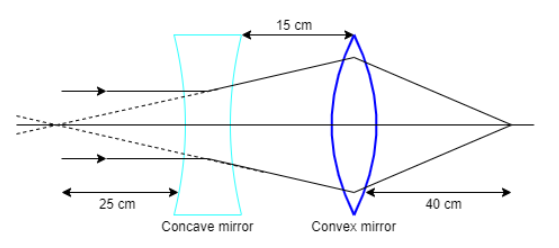
According to the question we are given focal length of diverging lens or concave lens = 25cm. The focal length of converging lens or convex lens is given = 20cm. While the distance between them is given as 15cm. As, parallel beams are falling on the diverging lens i.e. we can say at the left of the diverging lens with a distance 25cm. Thus, the image will be formed at the focus of the diverging lens as you can see in the figure given above. We know that v is the distance of an image and u is the distance of the object, so here the image which is forming at the focus of the diverging lens will act as an object for the converging lens, and the distance of the object is u. As, u is always taken as negative so distance will be = - (25 + 15) = - 40cm
Here, 25cm is the distance of an image from a diverging lens and 15 cm is the distance between two lenses.
So, u = - 40cm and we are given f = 20cm for converging lens.
Here, we can find out the image and the pole of the lens which is known as v.
So, from lens formula which is=$\dfrac{1}{f} = \dfrac{1}{v} - \dfrac{1}{u}$
Where f=20cm, v we have to find out and u is= - 40cm.
So,$\dfrac{1}{{20}} = \dfrac{1}{v} - \dfrac{1}{{ - 40}}$
=$\dfrac{1}{v} = \dfrac{1}{{20}} - \dfrac{1}{{40}}$
=$\dfrac{1}{v} = \dfrac{1}{{40}} = v = 40cm$
The value of v here has come in positive and when the image distance is positive, then the image is on the same side of the lens as the object, and it is real which means the image will be real and will form the right side of the converging lens at 40 cm.
Hence, option B is correct.
Note: For lens, the relationship between object, size, image distance, and focal length is called lens formula. Where, v is the image size, u is the object size, and f is the focal length. We can calculate the distance between the object and the image from the lens’ optical center. Also, we can determine if the image is positive or negative, as if the object is far side of the lens, then the image distance is positive and thus the image is real but if the image and object are on the same side of the lens, then the image distance is negative and thus, the image which will form will be virtual.
Formula Used: $\dfrac{1}{f} = \dfrac{1}{v} - \dfrac{1}{u}$
Complete step-by-step answer:
According to the question we are given focal length of diverging lens or concave lens = 25cm. The focal length of converging lens or convex lens is given = 20cm. While the distance between them is given as 15cm. As, parallel beams are falling on the diverging lens i.e. we can say at the left of the diverging lens with a distance 25cm. Thus, the image will be formed at the focus of the diverging lens as you can see in the figure given above. We know that v is the distance of an image and u is the distance of the object, so here the image which is forming at the focus of the diverging lens will act as an object for the converging lens, and the distance of the object is u. As, u is always taken as negative so distance will be = - (25 + 15) = - 40cm
Here, 25cm is the distance of an image from a diverging lens and 15 cm is the distance between two lenses.
So, u = - 40cm and we are given f = 20cm for converging lens.
Here, we can find out the image and the pole of the lens which is known as v.
So, from lens formula which is=$\dfrac{1}{f} = \dfrac{1}{v} - \dfrac{1}{u}$
Where f=20cm, v we have to find out and u is= - 40cm.
So,$\dfrac{1}{{20}} = \dfrac{1}{v} - \dfrac{1}{{ - 40}}$
=$\dfrac{1}{v} = \dfrac{1}{{20}} - \dfrac{1}{{40}}$
=$\dfrac{1}{v} = \dfrac{1}{{40}} = v = 40cm$
The value of v here has come in positive and when the image distance is positive, then the image is on the same side of the lens as the object, and it is real which means the image will be real and will form the right side of the converging lens at 40 cm.
Hence, option B is correct.
Note: For lens, the relationship between object, size, image distance, and focal length is called lens formula. Where, v is the image size, u is the object size, and f is the focal length. We can calculate the distance between the object and the image from the lens’ optical center. Also, we can determine if the image is positive or negative, as if the object is far side of the lens, then the image distance is positive and thus the image is real but if the image and object are on the same side of the lens, then the image distance is negative and thus, the image which will form will be virtual.
Recently Updated Pages
Master Class 12 Business Studies: Engaging Questions & Answers for Success

Master Class 12 Chemistry: Engaging Questions & Answers for Success
Master Class 12 Biology: Engaging Questions & Answers for Success
Class 12 Question and Answer - Your Ultimate Solutions Guide
Master Class 11 English: Engaging Questions & Answers for Success
Master Class 11 Social Science: Engaging Questions & Answers for Success
Trending doubts
Which are the Top 10 Largest Countries of the World?
Draw a labelled sketch of the human eye class 12 physics CBSE
Differentiate between homogeneous and heterogeneous class 12 chemistry CBSE
Differentiate between Pyramid of energy and pyramid class 12 biology CBSE
Why is the cell called the structural and functional class 12 biology CBSE
Draw the diagram of the pyramid of energy Explain In class 12 biology CBSE